Vaiarello Valentina, Schiavetto Stefano, Foti Federica, Gigante Antonietta, Iannazzo Francesco, Paone Gregorino, Palange Paolo, Rosato Edoardo
Department of Translational and Precision Medicine, Sapienza University, Rome, Italy.
Department of Public Health and Infectious Diseases, Lung Function and Exercise Section, Sapienza University, Rome, Italy.
Rheumatol Ther. 2020 Dec;7(4):1037-1044. doi: 10.1007/s40744-020-00232-5. Epub 2020 Aug 29.
Systemic sclerosis (SSc) is an autoimmune disease characterized by the overproduction of collagen leading to fibrosis of the skin and internal organs. Interstitial lung disease (ILD) is one of the major causes of death in patients with SSc. Exercise tolerance can be investigated by cardio-pulmonary exercise testing (CPET). First-line therapies in patients with SSc associated with ILD (SSc-ILD) include cyclophosphamide and mycophenolate mofetil (MMF). The aim of this study was to evaluate the response of patients with SSc-ILD to MMF by means of CPET.
Ten consecutive SSc patients were enrolled in this study. All SSc patients underwent clinical evaluation, echocardiography, pulmonary function tests, high-resolution computed tomography (HRCT) and CPET at baseline and after 2 years of therapy with MMF.
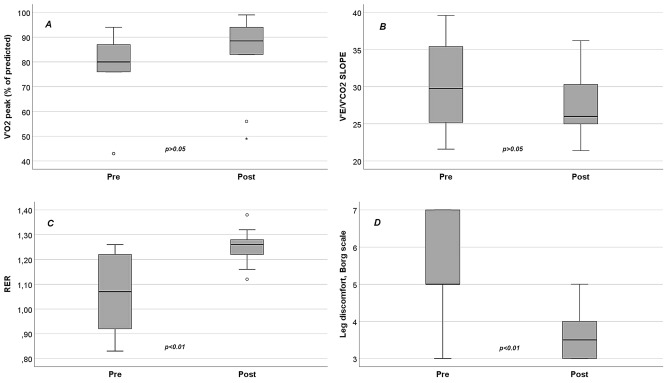
After 24 months of treatment with MMF (target dose 1500 mg twice daily), forced vitality capacity, diffusing capacity of the lungs for carbon monoxide and systolic pulmonary arterial pressure had not improved significantly and there were no significant differences in HRCT findigns. In addition, peak oxygen uptake (V'O peak) and ventilatory equivalents for carbon dioxide production (V'E/V'CO slope) had not improved significantly. In contrast, there was a significant improvement from baseline to 24 months of treatment in the respiratory exchange ratio [median (interquartile range): 1.07 (0.92-1.22) vs. 1.26 (1.22-1.28), respectively; p < 0.01] and in the Borg scale for leg discomfort [median (interquartile range): 5 (5-7) vs. 4 (3-4), respectively; p < 0.01] .
These data from our pilot study on a small cohort of SSc patients are the first to demonstrate that treatment with MMF can improves exercise tolerance and leg discomfort in patients with SSc-ILD. These preliminary results need to be confirmed in large randomized studies.
系统性硬化症(SSc)是一种自身免疫性疾病,其特征是胶原蛋白过度产生,导致皮肤和内脏器官纤维化。间质性肺疾病(ILD)是SSc患者的主要死亡原因之一。运动耐量可通过心肺运动试验(CPET)进行评估。伴有ILD的SSc(SSc-ILD)患者的一线治疗方法包括环磷酰胺和霉酚酸酯(MMF)。本研究的目的是通过CPET评估SSc-ILD患者对MMF的反应。
本研究纳入了10例连续的SSc患者。所有SSc患者在基线时以及接受MMF治疗2年后均接受了临床评估、超声心动图、肺功能测试、高分辨率计算机断层扫描(HRCT)和CPET。
接受MMF治疗24个月(目标剂量为每日两次1500 mg)后,用力肺活量、肺一氧化碳弥散量和肺动脉收缩压均未显著改善,HRCT检查结果也无显著差异。此外,峰值摄氧量(V'O峰值)和二氧化碳产生的通气当量(V'E/V'CO斜率)也未显著改善。相比之下,从基线到治疗24个月,呼吸交换率[中位数(四分位间距):分别为1.07(0.92-1.22)和1.26(1.22-1.28);p<0.01]和腿部不适的Borg量表评分[中位数(四分位间距):分别为5(5-7)和4(3-4);p<0.01]有显著改善。
我们对一小群SSc患者进行的初步研究数据首次表明,MMF治疗可改善SSc-ILD患者的运动耐量和腿部不适。这些初步结果需要在大型随机研究中得到证实。