
一项比较 ATTUNE 骨水泥固定交叉韧带保留型膝关节假体与 PFC-sigma 设计胫骨迁移的随机对照试验。
A randomized controlled trial comparing tibial migration of the ATTUNE cemented cruciate-retaining knee prosthesis with the PFC-sigma design.
机构信息
Department of Orthopaedics, Leiden University Medical Center, Leiden, Netherlands.
Department of Orthopaedic Surgery, Haaglanden Medical Center, The Hague, Netherlands.
出版信息
Bone Joint J. 2020 Sep;102-B(9):1158-1166. doi: 10.1302/0301-620X.102B9.BJJ-2020-0096.R1.
AIMS
The primary objective of this study was to compare migration of the cemented ATTUNE fixed bearing cruciate retaining tibial component with the cemented Press-Fit Condylar (PFC)-sigma fixed bearing cruciate retaining tibial component. The secondary objectives included comparing clinical and radiological outcomes and Patient Reported Outcome Measures (PROMs).
METHODS
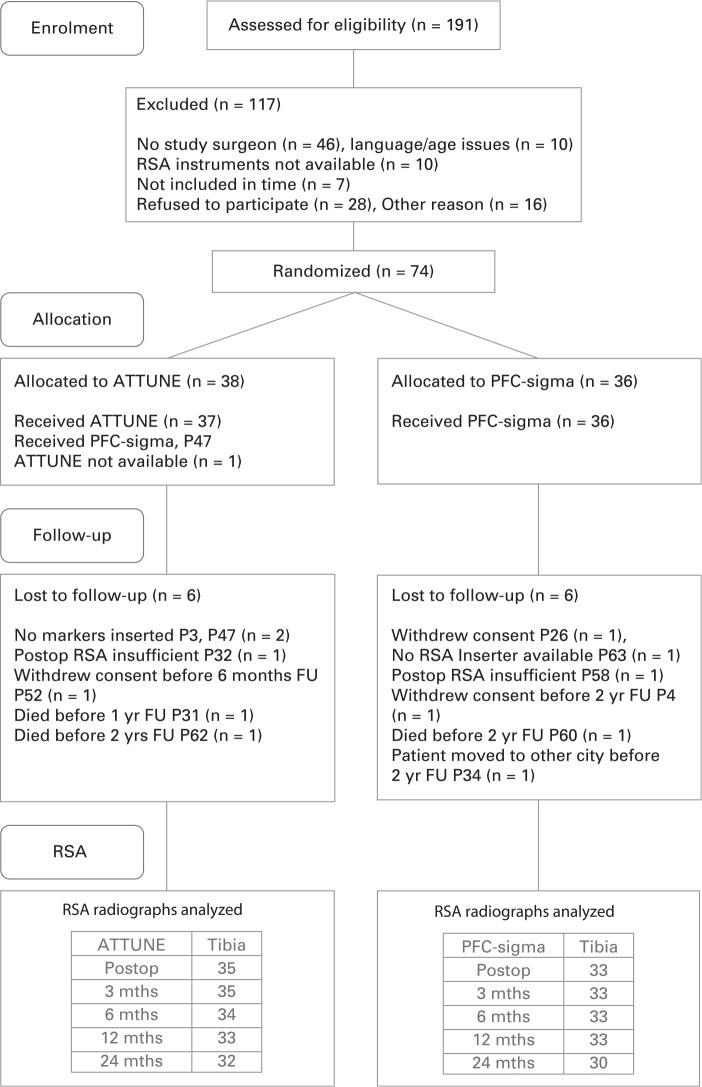
A single blinded randomized, non-inferiority study was conducted including 74 patients. Radiostereometry examinations were made after weight bearing, but before hospital discharge, and at three, six, 12, and 24 months postoperatively. PROMS were collected preoperatively and at three, six, 12, and 24 months postoperatively. Radiographs for measuring radiolucencies were collected at two weeks and two years postoperatively.
RESULTS
The overall migration (mean maximum total point motion (MPTM)) at two years was comparable: mean 1.13 mm (95% confidence interval (CI), 0.97 to 1.30) for the ATTUNE and 1.16 mm (95% CI, 0.99 to 1.35) for the PFC-sigma. At two years, the mean backward tilting was -0.43° (95% CI, -0.65 to -0.21) for the ATTUNE and 0.08° (95% CI -0.16 to 0.31), for the PFC-sigma. Overall migration between the first and second postoperative year was negligible for both components. The clinical outcomes and PROMs improved compared with preoperative scores and were not different between groups. Radiolucencies at the implant-cement interface were mainly seen below the medial baseplate: 17% in the ATTUNE and 3% in the PFC-sigma at two weeks, and at two years 42% and 9% respectively (p = 0.001).
CONCLUSION
In the first two postoperative years the initial version of the ATTUNE tibial component was not inferior with respect to overall migration, although it showed relatively more backwards tilting and radiolucent lines at the implant-cement interface than the PFC-sigma. The version of the ATTUNE tibial component examined in this study has subsequently undergone modification by the manufacturer. Level of Evidence: 1 (randomized controlled clinical trial) Cite this article: 2020;102-B(9):1158-1166.
目的
本研究的主要目的是比较使用水泥固定的 ATTUNE 固定轴承保留十字韧带胫骨组件与使用水泥固定 Press-Fit Condylar(PFC)-sigma 固定轴承保留十字韧带胫骨组件时,胫骨组件的水泥迁移情况。次要目标包括比较临床和放射学结果以及患者报告的结果测量指标(PROM)。
方法
这是一项单盲随机非劣效性研究,共纳入 74 例患者。在负重后、出院前,以及术后 3、6、12 和 24 个月时进行放射立体测量检查。在术前和术后 3、6、12 和 24 个月时收集患者报告的结果测量指标。在术后 2 周和 2 年时拍摄测量放射透光度的 X 线片。
结果
在术后 2 年时,两种胫骨组件的整体迁移(最大总点运动平均值(MPTM))相当:ATTUNE 组为 1.13mm(95%置信区间[CI],0.97 至 1.30),PFC-sigma 组为 1.16mm(95%CI,0.99 至 1.35)。在术后 2 年时,ATTUNE 组的向后倾斜平均值为-0.43°(95%CI,-0.65 至-0.21),PFC-sigma 组为 0.08°(95%CI,-0.16 至 0.31)。两种胫骨组件在术后第 1 年至第 2 年的整体迁移量都很小。与术前评分相比,临床结果和患者报告的结果测量指标均有所改善,且组间无差异。在植入物-水泥界面处,主要在内侧基板下方可见放射透光度线:ATTUNE 组在术后 2 周时为 17%,在术后 2 年时为 42%;PFC-sigma 组在术后 2 周时为 3%,在术后 2 年时为 9%(p=0.001)。
结论
在术后 2 年内,最初版本的 ATTUNE 胫骨组件在整体迁移方面并不劣于 PFC-sigma,但与 PFC-sigma 相比,它显示出相对更多的向后倾斜和植入物-水泥界面处的放射透光度线。本研究中检查的 ATTUNE 胫骨组件版本随后已被制造商修改。证据等级:1(随机对照临床试验)。



 Zotero 插件