Department of Medical Oncology, Sun Yat-sen University Cancer Center, State Key Laboratory of Oncology in South China, Collaborative Innovation Center for Cancer Medicine, Sun Yat-sen University Cancer Center, Guangzhou, Guangdong, China.
Department of Clinical Research, Sun Yat-sen University Cancer Center, State Key Laboratory of Oncology in South China, Collaborative Innovation Center for Cancer Medicine, Sun Yat-sen University Cancer Center, Guangzhou, China.
J Immunother Cancer. 2020 Aug;8(2). doi: 10.1136/jitc-2020-001170.
Immune checkpoint inhibitors (ICIs) have dramatically revolutionized lung cancer treatment, providing unprecedented clinical benefits. However, immune-related pneumonitis (IRP) caused by ICIs has aroused widespread concern due to its high rate of discontinuation and mortality. This network meta-analysis (NMA) aims to compare the risks of IRP among different regimens for advanced lung cancer.
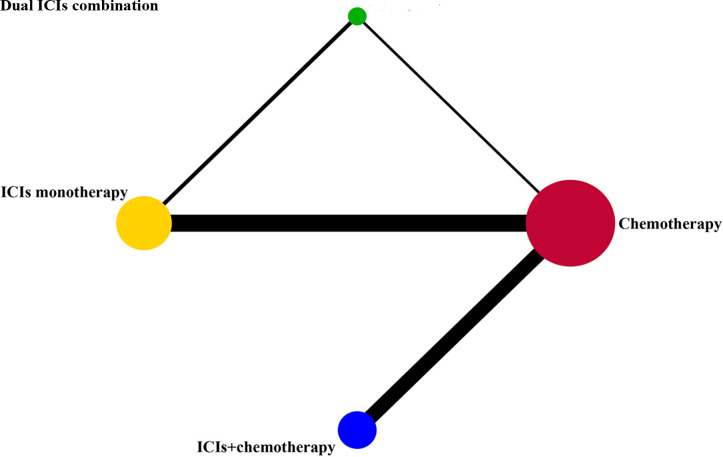
Phase II and III randomized clinical trials (RCTs) were searched from electronic databases. The rates of grade 1-5 IRP and grade 3-5 IRP were systematically extracted. An NMA was conducted among chemotherapy, ICIs monotherapy, dual ICIs combination, and ICIs+chemotherapy. Subgroup analysis was also compared based on specific types of ICIs.
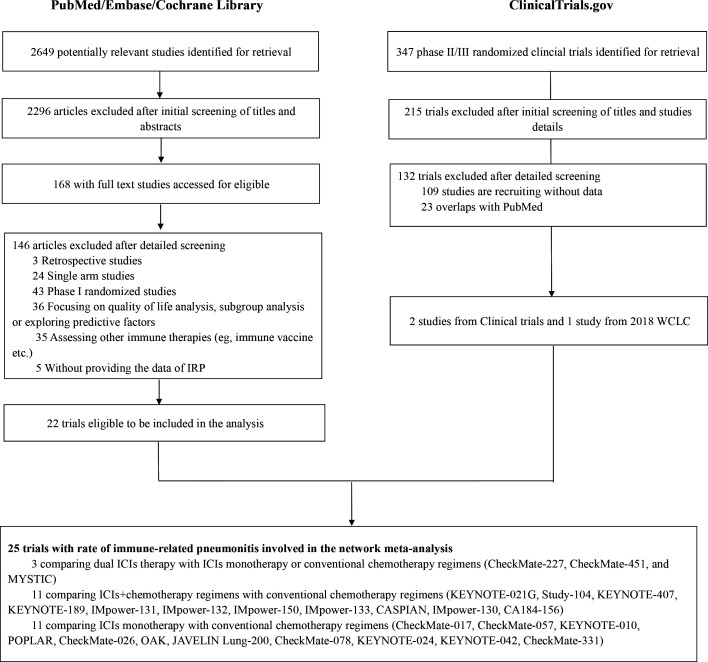
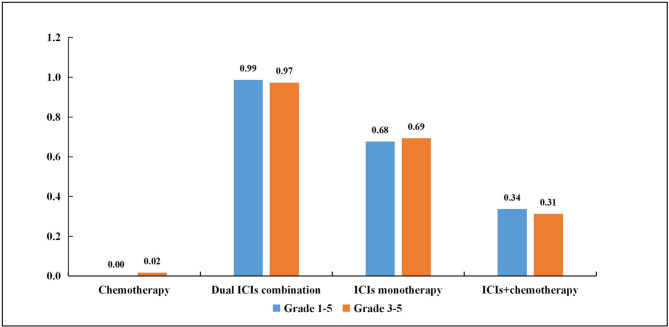
Twenty-five RCTs involving 17,310 patients were eligible for inclusion. Compared with chemotherapy, ICI-based regimens were associated with an increased risk of grade 1-5 IRP and grade 3-5 IRP. Compared with ICIs+chemotherapy, ICIs monotherapy (grade 1-5: OR 2.14, 95% credible interval 1.12 to 4.80; grade 3-5: 3.03, 1.491 to 6.69) and dual ICIs combination (grade 1-5: 3.86, 1.69 to 9.89; grade 3-5: 5.12, 2.01 to 13.68) were associated with a higher risk of grade 1-5 IRP and grade 3-5 IRP. No significant difference was found between dual ICIs combination and ICIs monotherapy in grade 1-5 IRP (1.85, 0.91 to 3.37) or in grade 3-5 IRP (1.65, 0.81 to 3.37). Besides, compared with programmed cell death protein 1 (PD-1) inhibitors (2.56, 1.12 to 6.60), a lower risk of grade 1-5 IRP was observed in programmed cell death ligand 1 (PD-L1) inhibitors.
Compared with chemotherapy, using ICIs is associated with an increased risk of IRP. ICIs+chemotherapy is associated with a lower risk of IRP compared with dual ICIs combination and ICIs monotherapy. PD-1 inhibitors are associated with a higher risk of 1-5 grade IRP compared with PD-L1 inhibitors.
免疫检查点抑制剂(ICIs)极大地改变了肺癌的治疗方式,提供了前所未有的临床获益。然而,ICI 引起的免疫相关肺炎(IRP)因其较高的停药率和死亡率而引起广泛关注。本网络荟萃分析(NMA)旨在比较不同方案治疗晚期肺癌的 IRP 风险。
从电子数据库中检索了 II 期和 III 期随机临床试验(RCT)。系统地提取了 1 级-5 级 IRP 和 3 级-5 级 IRP 的发生率。对化疗、ICI 单药治疗、双ICI 联合治疗和 ICI+化疗进行了 NMA。还根据特定类型的 ICI 进行了亚组分析。
纳入了 25 项涉及 17310 名患者的 RCT。与化疗相比,ICI 为基础的方案与 1 级-5 级 IRP 和 3 级-5 级 IRP 的风险增加相关。与 ICI+化疗相比,ICI 单药治疗(1 级-5 级:OR 2.14,95%可信区间 1.12 至 4.80;3 级-5 级:3.03,1.491 至 6.69)和双 ICI 联合治疗(1 级-5 级:3.86,1.69 至 9.89;3 级-5 级:5.12,2.01 至 13.68)与 1 级-5 级 IRP 和 3 级-5 级 IRP 的风险增加相关。双 ICI 联合治疗与 ICI 单药治疗在 1 级-5 级 IRP(1.85,0.91 至 3.37)或 3 级-5 级 IRP(1.65,0.81 至 3.37)方面无显著差异。此外,与程序性细胞死亡蛋白 1(PD-1)抑制剂(2.56,1.12 至 6.60)相比,程序性细胞死亡配体 1(PD-L1)抑制剂的 1 级-5 级 IRP 风险较低。
与化疗相比,使用 ICI 与 IRP 风险增加相关。与双 ICI 联合治疗和 ICI 单药治疗相比,ICI+化疗与 IRP 风险降低相关。与 PD-L1 抑制剂相比,PD-1 抑制剂与 1 级-5 级 IRP 风险增加相关。