• 文献检索
  • 文档翻译
  • 深度研究
  • 学术资讯
  • Suppr Zotero 插件Zotero 插件
  • 邀请有礼
  • 套餐&价格
  • 历史记录
应用&插件
Suppr Zotero 插件Zotero 插件浏览器插件Mac 客户端Windows 客户端微信小程序
定价
高级版会员购买积分包购买API积分包
服务
文献检索文档翻译深度研究API 文档MCP 服务
关于我们
关于 Suppr公司介绍联系我们用户协议隐私条款
关注我们

Suppr 超能文献

核心技术专利:CN118964589B侵权必究
粤ICP备2023148730 号-1Suppr @ 2026

文献检索

告别复杂PubMed语法,用中文像聊天一样搜索,搜遍4000万医学文献。AI智能推荐,让科研检索更轻松。

立即免费搜索

文件翻译

保留排版,准确专业,支持PDF/Word/PPT等文件格式,支持 12+语言互译。

免费翻译文档

深度研究

AI帮你快速写综述,25分钟生成高质量综述,智能提取关键信息,辅助科研写作。

立即免费体验

儿童的隐性食物认知:开发一种食物内隐联想测验。

Children's implicit food cognition: Developing a food Implicit Association Test.

作者信息

DeJesus Jasmine M, Gelman Susan A, Lumeng Julie C

机构信息

Department of Psychology, University of North Carolina at Greensboro.

Department of Psychology, University of Michigan.

出版信息

Cogn Dev. 2020 Apr-Jun;54. doi: 10.1016/j.cogdev.2020.100889. Epub 2020 May 15.

DOI:10.1016/j.cogdev.2020.100889
PMID:32863571
原文链接:https://pmc.ncbi.nlm.nih.gov/articles/PMC7448679/
Abstract

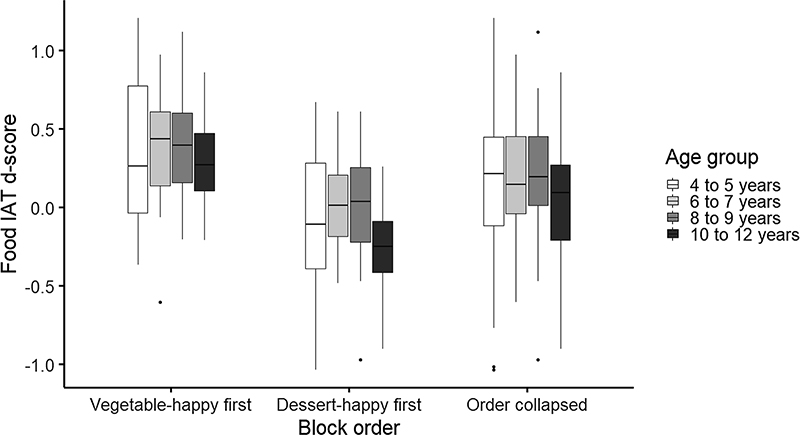
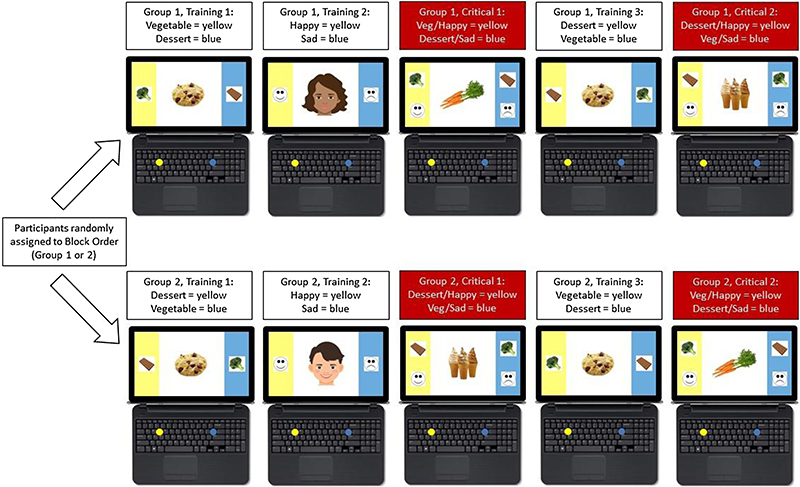
Assessing children's reasoning about food, including their health knowledge and their food preferences, is an important step toward understanding how health messages may influence children's food choices. However, in many studies, assessing children's reasoning relies on parent report or could be susceptible to social pressure from adults. To address these limitations, the present study describes the development of a food version of the Implicit Association Test (IAT). The IAT has been used to examine children's implicit stereotypes about social groups, yet few studies have used the IAT in other domains (such as food cognition). Four- to 12-year-olds ( = 123) completed the food IAT and an explicit card sort task, in which children assessed foods based on their perception of the food's healthfulness (healthy vs. unhealthy) and palatability (yummy vs. yucky). Surprisingly, children demonstrated positive implicit associations towards vegetables. This pattern may reflect children's health knowledge, given that the accuracy of children's healthfulness ratings in the card sort task positively predicted children's food IAT scores. Implications for both food cognition and the IAT are discussed.

摘要

评估儿童对食物的推理,包括他们的健康知识和食物偏好,是迈向理解健康信息如何影响儿童食物选择的重要一步。然而,在许多研究中,评估儿童的推理依赖于家长报告,或者可能容易受到来自成年人的社会压力影响。为了克服这些局限性,本研究描述了一种食物版内隐联想测验(IAT)的开发过程。IAT已被用于考察儿童对社会群体的内隐刻板印象,但很少有研究将IAT用于其他领域(如食物认知)。4至12岁的儿童(n = 123)完成了食物IAT和一项明确的卡片分类任务,在该任务中,儿童根据对食物健康程度(健康与不健康)和美味程度(好吃与难吃)的认知对食物进行评估。令人惊讶的是,儿童对蔬菜表现出积极的内隐联想。鉴于在卡片分类任务中儿童对健康程度评分的准确性能够正向预测儿童的食物IAT分数,这种模式可能反映了儿童的健康知识。本文还讨论了该研究对食物认知和IAT的启示。
https://cdn.ncbi.nlm.nih.gov/pmc/blobs/770b/7448679/dfad73da8b7e/nihms-1595200-f0003.jpg
https://cdn.ncbi.nlm.nih.gov/pmc/blobs/770b/7448679/48a97bbc58a0/nihms-1595200-f0001.jpg
https://cdn.ncbi.nlm.nih.gov/pmc/blobs/770b/7448679/68e8557e6bcf/nihms-1595200-f0002.jpg
https://cdn.ncbi.nlm.nih.gov/pmc/blobs/770b/7448679/dfad73da8b7e/nihms-1595200-f0003.jpg
https://cdn.ncbi.nlm.nih.gov/pmc/blobs/770b/7448679/48a97bbc58a0/nihms-1595200-f0001.jpg
https://cdn.ncbi.nlm.nih.gov/pmc/blobs/770b/7448679/68e8557e6bcf/nihms-1595200-f0002.jpg
https://cdn.ncbi.nlm.nih.gov/pmc/blobs/770b/7448679/dfad73da8b7e/nihms-1595200-f0003.jpg

相似文献

1
Children's implicit food cognition: Developing a food Implicit Association Test.儿童的隐性食物认知:开发一种食物内隐联想测验。
Cogn Dev. 2020 Apr-Jun;54. doi: 10.1016/j.cogdev.2020.100889. Epub 2020 May 15.
2
Do hedonic- versus nutrition-based attitudes toward food predict food choices? a cross-sectional study of 6- to 11-year-olds.基于享乐主义与营养的食物态度能否预测食物选择?一项针对6至11岁儿童的横断面研究。
Int J Behav Nutr Phys Act. 2017 Nov 25;14(1):162. doi: 10.1186/s12966-017-0618-4.
3
Relationships between the race implicit association test and other measures of implicit and explicit social cognition.种族内隐联想测验与其他内隐和外显社会认知测量方法之间的关系。
Front Psychol. 2023 Jul 27;14:1197298. doi: 10.3389/fpsyg.2023.1197298. eCollection 2023.
4
Using the Implicit Association Test to Assess Children's Implicit Attitudes toward Smoking.使用内隐联想测验评估儿童对吸烟的内隐态度。
J Appl Soc Psychol. 2010 Sep;40(9):2387-2406. doi: 10.1111/j.1559-1816.2010.00663.x.
5
Development of children's implicit and explicit attitudes toward healthy food: Personal and environmental factors.儿童对健康食品的内隐和外显态度的发展:个人和环境因素。
Appetite. 2022 Sep 1;176:106094. doi: 10.1016/j.appet.2022.106094. Epub 2022 May 26.
6
The role of external sources of information in children's evaluative food categories.外部信息来源在儿童食物评价类别中的作用。
Infant Child Dev. 2012;21(2):216-235. doi: 10.1002/icd.745. Epub 2011 Aug 8.
7
Explicit and implicit tasks for assessing hedonic-versus nutrition-based attitudes towards food in French children.评估法国儿童对食物基于享乐与营养态度的显性和隐性任务。
Appetite. 2016 Jan 1;96:580-587. doi: 10.1016/j.appet.2015.10.026. Epub 2015 Oct 30.
8
Metabolic state as a modulator of neural event-related potentials for food stimuli in an implicit association test.代谢状态作为食物刺激神经事件相关电位的调节因子在内隐联想测验中的作用。
Physiol Behav. 2019 Oct 1;209:112589. doi: 10.1016/j.physbeh.2019.112589. Epub 2019 Jun 26.
9
Measuring implicit attitudes of 4-year-olds: the preschool implicit association test.测量 4 岁儿童的内隐态度:学前内隐联想测验。
J Exp Child Psychol. 2011 Jun;109(2):187-200. doi: 10.1016/j.jecp.2010.11.002. Epub 2011 Jan 6.
10
Children's alcohol cognitions prior to drinking onset: discrepant patterns from implicit and explicit measures.儿童饮酒前的酒精认知:内隐和外显测量的不一致模式。
Psychol Addict Behav. 2012 Sep;26(3):451-9. doi: 10.1037/a0025531. Epub 2011 Sep 19.

引用本文的文献

1
Food-related implicit associations predict self-reported eating behaviors and dietary habits in large US samples.与食物相关的内隐联想可预测美国大量样本中自我报告的饮食行为和饮食习惯。
Obesity (Silver Spring). 2025 Apr;33(4):796-806. doi: 10.1002/oby.24247. Epub 2025 Mar 4.
2
The Influence of Packaging Color on Consumer Perceptions of Healthfulness: A Systematic Review and Theoretical Framework.包装颜色对消费者健康认知的影响:系统综述与理论框架
Foods. 2023 Oct 25;12(21):3911. doi: 10.3390/foods12213911.
3
Strength or Nausea? Children's Reasoning About the Health Consequences of Food Consumption.力量还是恶心?儿童对食物消费健康后果的推理。
Front Psychol. 2021 Apr 8;12:651889. doi: 10.3389/fpsyg.2021.651889. eCollection 2021.

本文引用的文献

1
Why do we eat cereal but not lamb chops at breakfast? Investigating Americans' beliefs about breakfast foods.为什么早餐我们吃谷物而不是羊排?探究美国人对早餐食物的看法。
Appetite. 2020 Jan 1;144:104458. doi: 10.1016/j.appet.2019.104458. Epub 2019 Sep 14.
2
Longitudinal associations between overweight/obesity and stress biology in low-income children.低收入儿童超重/肥胖与应激生物学的纵向关联。
Int J Obes (Lond). 2020 Mar;44(3):646-655. doi: 10.1038/s41366-019-0447-4. Epub 2019 Sep 2.
3
How information about what is "healthy" versus "unhealthy" impacts children's consumption of otherwise identical foods.什么样的食物是“健康的”,什么样的食物是“不健康的”,这些信息会如何影响儿童对原本相同食物的消费。
J Exp Psychol Gen. 2019 Dec;148(12):2091-2103. doi: 10.1037/xge0000588. Epub 2019 Apr 11.
4
Patterns of Implicit and Explicit Attitudes: I. Long-Term Change and Stability From 2007 to 2016.内隐和外显态度模式:I. 2007 年至 2016 年的长期变化和稳定性。
Psychol Sci. 2019 Feb;30(2):174-192. doi: 10.1177/0956797618813087. Epub 2019 Jan 3.
5
Children judge others based on their food choices.儿童会根据他人的食物选择来评判他人。
J Exp Child Psychol. 2019 Mar;179:143-161. doi: 10.1016/j.jecp.2018.10.009. Epub 2018 Dec 1.
6
Selective eating behaviors in children: An observational validation of parental report measures.儿童选择性进食行为:父母报告测量的观察验证。
Appetite. 2018 Aug 1;127:163-170. doi: 10.1016/j.appet.2018.04.028. Epub 2018 May 3.
7
Mere social knowledge impacts children's consumption and categorization of foods.单纯的社会知识会影响儿童对食物的消费和分类。
Dev Sci. 2018 Sep;21(5):e12627. doi: 10.1111/desc.12627. Epub 2017 Nov 29.
8
Visual exposure and categorization performance positively influence 3- to 6-year-old children's willingness to taste unfamiliar vegetables.视觉暴露和分类表现积极影响 3 至 6 岁儿童品尝不熟悉蔬菜的意愿。
Appetite. 2018 Jan 1;120:32-42. doi: 10.1016/j.appet.2017.08.016. Epub 2017 Aug 31.
9
Through the eyes of a child: preschoolers' identification of emotional expressions from the child affective facial expression (CAFE) set.透过孩子的视角:学龄前儿童对儿童情感面部表情(CAFE)集中情感表情的识别。
Cogn Emot. 2018 Aug;32(5):1122-1130. doi: 10.1080/02699931.2017.1365046. Epub 2017 Aug 10.
10
Changes in household food insecurity are related to changes in BMI and diet quality among Michigan Head Start preschoolers in a sex-specific manner.密歇根州启智计划学龄前儿童家庭粮食不安全状况的变化与BMI及饮食质量的变化存在性别特异性关联。
Soc Sci Med. 2017 May;181:168-176. doi: 10.1016/j.socscimed.2017.04.003. Epub 2017 Apr 4.