Reinert Tomás, Pellegrini Rodrigo, Barrios Carlos Henrique
Latin American Cooperative Oncology Group (LACOG), Porto Alegre, 90619-900, Brazil.
Oncoclinicas, Porto Alegre, 90570-020, Brazil.
Ecancermedicalscience. 2020 Jul 30;14:1081. doi: 10.3332/ecancer.2020.1081. eCollection 2020.
A CDK4/6 inhibitor (CDK4/6i) combined with endocrine therapy is the standard of care for patients with hormone receptor-positive (HR+) and HER2-negative (HER2-) metastatic breast cancer (MBC). However, the incorporation of these agents into clinical practice remains challenging. This study aims to estimate the impact of the lack of access to ribociclib on mortality of premenopausal patients with MBC in Brazil.
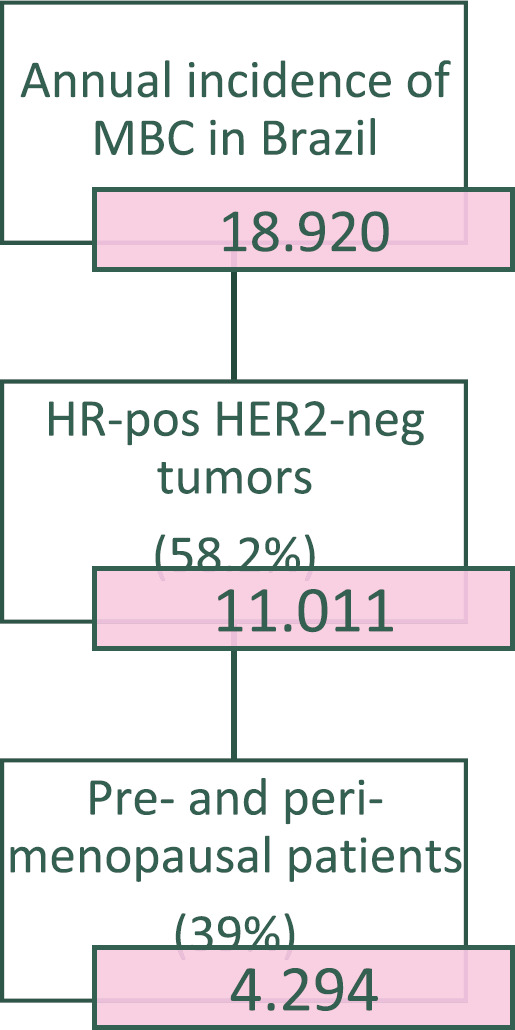
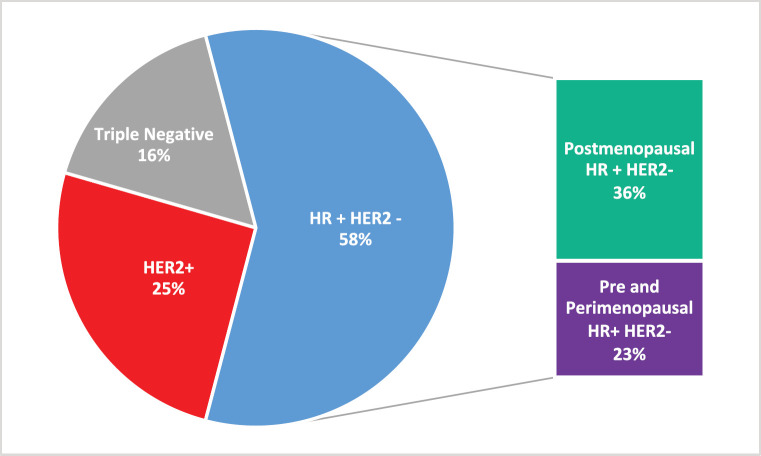
Based on published epidemiological studies and national cancer registries, we estimated the number of premenopausal patients with potential indication of ribociclib as first-line treatment for MBC. Efficacy estimates were based on results from the Monaleesa-7 trial. Our analysis is made under the unrealistic assumption that all premenopausal MBC patients would be candidates for the treatment. To estimate the number of yearly premature deaths that could be prevented, we considered the largest absolute effect on mortality when sequentially applying the observed hazard ratio.
We estimated an annual incidence of 4,294 premenopausal HR+, HER2- MBC patients in Brazil. Considering these patients, at 12, 24 and 60 months, the number of surviving subjects would be 3,504, 2,859 and 1,553 for endocrine therapy (ET) alone; and 3,717, 3,217 and 2,086 for ET plus ribociclib. The largest difference between both groups was observed at the end of the sixth year when the use of ribociclib would prevent 538 premature deaths (survival of 1,805 versus 1,267 patients by the 72nd month).
We estimate that lack of access to CDK4/6i for patients with HR+, HER2-, MBC will cause the premature death of a significant number of premenopausal women with MBC. The unavailability of effective therapies has measurable consequences. Progress in this area demands a concerted effort to prevent further loss of lives.
细胞周期蛋白依赖性激酶4/6抑制剂(CDK4/6i)联合内分泌治疗是激素受体阳性(HR+)和人表皮生长因子受体2阴性(HER2-)转移性乳腺癌(MBC)患者的标准治疗方案。然而,将这些药物纳入临床实践仍具有挑战性。本研究旨在评估巴西绝经前MBC患者无法使用瑞博西尼对死亡率的影响。
基于已发表的流行病学研究和国家癌症登记处的数据,我们估算了有使用瑞博西尼作为MBC一线治疗潜在指征的绝经前患者数量。疗效评估基于Monaleesa-7试验的结果。我们的分析是在一个不现实的假设下进行的,即所有绝经前MBC患者均为该治疗的候选对象。为了估算每年可预防的过早死亡人数,我们在依次应用观察到的风险比时考虑了对死亡率的最大绝对影响。
我们估算巴西每年有4294例绝经前HR+、HER2-MBC患者。对于这些患者,在12个月、24个月和60个月时,单纯内分泌治疗(ET)的存活患者数量分别为3504例、2859例和1553例;ET联合瑞博西尼的存活患者数量分别为3717例、3217例和2086例。两组之间的最大差异在第六年末观察到,此时使用瑞博西尼可预防538例过早死亡(到第72个月时,存活患者分别为1805例和1267例)。
我们估计,HR+、HER2-、MBC患者无法使用CDK4/6i将导致大量绝经前MBC女性过早死亡。有效治疗方法的不可用会产生可衡量的后果。该领域的进展需要共同努力以防止更多生命损失。