Liu Meng, Ren Yuan, Wang Xianfu, Lu Xianglan, Li Ming, Kim Young Mi, Li Shibo, Zhang Lijun
Department of Hematology, The First Hospital of China Medical University, 155 Nanjing North Street, Shenyang, 110000 Liaoning People's Republic of China.
Department of Pediatrics, University of Oklahoma Health Sciences Center, Oklahoma City, OK USA.
Mol Cytogenet. 2020 Aug 25;13:37. doi: 10.1186/s13039-020-00507-0. eCollection 2020.
Acute myeloid leukemia (AML) is a complex hematological disease characterized by genetic and clinical heterogeneity. The identification and understanding of chromosomal abnormalities are important for the diagnosis and management of AML patients. Compared with recurrent chromosomal translocations in AML, t(8;16)(p11.2;p13.3) can be found in any age group but is very rare and typically associated with poor prognosis.
Conventional cytogenetic studies were performed among 1,824 AML patients recorded in our oncology database over the last 20 years. Fluorescence in situ hybridization (FISH) was carried out to detect the translocation fusion. Array comparative genome hybridization (aCGH) was carried out to further characterize the duplication of chromosomes.
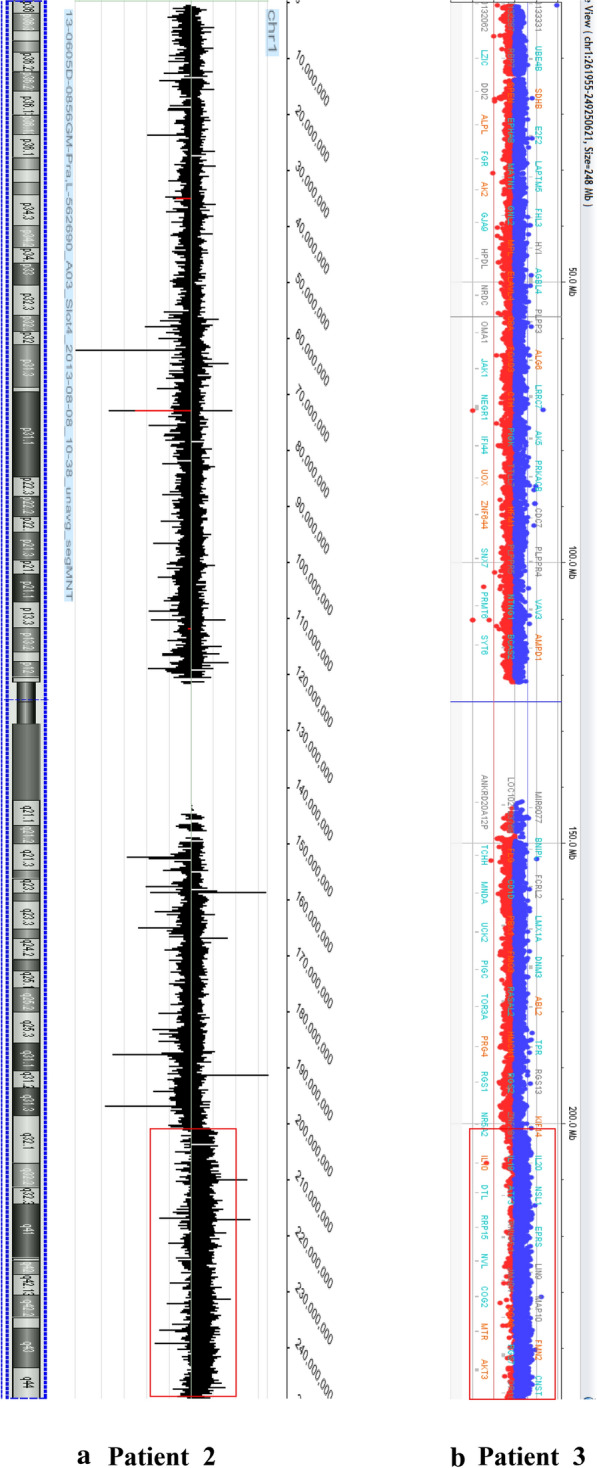
We identified three AML patients with t(8;16)(p11.2;p13.3) by chromosome analysis. Two of the three patients, who harbored an additional 1q duplication, were detected by FISH and aCGH. aCGH characterized a 46.7 Mb and 49.9 Mb gain in chromosome 1 at band q32.1q44 separately in these two patients. One patient achieved complete remission (CR) but relapsed 3 months later. The other patient never experienced CR and died 2 years after diagnosis.
A 1q duplication was detected in two of three AML patients with t(8;16)(p11.2;p13.3), suggesting that 1q duplication can be a recurrent event in AML patients with t(8;16). In concert with the findings of previous studies on similar patients, our work suggests that 1q duplication may also be an unfavorable prognostic factor of the disease.
急性髓系白血病(AML)是一种复杂的血液系统疾病,具有遗传和临床异质性。染色体异常的识别和理解对于AML患者的诊断和管理至关重要。与AML中常见的染色体易位相比,t(8;16)(p11.2;p13.3)可见于任何年龄组,但非常罕见,且通常与预后不良相关。
对我们肿瘤学数据库中记录的过去20年里的1824例AML患者进行了常规细胞遗传学研究。采用荧光原位杂交(FISH)检测易位融合。进行了阵列比较基因组杂交(aCGH)以进一步表征染色体的重复情况。
通过染色体分析,我们鉴定出3例患有t(8;16)(p11.2;p13.3)的AML患者。其中2例患者还存在额外的1q重复,通过FISH和aCGH检测到。aCGH分别在这2例患者中表征了染色体1在q32.1q44带处有46.7 Mb和49.9 Mb的增益。1例患者达到完全缓解(CR),但3个月后复发。另1例患者从未达到CR,诊断后2年死亡。
在3例患有t(8;16)(p11.2;p13.3)的AML患者中,有2例检测到1q重复,提示1q重复可能是t(8;16) AML患者中的一个复发性事件。与先前对类似患者的研究结果一致,我们的工作表明1q重复也可能是该疾病的一个不良预后因素。