Jin Jing, Chen Naiwen, Pan Huan, Xie Wenhua, Xu Hong, Lei Siyu, Guo Zhiqin, Ding Renye, He Yi, Gao Jinlai
Department of Urology, The Affiliated Hospital of Jiaxing University, Jiaxing, Zhejiang 314001, P.R. China.
Department of Surgety, The Second Clinical Medical College of Zhejiang Chinese Medical University, Hangzhou, Zhejiang 310053, P.R. China.
Oncol Lett. 2020 Oct;20(4):73. doi: 10.3892/ol.2020.11934. Epub 2020 Jul 30.
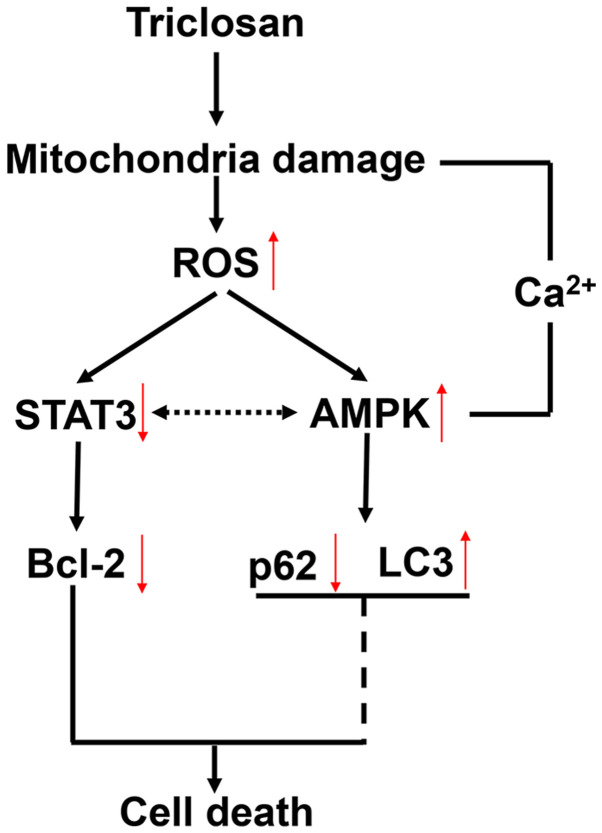
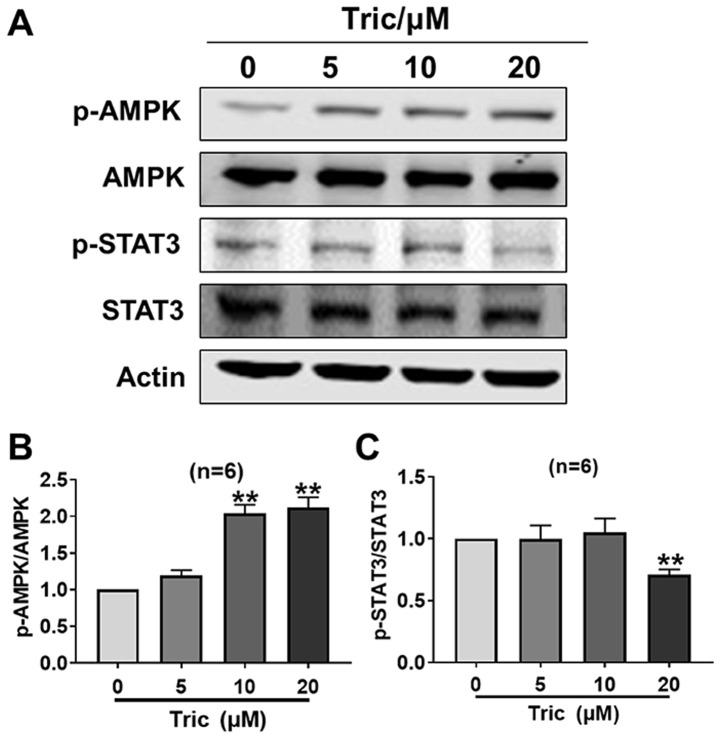
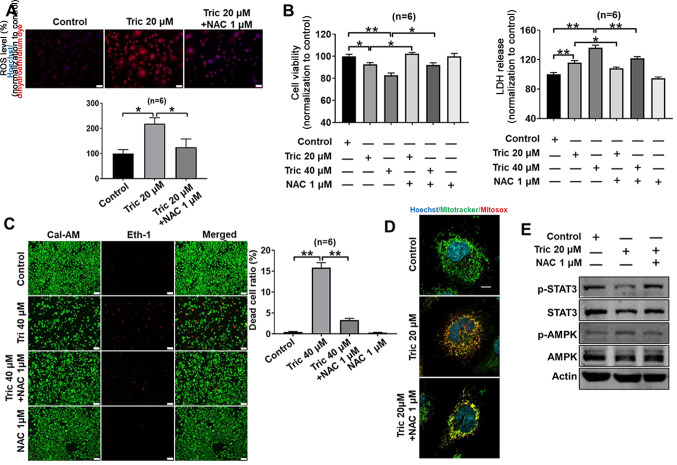
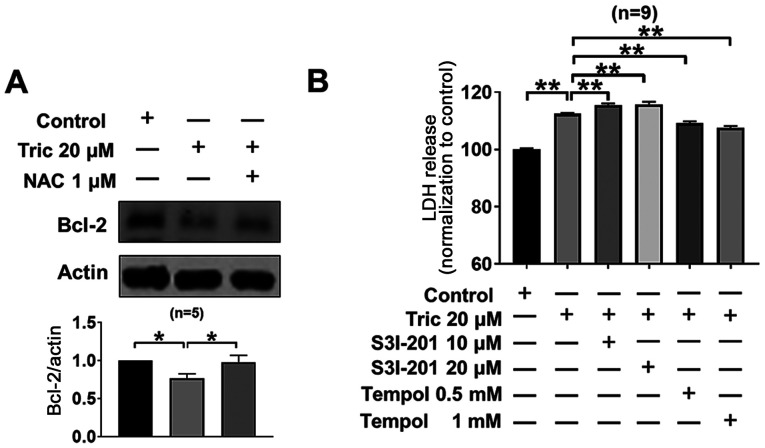
Melanoma is a common type of cutaneous tumor, but current drug treatments do not satisfy clinical practice requirements. At present, mitochondrial uncoupling is an effective antitumor treatment. Triclosan, a common antimicrobial, also acts as a mitochondrial uncoupler. The aims of the present study were to investigate the effects of triclosan on melanoma cells and the underlying mechanisms. Mitochondrial membrane potential (MMP), mitochondrial morphology, mitochondrial reactive oxygen species (mito-ROS), intracellular superoxide anion and [Ca] were measured using confocal microscopy. It was found that triclosan application was associated with decreased A375 cell viability in a dose- and time-dependent manner and these effects may have cell specificity. Furthermore, triclosan induced MMP depolarization, ATP content decrease, mito-ROS and [Ca] level increases, excessive mitochondrial fission, AMP-activated protein kinase (AMPK) activation and STAT3 inhibition. Moreover, these aforementioned effects were reversed by acetylcysteine treatment. Triclosan acute treatment also induced mitochondrial swelling, which was reversed after AMPK-knockdown associated with [Ca] overload. Cell death was caused by STAT3 inhibition but not AMPK activation. Moreover, triclosan induced autophagy via the ROS/AMPK/p62/microtubule-associated protein 1A/1B-light chain 3 (LC3) signaling pathway, which may serve a role in feedback protection. Collectively, the present results suggested that triclosan increased mito-ROS production in melanoma cells, following induced cell death via the STAT3/Bcl-2 pathway and autophagy via the AMPK/p62/LC3 pathway.
黑色素瘤是一种常见的皮肤肿瘤类型,但目前的药物治疗并不满足临床实践需求。目前,线粒体解偶联是一种有效的抗肿瘤治疗方法。三氯生是一种常见的抗菌剂,也可作为线粒体解偶联剂。本研究的目的是探讨三氯生对黑色素瘤细胞的影响及其潜在机制。使用共聚焦显微镜测量线粒体膜电位(MMP)、线粒体形态、线粒体活性氧(mito-ROS)、细胞内超氧阴离子和[Ca]。结果发现,三氯生的应用与A375细胞活力的剂量和时间依赖性降低有关,且这些影响可能具有细胞特异性。此外,三氯生还可诱导MMP去极化、ATP含量降低、mito-ROS和[Ca]水平升高、过度的线粒体裂变、AMP激活蛋白激酶(AMPK)激活以及STAT3抑制。此外,上述影响可通过乙酰半胱氨酸处理逆转。三氯生急性处理还可诱导线粒体肿胀,在与[Ca]过载相关的AMPK敲低后可逆转。细胞死亡是由STAT3抑制而非AMPK激活引起的。此外,三氯生通过ROS/AMPK/p62/微管相关蛋白1A/1B轻链3(LC3)信号通路诱导自噬,这可能在反馈保护中发挥作用。总体而言,本研究结果表明,三氯生增加了黑色素瘤细胞中mito-ROS的产生,随后通过STAT3/Bcl-2途径诱导细胞死亡,并通过AMPK/p62/LC3途径诱导自噬。