Lee Eunhye, Li Xingshu, Oh Juwon, Kwon Nahyun, Kim Gyoungmi, Kim Dongho, Yoon Juyoung
Department of Chemistry and Nanoscience , Ewha Womans University , Seoul 120-750 , Republic of Korea . Email:
College of Chemistry , State Key Laboratory of Photocatalysis on Energy and Environment , Fujian Provincial Key Laboratory of Cancer Metastasis Chemoprevention and Chemotherapy , Fuzhou University , Fuzhou 350108 , China . Email:
Chem Sci. 2020 May 18;11(22):5735-5739. doi: 10.1039/d0sc01351j. eCollection 2020 Jun 14.
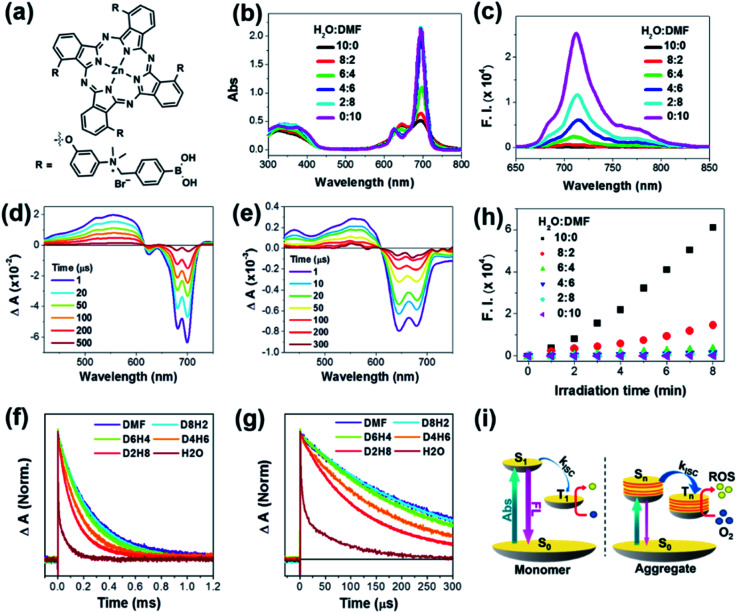
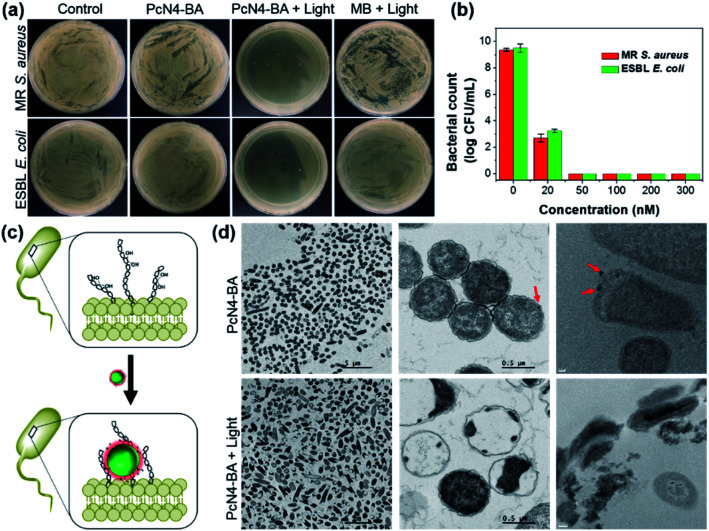
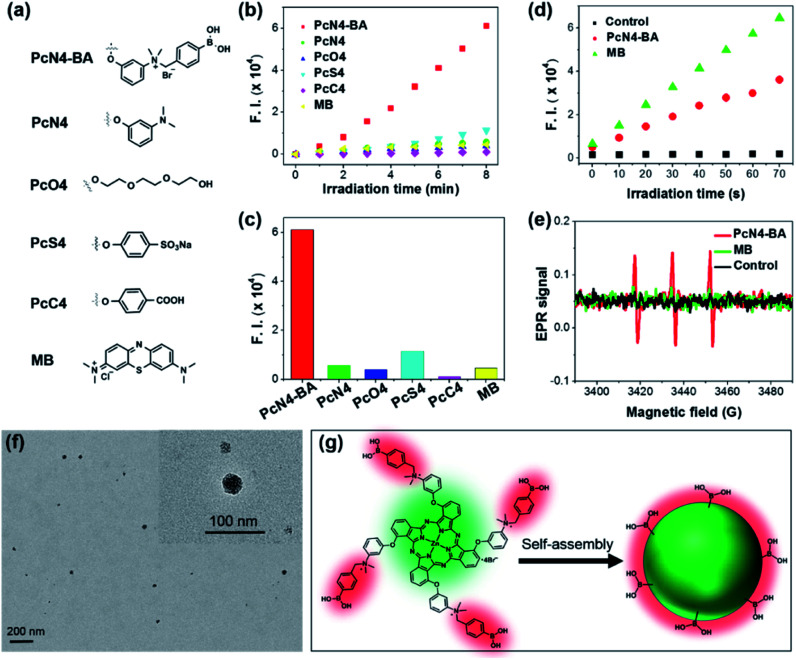
Most existing photosensitizers (, porphyrins) are often aggregated in aqueous solution because of their large conjugated molecular structures. This aggregation usually results in a lack or low levels of reactive oxygen species (ROS) generation due to aggregation-caused quenching, which severely hampers the application of photosensitizers in photodynamic therapy (PDT). Herein, we make an interesting finding that a boronic acid-functionalized phthalocyanine (PcN4-BA) displays an uncommon phenomenon, an aggregation-enhanced photodynamic effect. The combination of the ability to form uniform nanostructured self-assemblies in water, highly efficient ROS generation and boronic acid-induced targeting give PcN4-BA excellent performances in antimicrobial PDT.
大多数现有的光敏剂(如卟啉)由于其大的共轭分子结构,在水溶液中常常会发生聚集。这种聚集通常会由于聚集导致的猝灭而导致活性氧(ROS)生成不足或水平较低,这严重阻碍了光敏剂在光动力疗法(PDT)中的应用。在此,我们有一个有趣的发现,即硼酸功能化酞菁(PcN4-BA)表现出一种不寻常的现象,即聚集增强的光动力效应。在水中形成均匀纳米结构自组装体的能力、高效的ROS生成以及硼酸诱导的靶向作用相结合,使得PcN4-BA在抗菌光动力疗法中具有优异的性能。