Department of Agricultural and Environmental Sciences, College of Agriculture, Tennessee State University, Otis L. Floyd Nursery Research Center, McMinnville, TN.
Department of Plant and Environmental Sciences, Clemson University, Pee Dee Research and Education Center, Florence, SC.
J Econ Entomol. 2020 Oct 16;113(5):2418-2426. doi: 10.1093/jee/toaa186.
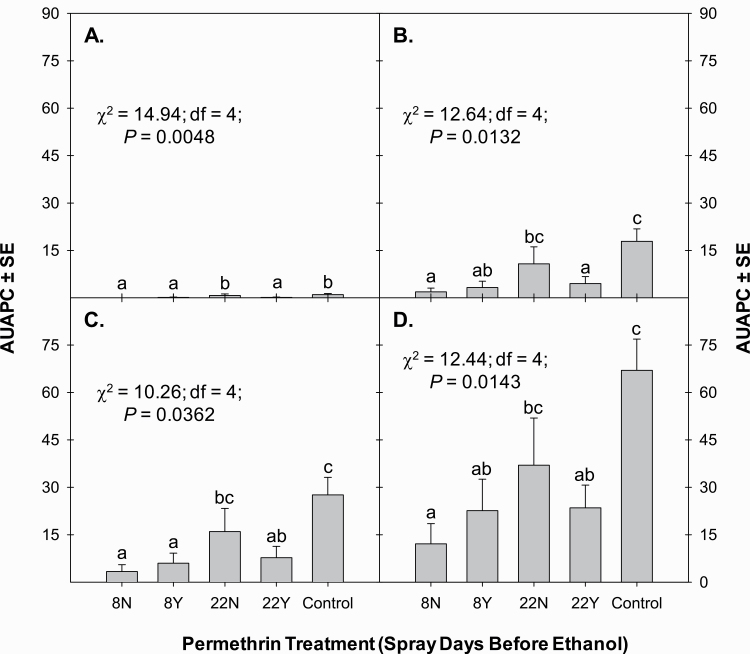
Adult ambrosia beetles (Coleoptera: Curculionidae: Scolytinae) bore into ornamental nursery trees resulting in trunk vascular tissue damage, which can potentially kill trees. Ambrosia beetle exposure to surface-applied insecticides is minimal after internal trunk galleries are formed, so effective management requires insecticide treatments to be applied near the time of infestation or to have residual activity on the bark. Tree trunk sections (bolts) were used to determine the effect of field aging or irrigation (i.e., simulated rainfall weathering) on permethrin residual activity against ambrosia beetles. In all experiments, 30-cm-long bolts from Liriodendron tulipifera L. (Magnoliales: Magnoliaceae) were hollowed and filled with 70% ethanol at field deployment to induce ambrosia beetle attacks over a 2-wk period. To evaluate insecticide residual activity, permethrin was sprayed onto tree bolts at 0, 8, 17, or 24 d before ethanol addition, and then bolts were deployed along a wooded border in fall 2017 and spring 2018. Tree bolts with permethrin residues ≤17 d old had significantly fewer ambrosia beetle attacks than bolts with 24-d-old residues or the non-permethrin-treated control bolts. To evaluate simulated rainfall weathering, permethrin was applied to tree bolts 8 or 22 d before ethanol (spring 2018) or 10 or 24 d before ethanol (fall 2018) with half of the bolts receiving regular irrigation events. Irrigation had no significant effect on permethrin residual activity against ambrosia beetles during either test. This study determined ambrosia beetle control was affected by permethrin residue age more than simulated rainfall weathering, and a reapplication interval of ≤17 d maximized beetle control.
成年天牛(鞘翅目:象甲科:小蠹科)钻入观赏苗圃树木,导致树干维管束组织受损,这可能导致树木死亡。天牛在内部树干虫道形成后,接触表面施用的杀虫剂的机会很少,因此有效的管理需要在侵染时或在树皮上有残留活性时进行杀虫剂处理。树干段(螺栓)用于确定野外老化或灌溉(即模拟降雨风化)对拟除虫菊酯防治天牛的残留活性的影响。在所有实验中,从 Liriodendron tulipifera L.(木兰纲:木兰科)中取出 30 厘米长的螺栓,在野外部署时将其掏空并用 70%乙醇填充,以在 2 周的时间内诱导天牛的攻击。为了评估杀虫剂残留活性,在添加乙醇之前 0、8、17 或 24 天将拟除虫菊酯喷洒到树螺栓上,然后在 2017 年秋季和 2018 年春季将螺栓部署在树木边界沿线。残留拟除虫菊酯≤17 天的树螺栓受到的天牛攻击明显少于残留 24 天或未用拟除虫菊酯处理的对照螺栓。为了评估模拟降雨风化,在添加乙醇之前 8 或 22 天(2018 年春季)或 10 或 24 天将拟除虫菊酯施用于树螺栓,一半的螺栓接受常规灌溉事件。在两个测试中,灌溉对拟除虫菊酯防治天牛的残留活性均无显著影响。本研究确定天牛的防治效果受拟除虫菊酯残留年龄的影响大于模拟降雨风化的影响,≤17 天的重喷间隔可最大限度地控制甲虫。