Oundo Joseph Wang'ang'a, Villinger Jandouwe, Jeneby Maamun, Ong'amo George, Otiende Moses Yongo, Makhulu Edward Edmond, Musa Ali Abdulahi, Ouso Daniel Obado, Wambua Lillian
International Centre of Insect Physiology and Ecology (icipe), Nairobi, Kenya.
School of Biological Sciences, University of Nairobi, Nairobi, Kenya.
PLoS One. 2020 Aug 31;15(8):e0228366. doi: 10.1371/journal.pone.0228366. eCollection 2020.
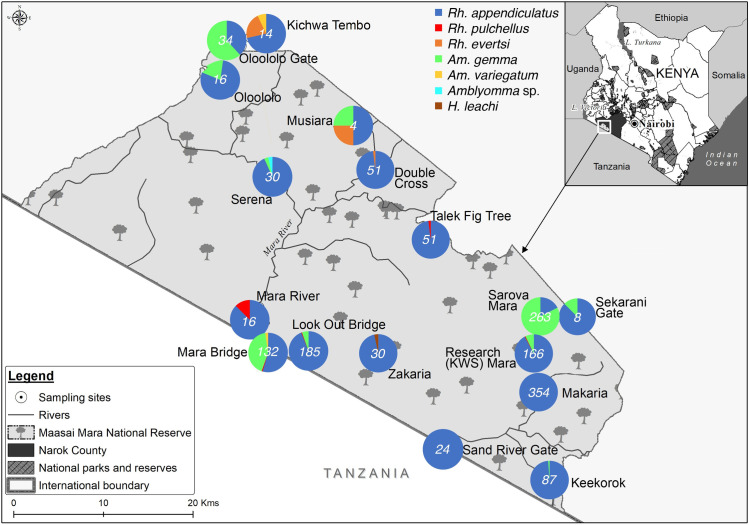
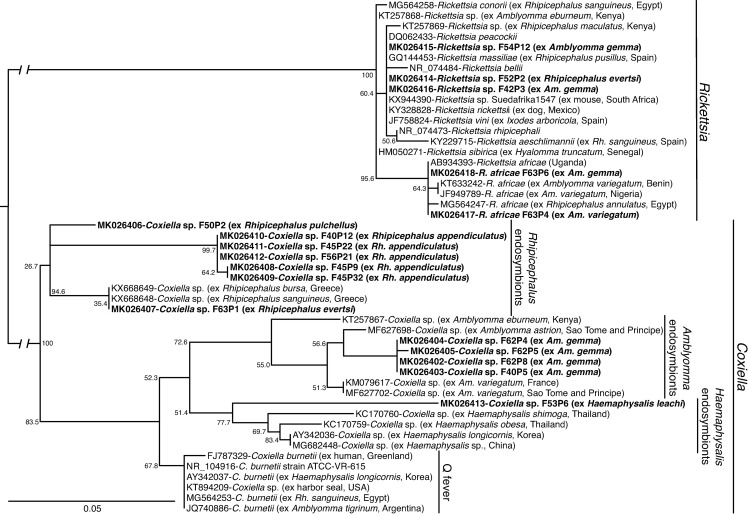
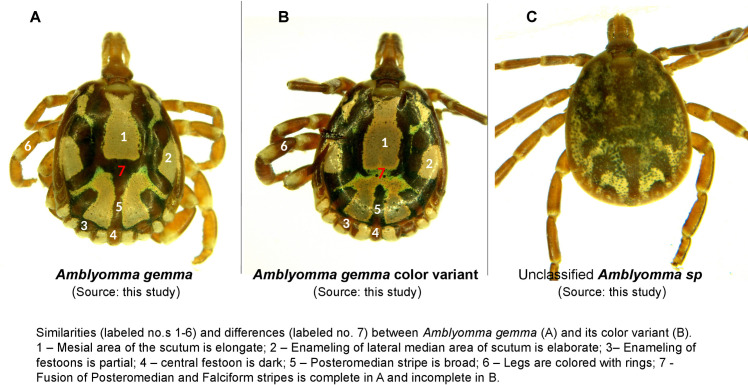
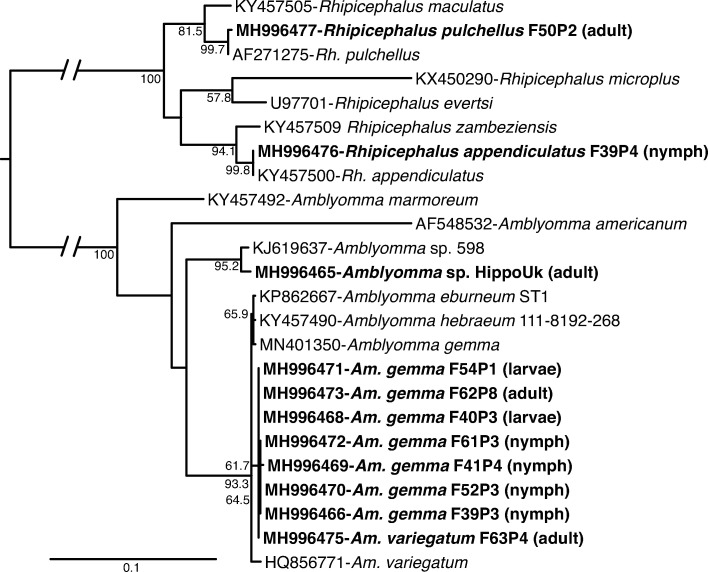
The role of questing ticks in the epidemiology of tick-borne diseases in Kenya's Maasai Mara National Reserve (MMNR), an ecosystem with intensified human-wildlife-livestock interactions, remains poorly understood. We surveyed the diversity of questing ticks, their blood-meal hosts, and tick-borne pathogens to understand potential effects on human and livestock health. By flagging and hand-picking from vegetation in 25 localities, we collected 1,465 host-seeking ticks, mostly Rhipicephalus and Amblyomma species identified by morphology and molecular analysis. We used PCR with high-resolution melting (HRM) analysis and sequencing to identify Anaplasma, Babesia, Coxiella, Ehrlichia, Rickettsia, and Theileria pathogens and blood-meal remnants in 231 tick pools. We detected blood-meals from humans, wildebeest, and African buffalo in Rh. appendiculatus, goat in Rh. evertsi, sheep in Am. gemma, and cattle in Am. variegatum. Rickettsia africae was detected in Am. gemma (MIR = 3.10) that had fed on sheep and in Am. variegatum (MIR = 250) that had fed on cattle. We found Rickettsia spp. in Am. gemma (MIR = 9.29) and Rh. evertsi (MIR = 200), Anaplasma ovis in Rh. appendiculatus (MIR = 0.89) and Rh. evertsi (MIR = 200), Anaplasma bovis in Rh. appendiculatus (MIR = 0.89), and Theileria parva in Rh. appendiculatus (MIR = 24). No Babesia, Ehrlichia, or Coxiella pathogens were detected. Unexpectedly, species-specific Coxiella sp. endosymbionts were detected in all tick genera (174/231 pools), which may affect tick physiology and vector competence. These findings show that ticks from the MMNR are infected with zoonotic R. africae and unclassified Rickettsia spp., demonstrating risk of African tick-bite fever and other spotted-fever group rickettsioses to locals and visitors. The protozoan pathogens identified may also pose risk to livestock production. The diverse vertebrate blood-meals of questing ticks in this ecosystem including humans, wildlife, and domestic animals, may amplify transmission of tick-borne zoonoses and livestock diseases.
在肯尼亚马赛马拉国家保护区(MMNR)这个人类、野生动物和家畜互动频繁的生态系统中,伺机觅食的蜱虫在蜱传疾病流行病学中的作用仍知之甚少。我们调查了伺机觅食蜱虫的多样性、它们的血餐宿主以及蜱传病原体,以了解对人类和家畜健康的潜在影响。通过在25个地点的植被上进行标记和手工挑选,我们收集了1465只寻找宿主的蜱虫,大多数是通过形态学和分子分析鉴定的璃眼蜱属和钝缘蜱属物种。我们使用聚合酶链反应(PCR)结合高分辨率熔解(HRM)分析和测序,来鉴定231个蜱虫样本池中的无形体属、巴贝斯虫属、柯克斯体属、埃立克体属、立克次体属和泰勒虫属病原体以及血餐残余物。我们在具尾璃眼蜱中检测到人类、角马和非洲水牛的血餐,在埃氏璃眼蜱中检测到山羊的血餐,在宝石钝缘蜱中检测到绵羊的血餐,在变异钝缘蜱中检测到牛的血餐。在以绵羊为食的宝石钝缘蜱(感染率 = 3.10)和以牛为食的变异钝缘蜱(感染率 = 250)中检测到非洲立克次体。我们在宝石钝缘蜱(感染率 = 9.29)和埃氏璃眼蜱(感染率 = 200)中发现了立克次体属,在具尾璃眼蜱(感染率 = 0.89)和埃氏璃眼蜱(感染率 = 200)中发现了绵羊无形体,在具尾璃眼蜱(感染率 = 0.89)中发现了牛无形体,在具尾璃眼蜱(感染率 = 24)中发现了小泰勒虫。未检测到巴贝斯虫属、埃立克体属或柯克斯体属病原体。出乎意料的是,在所有蜱属中都检测到了物种特异性的柯克斯体属内共生菌(231个样本池中的174个),这可能会影响蜱的生理机能和传播能力。这些发现表明,来自MMNR的蜱虫感染了人畜共患的非洲立克次体和未分类的立克次体属,证明了非洲蜱咬热和其他斑点热群立克次体病对当地人和游客的风险。鉴定出的原生动物病原体也可能对家畜生产构成风险。在这个生态系统中,伺机觅食的蜱虫以包括人类、野生动物和家畜在内的多种脊椎动物为血餐,这可能会扩大蜱传人畜共患病和家畜疾病的传播。