Key Laboratory of Organ Regeneration and Transplantation of the Ministry of Education, The First Hospital, Institute of Immunology, Jilin University, Changchun, China.
National-local Joint Engineering Laboratory of Animal Models for Human Diseases, Changchun, China.
Aging Cell. 2020 Oct;19(10):e13224. doi: 10.1111/acel.13224. Epub 2020 Aug 31.
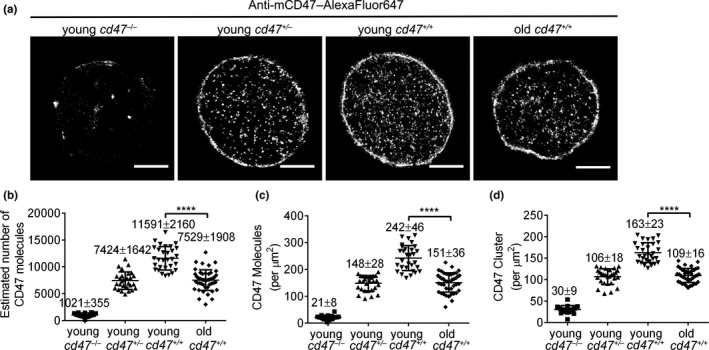
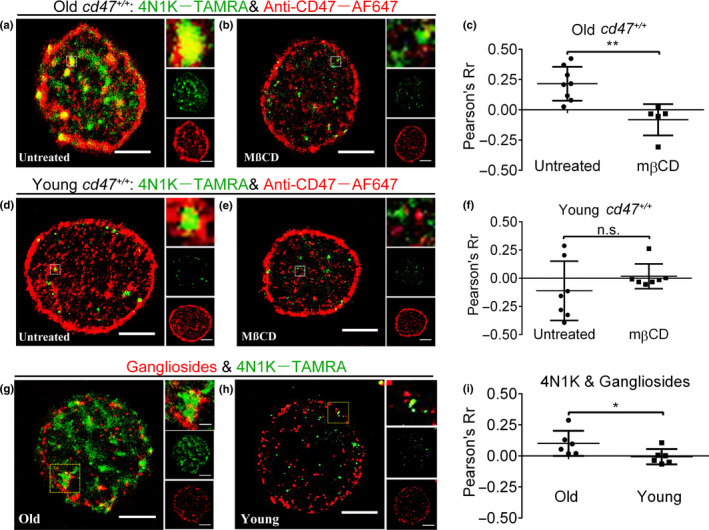
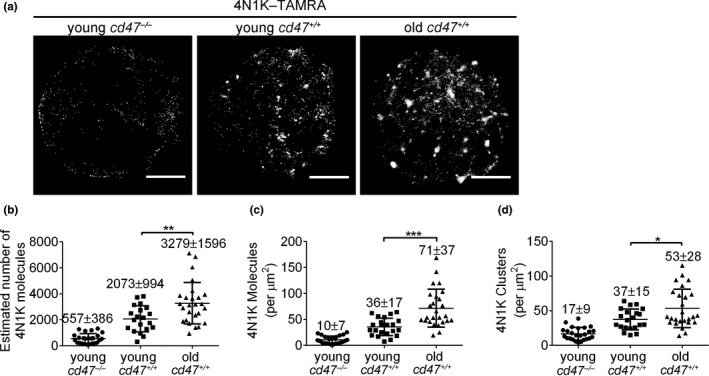
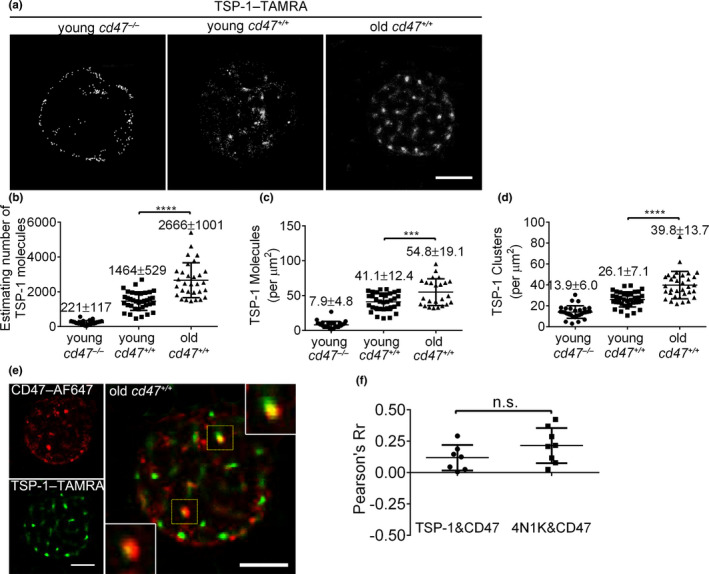
CD47 serves as a ligand for signaling regulatory protein α (SIRPα) and as a receptor for thrombospondin-1 (TSP-1). Although CD47, TSP-1, and SIRPα are thought to be involved in the clearance of aged red blood cells (RBCs), aging-associated changes in the expression and interaction of these molecules on RBCs have been elusive. Using direct stochastic optical reconstruction microscopy (dSTORM)-based imaging and quantitative analysis, we can report that CD47 molecules on young RBCs reside as nanoclusters with little binding to TSP-1, suggesting a minimal role for TSP-1/CD47 signaling in normal RBCs. On aged RBCs, CD47 molecules decreased in number but formed bigger and denser clusters, with increased ability to bind TSP-1. Exposure of aged RBCs to TSP-1 resulted in a further increase in the size of CD47 clusters via a lipid raft-dependent mechanism. Furthermore, CD47 cluster formation was dramatically inhibited on thbs1 mouse RBCs and associated with a significantly prolonged RBC lifespan. These results indicate that the strength of CD47 binding to its ligand TSP-1 is predominantly determined by the distribution pattern and not the amount of CD47 molecules on RBCs, and offer direct evidence for the role of TSP-1 in phagocytosis of aged RBCs. This study provides clear nanoscale pictures of aging-associated changes in CD47 distribution and TSP-1/CD47 interaction on the cell surface, and insights into the molecular basis for how these molecules coordinate to remove aged RBCs.
CD47 作为信号调节蛋白 α(SIRPα)的配体和血小板反应蛋白-1(TSP-1)的受体。虽然 CD47、TSP-1 和 SIRPα 被认为参与清除衰老的红细胞(RBCs),但 RBC 上这些分子的表达和相互作用与衰老相关的变化仍然难以捉摸。使用直接随机光学重建显微镜(dSTORM)为基础的成像和定量分析,我们可以报告年轻 RBC 上的 CD47 分子以纳米簇的形式存在,与 TSP-1 的结合很少,这表明 TSP-1/CD47 信号在正常 RBC 中作用很小。在衰老的 RBC 上,CD47 分子数量减少,但形成更大、更密集的簇,与 TSP-1 的结合能力增加。通过脂质筏依赖性机制,暴露于 TSP-1 的衰老 RBC 导致 CD47 簇的大小进一步增加。此外,在 thbs1 小鼠 RBC 上,CD47 簇的形成被显著抑制,并与 RBC 寿命显著延长相关。这些结果表明,CD47 与其配体 TSP-1 的结合强度主要取决于 CD47 分子在 RBC 上的分布模式,而不是数量,为 TSP-1 在吞噬衰老 RBC 中的作用提供了直接证据。本研究提供了 CD47 分布和 TSP-1/CD47 相互作用在细胞表面上与衰老相关变化的清晰纳米级图像,并深入了解这些分子如何协调去除衰老 RBC 的分子基础。