Department of Dermatology, Instituto de Investigación Sanitaria Princesa, Hospital Universitario la Princesa, Universidad Autónoma de Madrid, Madrid, Spain.
Department of Immunology, Instituto de Investigación Sanitaria Princesa, Hospital Universitario la Princesa, Universidad Autónoma de Madrid, Madrid, Spain.
Front Immunol. 2019 Jun 4;10:1268. doi: 10.3389/fimmu.2019.01268. eCollection 2019.
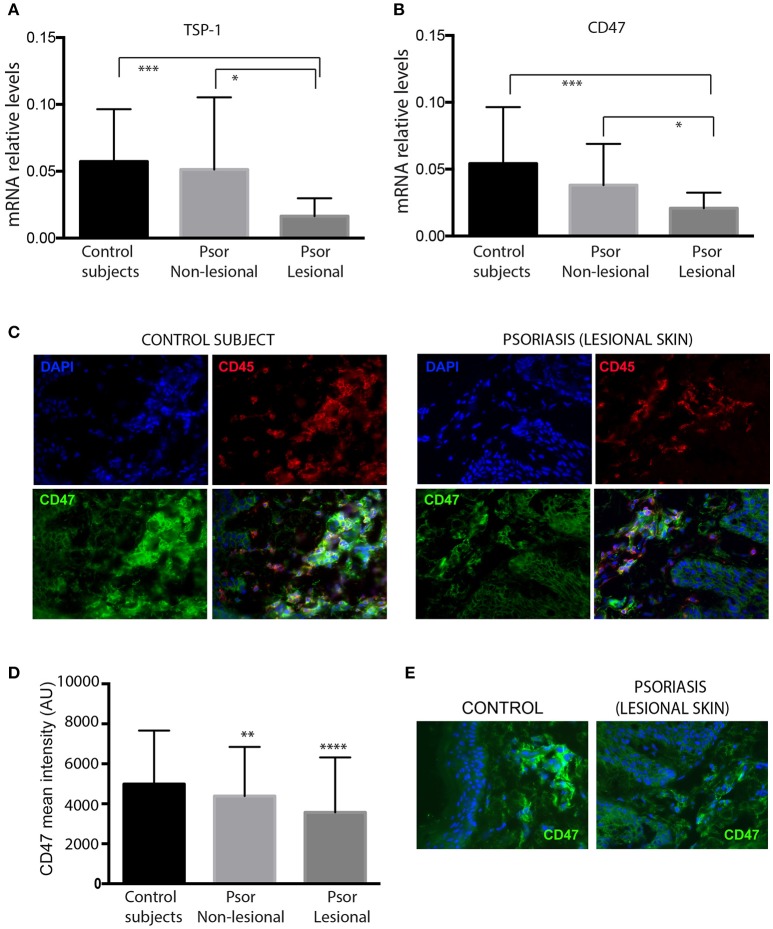
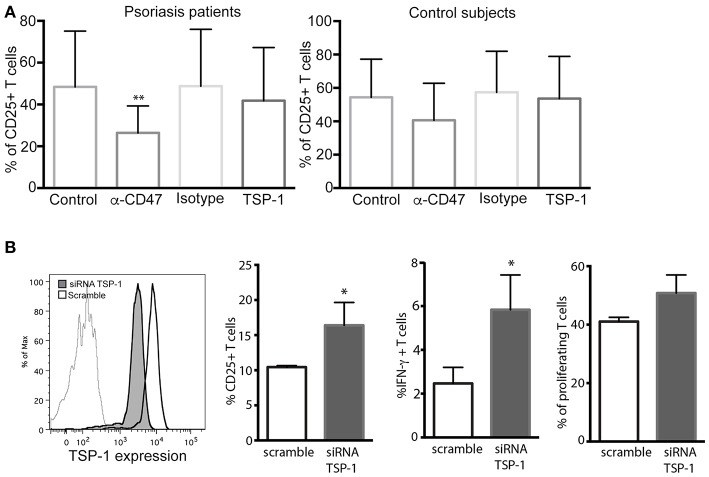
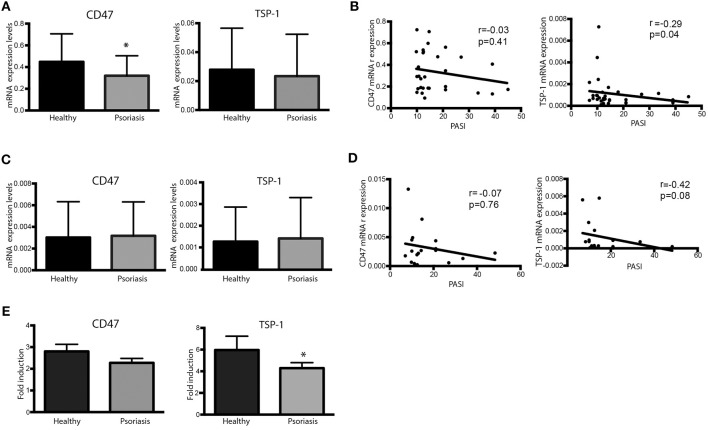
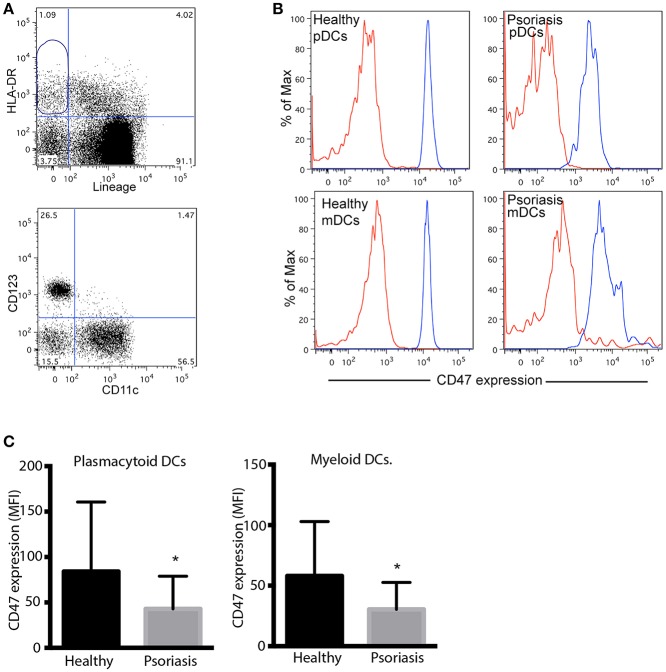
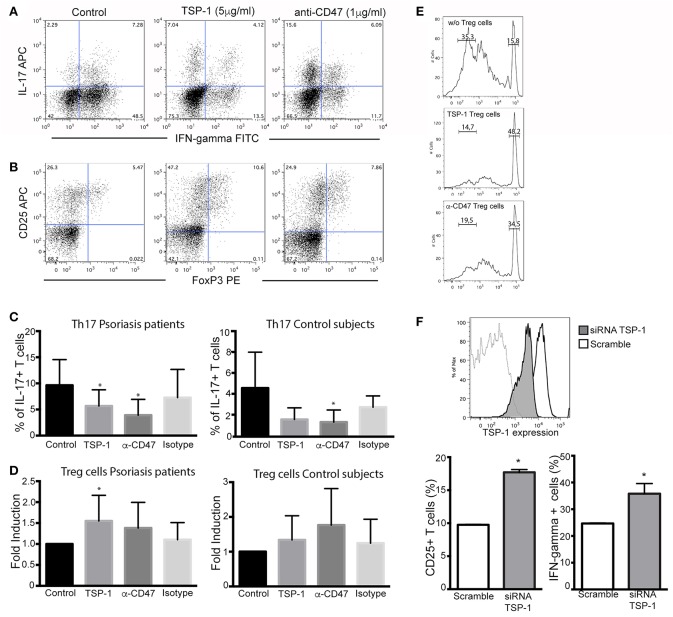
Accumulating evidence on the role of Thrombospondin-1 (TSP-1) in the immune response has emerged during the last years. In spite of the importance of TSP-1 not only as anti-angiogenic factor but also as an immunomodulatory molecule, studies on the role of TSP-1 in psoriasis have been neglected. TSP-1 and CD47 expression were analyzed in skin samples from psoriasis patients and control subjects using RT-PCR and immunofluorescence. Expression of these molecules was also evaluated in peripheral blood CD4+ T cells, moDCs, and circulating primary DCs. The functional role of TSP-1/CD47 signaling axis in psoriasis was assessed in Th17 and Treg differentiation assays. Additionally, small interfering RNA assays specific to TSP-1 were performed in CD4+ T cells and monocyte derived DC to specifically evaluate the function of this protein. Lesional skin of psoriasis patients expressed lower TSP-1 and CD47 mRNA levels compared to non-lesional skin or skin from controls. Immunofluorescence staining revealed decreased expression of CD47 in CD45+ dermal cells from psoriasis samples compared to control subjects. Peripheral CD4+ T cells and circulating primary DCs from psoriasis also expressed lower levels of CD47 compared to controls. Although no significant differences were detected in TSP-1 expression in CD4+ T cells and moDCs between patients and controls, TSP-1 expression in psoriasis patients inversely correlated with disease activity evaluated by the Psoriasis Area and Index Activity. Furthermore, exogenous TSP-1 inhibited Th17 differentiation and stimulated the differentiation of CD4+ T cells toward Treg cells. Furthermore, RNA interference specific for TSP-1 confirmed the role of this molecule as a negative regulator of T cell activation. Because of the impact of TSP-1/CD47 signaling axis in Th17 and Treg differentiation, a dysregulated expression of these molecules in the immune cells from psoriasis patients may favor the exacerbated inflammatory response in this disease.
近年来,人们逐渐认识到血小板反应蛋白-1(TSP-1)在免疫反应中的作用。尽管 TSP-1 不仅作为一种抗血管生成因子,而且作为一种免疫调节分子非常重要,但人们对 TSP-1 在银屑病中的作用的研究却被忽视了。使用 RT-PCR 和免疫荧光法分析了银屑病患者和对照者皮肤样本中的 TSP-1 和 CD47 的表达。还评估了这些分子在外周血 CD4+T 细胞、moDC 和循环原代 DC 中的表达。通过 Th17 和 Treg 分化测定评估 TSP-1/CD47 信号轴在银屑病中的功能作用。此外,在 CD4+T 细胞和单核细胞衍生的 DC 中进行了针对 TSP-1 的小干扰 RNA 测定,以专门评估该蛋白的功能。与非病变皮肤或对照皮肤相比,银屑病患者的皮损皮肤中 TSP-1 和 CD47 mRNA 水平较低。免疫荧光染色显示与对照者相比,来自银屑病样本的 CD45+真皮细胞中 CD47 的表达降低。与对照者相比,来自银屑病患者的外周血 CD4+T 细胞和循环原代 DC 也表达较低水平的 CD47。尽管患者和对照者之间 CD4+T 细胞和 moDC 中的 TSP-1 表达无明显差异,但 TSP-1 在银屑病患者中的表达与通过银屑病面积和活动度指数评估的疾病活动呈负相关。此外,外源性 TSP-1 抑制了 Th17 分化,并刺激 CD4+T 细胞向 Treg 细胞分化。此外,针对 TSP-1 的 RNA 干扰证实了该分子作为 T 细胞活化负调节剂的作用。由于 TSP-1/CD47 信号轴在 Th17 和 Treg 分化中的作用,这些分子在银屑病患者免疫细胞中的失调表达可能有利于这种疾病中炎症反应的加剧。