Sarriá Beatriz, Sierra-Cinos José Luis, García-Diz Luis, Martínez-López Sara, Mateos Raquel, Bravo-Clemente Laura
Department of Metabolism and Nutrition, Institute of Food Science, Technology and Nutrition (ICTAN-CSIC), Spanish National Research Council (CSIC), José Antonio Nováis 10, 28040 Madrid, Spain.
Department of Nutrition and Food Science I, School of Pharmacy, Complutense University of Madrid (UCM), Ciudad Universitaria, s/n 28040 Madrid, Spain.
Foods. 2020 Aug 28;9(9):1191. doi: 10.3390/foods9091191.
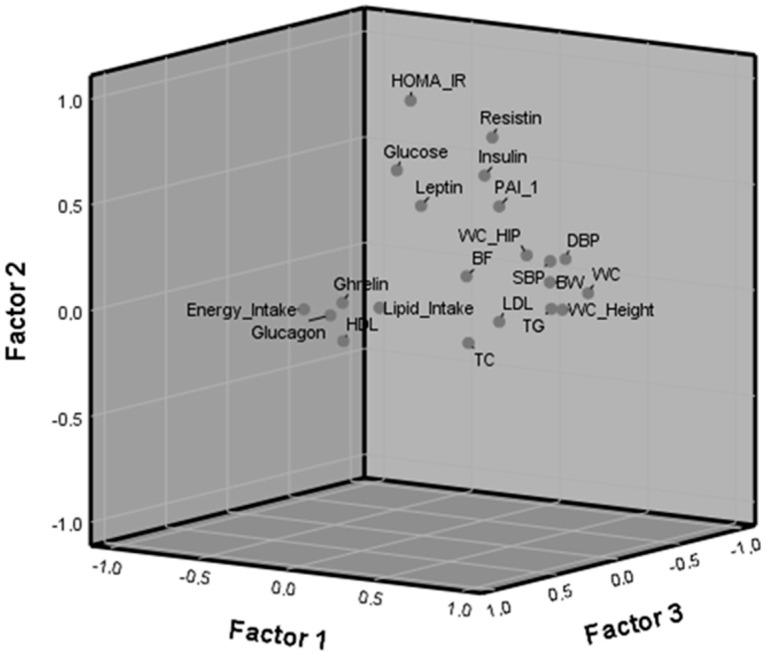
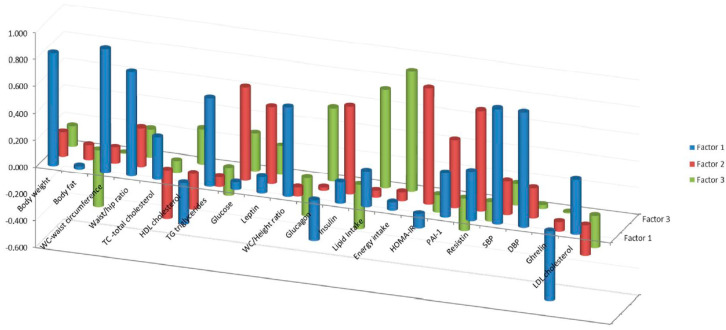
In previous studies, after regularly consuming a green/roasted coffee blend, body weight, body fat%, glucose, plasminogen activator inhibitor-1 (PAI-1), resistin, leptin, ghrelin, diastolic (DBP) and systolic blood pressure (SBP) significantly changed in healthy and hypercholesterolemic subjects. However, glucagon, total-cholesterol (T-C), triglycerides (TG), LDL-cholesterol (LDL-C) and Homeostasis Model Assessment index to estimate insulin resistance (HOMA-IR) only changed in the hypercholesterolemics. This work looks into the antiobesity effects of coffee blend and into the relationship of antiobesity with the aforementioned cardiometabolic modifications in hypercholesterolemics. (1) Methods: Tricipital and subscapular skinfolds, hip, thigh, arm and waist circumference (WC) were measured in normocholesterolemic and hypercholesterolemics. To understand the relationship between cardiometabolic and antiobesity results in hypercholesterolemics, factor analysis was carried out using baseline values of the variables that changed. (2) Results: WC, WC/hip and WC/height showed significant coffee×group interaction, and in hypercholesterolemics tended to decrease. After factor analysis, three factors emerged, accounting for 29.46, 13.13 and 11.79% of variance. Only factor 1 (main loadings: WC, DBP and SBP, body weight, WC/hip and WC/height ratios, TG and ghrelin, inversely) decreased after coffee intake. (3) Conclusion: Regularly consuming green/roasted coffee may help to control body weight, and in hypercholesterolemics, may reduce cardiovascular risk by reducing abdominal adiposity and blood pressure.
在先前的研究中,健康受试者和高胆固醇血症受试者在定期饮用混合的生咖啡/烘焙咖啡后,体重、体脂百分比、血糖、纤溶酶原激活物抑制剂-1(PAI-1)、抵抗素、瘦素、胃饥饿素、舒张压(DBP)和收缩压(SBP)均发生了显著变化。然而,胰高血糖素、总胆固醇(T-C)、甘油三酯(TG)、低密度脂蛋白胆固醇(LDL-C)以及用于评估胰岛素抵抗的稳态模型评估指数(HOMA-IR)仅在高胆固醇血症受试者中发生了变化。本研究探讨了混合咖啡的抗肥胖作用以及高胆固醇血症患者中抗肥胖作用与上述心脏代谢改变之间的关系。(1)方法:测量了正常胆固醇血症患者和高胆固醇血症患者的肱三头肌和肩胛下皮褶厚度、臀围、大腿围、上臂围和腰围(WC)。为了解高胆固醇血症患者心脏代谢与抗肥胖结果之间的关系,对发生变化的变量的基线值进行了因子分析。(2)结果:WC、WC/臀围和WC/身高显示出显著的咖啡×组交互作用,在高胆固醇血症患者中呈下降趋势。因子分析后出现了三个因子,分别解释了29.46%、13.13%和11.79%的方差。饮用咖啡后,只有因子1(主要负荷指标:WC、DBP和SBP、体重、WC/臀围和WC/身高比值、TG和胃饥饿素,呈负相关)下降。(3)结论:定期饮用生咖啡/烘焙咖啡可能有助于控制体重,对于高胆固醇血症患者,可能通过减少腹部肥胖和血压来降低心血管风险。