de la Pinta Carolina, Fernández-Lizarbe E, Sevillano D, Capúz A B, Martín M, Hernanz R, Vallejo C, Martín M, Sancho S
Department of Radiation Oncology, Ramón y Cajal Hospital, Madrid, Spain.
Department of Medical Physics, Ramón y Cajal Hospital, Madrid, Spain.
J Clin Transl Res. 2020 Jul 8;6(1):6-13. eCollection 2020 Jul 16.
Radiosurgery is employed for the treatment of brain metastases. The aim of this study is to evaluate the efficacy and tolerability of single-dose radiosurgery (SRS) compared to hypofractionated stereotactic radiotherapy (hFSRT).
Between 2004 and 2018, we analyzed treatments of 97 patients with 135 brain metastases. Fifty-six patients were treated with SRS, and 41 patients were treated with hFSRT. Median dose was 16 Gy (12-20 Gy) for the SRS group and 30 Gy in 5-6 fractions for the hFSRT group. hFSRT was used for larger lesions and lesions located near critical structures. Kaplan-Meier curves were constructed for overall survival (OS) and local control (LC).
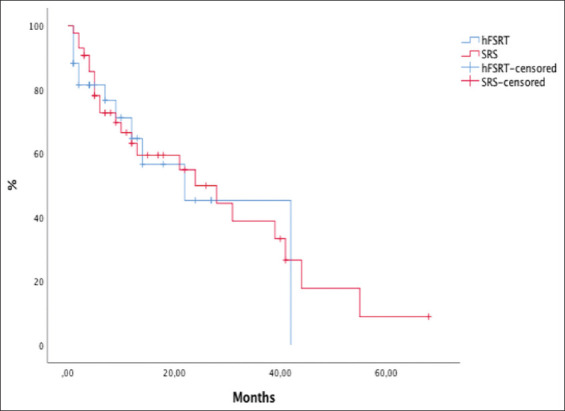
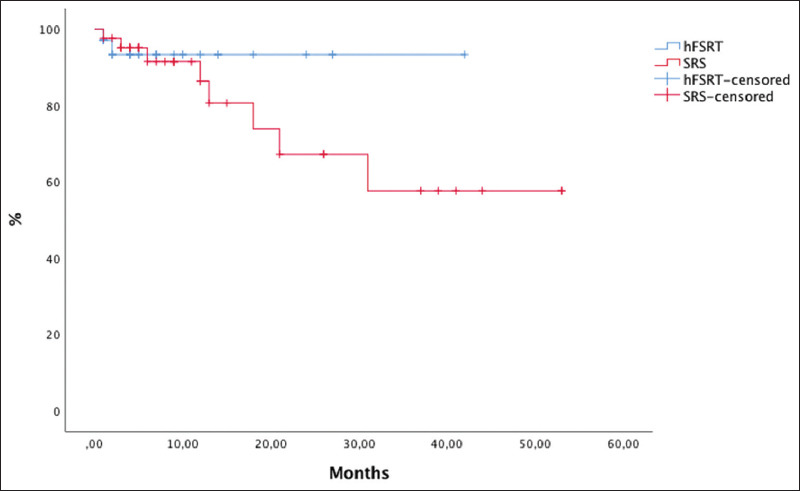
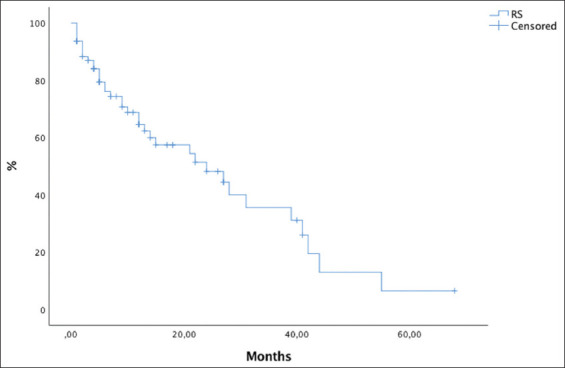
Median age was 64 years (range, 32-89 years). Median survival was 10 months (1-68 months). With a median follow-up of 10 months, no significant differences in OS between groups were found (=0.21). LC for all patients was 67%. Local progression-free survival (LPFS) at 6 months and 1 year was 71% and 60% for the SRS group, respectively, and 80% and 69% for the hFSRT group, respectively (=0.93). Although hFSRT was used for larger lesions and lesions in adverse locations, LPFS was not inferior compared to lesions treated with SRS. We observed acute toxicity grade 1-2 in 25 patients (25.8%). Late complications were observed in 11 patients (11.3%). Acute and late toxicity was similar in the SRS- and hFSRT-treated patients (=0.63 and =0.11, respectively). Brain recurrence occurred in 37.5% and 14.6% in the hFSRT and SRS group, respectively (=0.06).
Since patients treated with hFSRT exhibited similar survival and LPFS rates without differences in toxicity compared to those treated with SRS, hFSRT can be beneficial, particularly for patients with brain metastases.
Hypofractionated schemes in stereotactic radiosurgery offers treatment alternatives to patients with large lesions or lesions near critical structures.
放射外科用于治疗脑转移瘤。本研究的目的是评估与分割立体定向放射治疗(hFSRT)相比,单次剂量放射外科(SRS)的疗效和耐受性。
2004年至2018年期间,我们分析了97例有135个脑转移瘤患者的治疗情况。56例患者接受了SRS治疗,41例患者接受了hFSRT治疗。SRS组的中位剂量为16 Gy(12 - 20 Gy),hFSRT组为30 Gy分5 - 6次给予。hFSRT用于较大的病灶以及位于关键结构附近的病灶。构建了总生存期(OS)和局部控制(LC)的Kaplan - Meier曲线。
中位年龄为64岁(范围32 - 89岁)。中位生存期为10个月(1 - 68个月)。中位随访10个月,两组间OS无显著差异(P = 0.21)。所有患者的LC为67%。SRS组6个月和1年时的局部无进展生存期(LPFS)分别为71%和60%,hFSRT组分别为80%和69%(P = 0.93)。尽管hFSRT用于较大的病灶和不利位置的病灶,但与接受SRS治疗的病灶相比,LPFS并不逊色。我们观察到25例患者(25.8%)出现1 - 2级急性毒性。11例患者(11.3%)出现晚期并发症。SRS组和hFSRT组患者的急性和晚期毒性相似(分别为P = 0.63和P = 0.11)。hFSRT组和SRS组的脑复发率分别为37.5%和14.6%(P = 0.06)。
由于与接受SRS治疗的患者相比接受hFSRT治疗的患者在生存率和LPFS率方面相似且毒性无差异,hFSRT可能有益,特别是对于脑转移瘤患者。
立体定向放射外科中的分割方案为有较大病灶或关键结构附近病灶的患者提供了治疗选择。