Department of Neuroscience, Erasmus University Medical Center, 3015 GD Rotterdam, The Netherlands.
ENCORE Expertise Center for Neurodevelopmental Disorders, Erasmus University Medical Center, 3015 GD Rotterdam, The Netherlands.
Hum Mol Genet. 2020 Nov 4;29(18):3032-3043. doi: 10.1093/hmg/ddaa194.
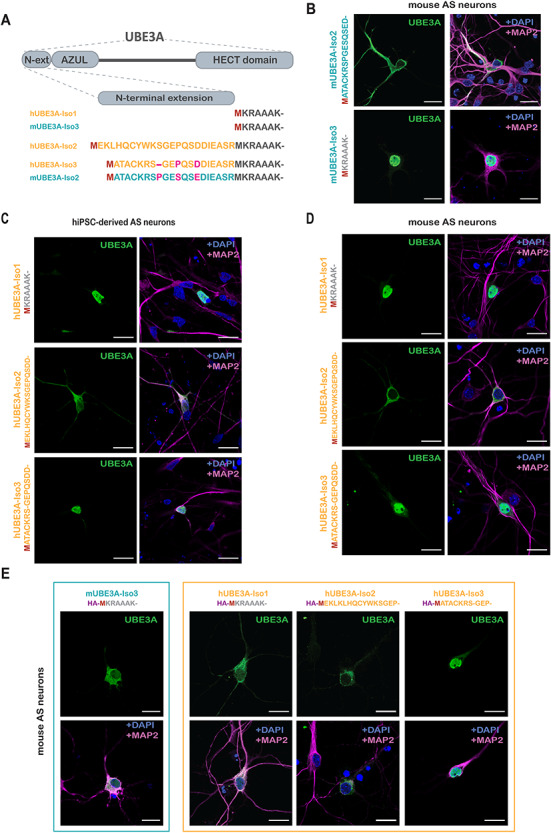
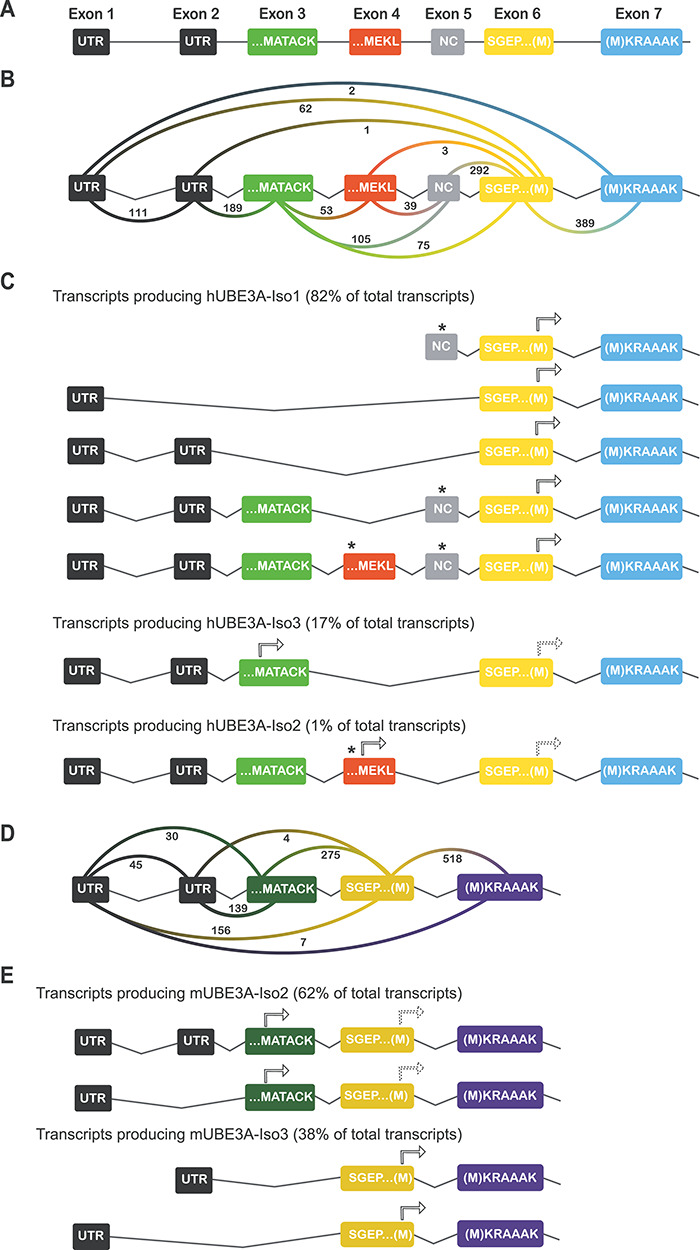
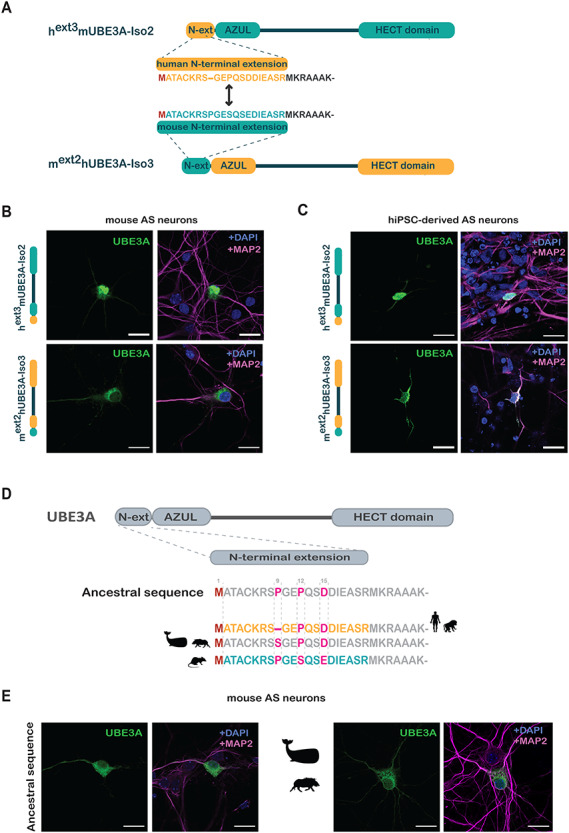
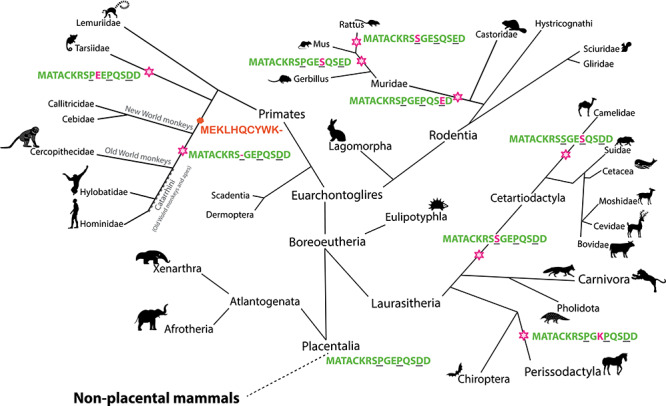
The human UBE3A gene, which is essential for normal neurodevelopment, encodes three Ubiquitin E3 ligase A (UBE3A) protein isoforms. However, the subcellular localization and relative abundance of these human UBE3A isoforms are unknown. We found, as previously reported in mice, that UBE3A is predominantly nuclear in human neurons. However, this conserved subcellular distribution is achieved by strikingly distinct cis-acting mechanisms. A single amino-acid deletion in the N-terminus of human hUBE3A-Iso3, which is homologous to cytosolic mouse mUBE3A-Iso2, results in its translocation to the nucleus. This singe amino-acid deletion is shared with apes and Old World monkeys and was preceded by the appearance of the cytosolic hUBE3A-Iso2 isoform. This hUBE3A-Iso2 isoform arose after the lineage of New World monkeys and Old World monkeys separated from the Tarsiers (Tarsiidae). Due to the loss of a single nucleotide in a non-coding exon, this exon became in frame with the remainder of the UBE3A protein. RNA-seq analysis of human brain samples showed that the human UBE3A isoforms arise by alternative splicing. Consistent with the predominant nuclear enrichment of UBE3A in human neurons, the two nuclear-localized isoforms, hUBE3A-Iso1 and -Iso3, are the most abundantly expressed isoforms of UBE3A, while hUBE3A-Iso2 maintains a small pool of cytosolic UBE3A. Our findings provide new insight into UBE3A localization and evolution and may have important implications for gene therapy approaches in Angelman syndrome.
人类 UBE3A 基因对于正常的神经发育至关重要,它编码三种泛素 E3 连接酶 A(UBE3A)蛋白异构体。然而,这些人类 UBE3A 异构体的亚细胞定位和相对丰度尚不清楚。我们发现,与之前在小鼠中报道的情况一样,UBE3A 在人类神经元中主要位于核内。然而,这种保守的亚细胞分布是通过截然不同的顺式作用机制实现的。人类 hUBE3A-Iso3 的 N 端单个氨基酸缺失,与细胞质中的小鼠 mUBE3A-Iso2 同源,导致其易位到核内。这个单一的氨基酸缺失与类人猿和旧大陆猴共有,并且在细胞质 hUBE3A-Iso2 异构体出现之前就已经存在。这个 hUBE3A-Iso2 异构体出现在新世界猴和旧大陆猴与狐猴(狐猴科)分离之后。由于一个非编码外显子中的单个核苷酸丢失,这个外显子与 UBE3A 蛋白的其余部分成为框架。对人类脑组织样本的 RNA-seq 分析表明,人类 UBE3A 异构体通过选择性剪接产生。与 UBE3A 在人类神经元中主要富集于核内的情况一致,两种定位于核内的异构体 hUBE3A-Iso1 和 -Iso3 是 UBE3A 表达最丰富的异构体,而 hUBE3A-Iso2 则保持少量细胞质 UBE3A。我们的发现为 UBE3A 的定位和进化提供了新的见解,并且可能对 Angelman 综合征的基因治疗方法具有重要意义。