Division of Hematology, Department of Medicine, Johns Hopkins University School of Medicine, Baltimore, MD, USA.
J Thromb Haemost. 2021 Mar;19(3):607-616. doi: 10.1111/jth.15082. Epub 2021 Feb 10.
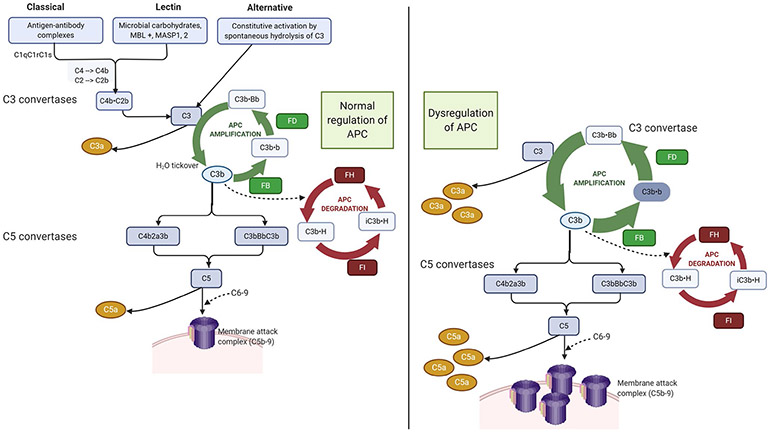
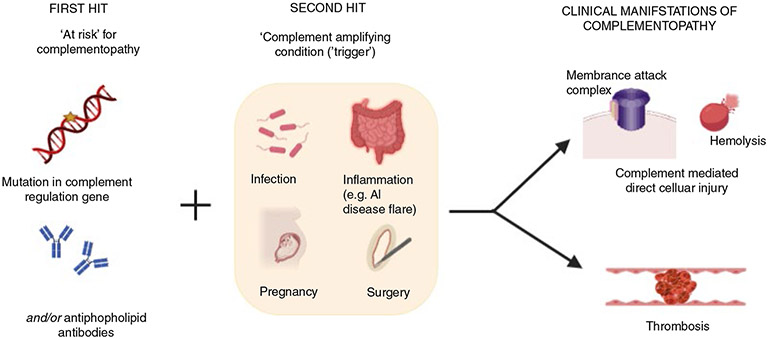
Antiphospholipid syndrome (APS) is an acquired thromboinflammatory disorder characterized by the presence of antiphospholipid antibodies as well as an increased frequency of venous or arterial thrombosis and/or obstetrical morbidity. The spectrum of disease varies from asymptomatic to a severe form characterized by widespread thrombosis and multiorgan failure, termed catastrophic APS (CAPS). CAPS affects only about ∼1% of APS patients, often presents as a thrombotic microangiopathy and has a fulminant course with >40% mortality, despite the best available therapy. Animal models have implicated complement in the pathophysiology of thrombosis in APS, with more recent data from human studies confirming the interaction between the coagulation and complement pathways. Activation of the complement cascade via antiphospholipid antibodies can cause cellular injury and promote coagulation via multiple mechanisms. Finally, analogous to classic complement-mediated diseases such as atypical hemolytic uremic syndrome, a subset of patients with APS may be at increased risk for development of CAPS because of the presence of germline variants in genes crucial for complement regulation. Together, these data make complement inhibition an attractive and potentially lifesaving therapy to mitigate morbidity and mortality in severe thrombotic APS and CAPS.
抗磷脂综合征(APS)是一种获得性血栓炎症性疾病,其特征是存在抗磷脂抗体,以及静脉或动脉血栓形成和/或产科发病率增加。疾病谱从无症状到以广泛血栓形成和多器官衰竭为特征的严重形式不等,称为灾难性 APS(CAPS)。CAPS 仅影响约 1%的 APS 患者,通常表现为血栓性微血管病,尽管采用了最佳可用疗法,但病程急骤,死亡率超过 40%。动物模型提示补体在 APS 血栓形成的病理生理学中起作用,最近来自人类研究的数据证实了凝血和补体途径之间的相互作用。抗磷脂抗体通过激活补体级联反应可通过多种机制导致细胞损伤和促进凝血。最后,类似于经典补体介导的疾病,如非典型溶血性尿毒症综合征,由于关键补体调节基因的种系变异,一部分 APS 患者可能会增加 CAPS 的发病风险。综上所述,补体抑制是一种有吸引力的、潜在的救生治疗方法,可减轻严重血栓性 APS 和 CAPS 的发病率和死亡率。