Department of Psychology.
Psychol Trauma. 2020 Oct;12(7):707-715. doi: 10.1037/tra0000962. Epub 2020 Sep 3.
Military veterans with posttraumatic stress disorder (PTSD) exhibit heightened rates of deliberate self-harm, yet few studies have explored underlying mechanisms. Addressing this critical gap in the literature, the present study examined the roles of negative and positive emotion dysregulation in the relation between PTSD severity and deliberate self-harm.
Data were collected from 465 trauma-exposed military veterans in the community ( = 38.00, 71.4% male, 69.5% White) who responded to an online survey.
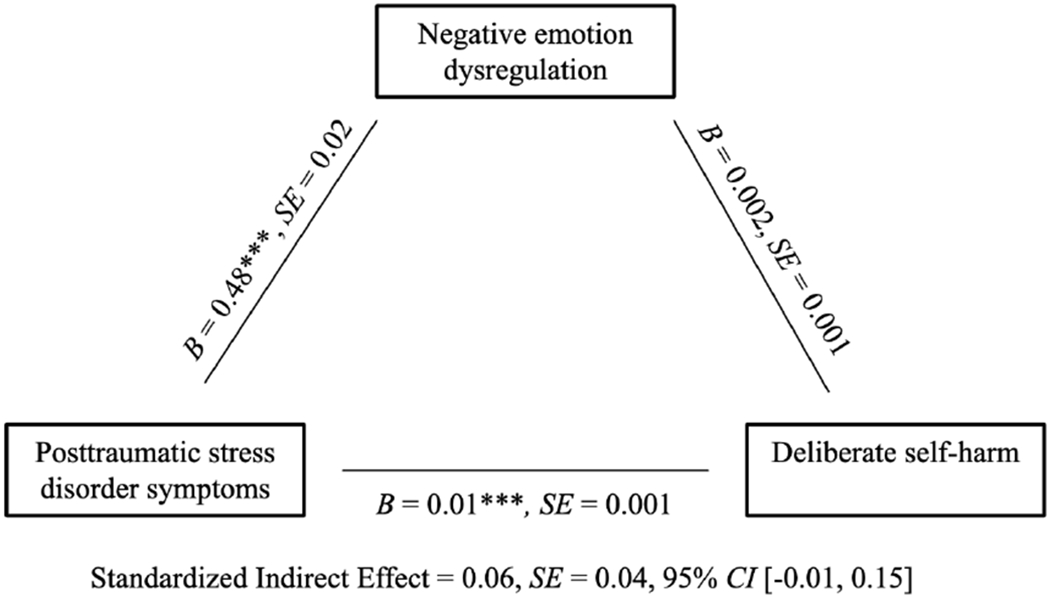
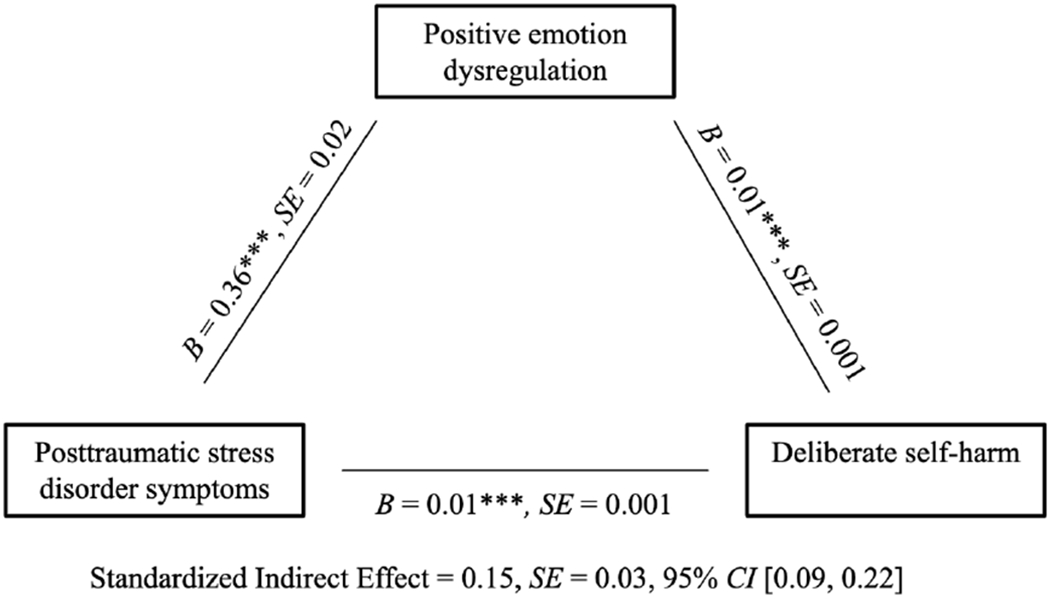
Findings indicated that PTSD severity was indirectly related to deliberate self-harm through overall positive (but not negative) emotion dysregulation. Secondary analyses indicated an underlying role of the negative emotion dysregulation domains of difficulties controlling impulsive behaviors when experiencing negative emotions and lack of emotional clarity and the positive emotion dysregulation domains of nonacceptance of positive emotions, difficulties engaging in goal-directed behavior when experiencing positive emotions, and difficulties controlling impulsive behaviors when experiencing positive emotions in the association between PTSD severity and deliberate self-harm.
This study offers preliminary evidence for specific domains of negative and positive emotion dysregulation as possible pathways linking PTSD severity and deliberate self-harm. Findings highlight new avenues for research and treatment focused on the effects of emotion dysregulation on deliberate self-harm among trauma-exposed military veterans. (PsycInfo Database Record (c) 2020 APA, all rights reserved).
患有创伤后应激障碍(PTSD)的退伍军人故意自残的比率较高,但很少有研究探讨其潜在机制。本研究针对文献中的这一关键空白,考察了负性和正性情绪失调在 PTSD 严重程度与故意自残之间的关系中的作用。
本研究共收集了来自社区中 465 名创伤后暴露的退伍军人( = 38.00,71.4%为男性,69.5%为白人)的数据,他们对在线调查做出了回应。
研究结果表明,PTSD 严重程度通过整体正性(而非负性)情绪失调与故意自残呈间接相关。进一步分析表明,在 PTSD 严重程度与故意自残之间的关联中,负性情绪失调的两个领域(经历负性情绪时难以控制冲动行为和缺乏情绪清晰性)和正性情绪失调的两个领域(不接受正性情绪、经历正性情绪时难以进行目标导向行为、经历正性情绪时难以控制冲动行为)起到了潜在作用。
本研究初步证明了负性和正性情绪失调的特定领域可能是 PTSD 严重程度与故意自残之间的联系途径。研究结果强调了针对创伤后暴露的退伍军人中情绪失调对故意自残的影响的新的研究和治疗途径。(PsycInfo 数据库记录(c)2020 APA,保留所有权利)。