University of Rhode Island, United States.
University of North Texas, United States.
J Anxiety Disord. 2020 Apr;71:102198. doi: 10.1016/j.janxdis.2020.102198. Epub 2020 Feb 25.
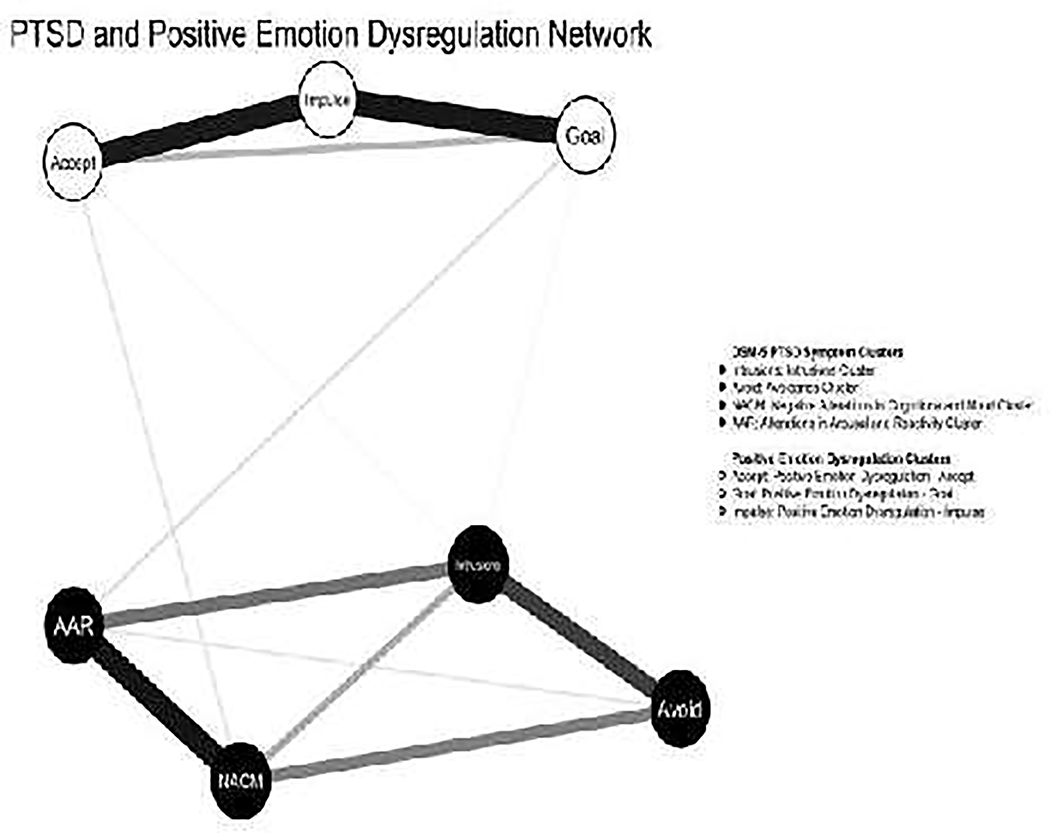
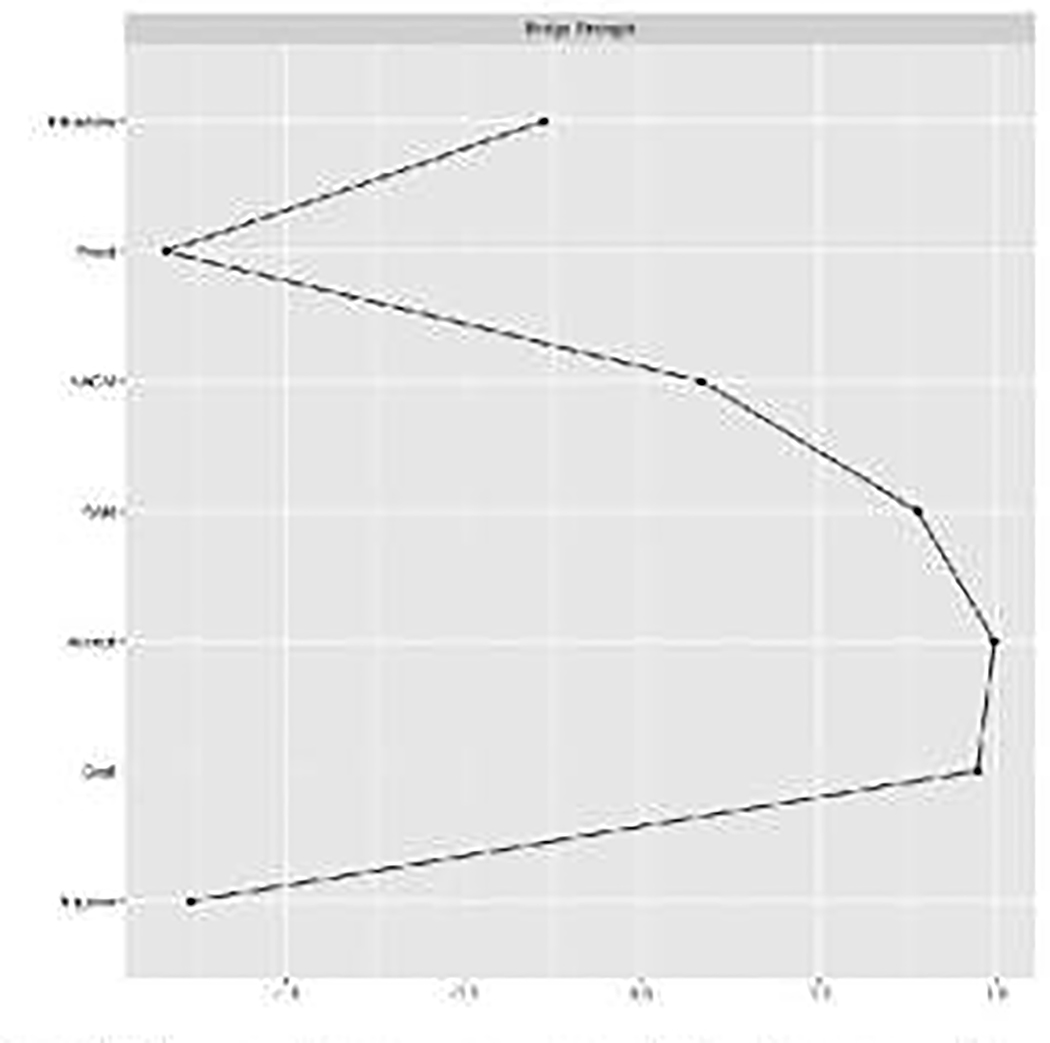
Posttraumatic stress disorder (PTSD) has empirically-established associations with positive emotion dysregulation. Extending existing research, we utilized a network approach to examine relations between PTSD symptom clusters (intrusions, avoidance, negative alterations in cognitions and mood [NACM], alterations in arousal and reactivity [AAR]) and positive emotion dysregulation dimensions (nonacceptance, impulse control, goal-directed behavior). We identified (1) differential relations of PTSD symptom clusters with positive emotion dysregulation, and (2) central symptoms accounting for the PTSD and positive emotion dysregulation inter-group interconnections. Participants were 371 trauma-exposed community individuals (M = 43.68; 70.9 % females; 34.5 % white). We estimated a regularized Gaussian Graphic Model comprising four nodes representing the PTSD symptom clusters and three nodes representing positive emotion dysregulation dimensions. Study results indicated the key role of AAR and intrusions clusters in the PTSD group and impulse control difficulties in the positive emotion dysregulation group. Regarding cross-group connectivity patterns, findings indicate the pivotal role of (1) AAR in its link with positive emotion dysregulation dimensions, and (2) nonacceptance of positive emotions and impairment in goal-directed behavior in the context of positive emotions in their link to PTSD symptom clusters. Thus, the current study indicates the potentially central role of particular PTSD symptom clusters and positive emotion dysregulation dimensions, informing assessment and treatment targets.
创伤后应激障碍(PTSD)与积极情绪失调有实证关联。本研究扩展了现有研究,采用网络方法检验了 PTSD 症状群(闯入、回避、认知和情绪的负性改变[NACM]、唤醒和反应性改变[AAR])与积极情绪失调维度(不接受、冲动控制、目标导向行为)之间的关系。我们发现:(1)PTSD 症状群与积极情绪失调的关系存在差异;(2)中心症状解释了 PTSD 和积极情绪失调组间的相互联系。参与者为 371 名经历过创伤的社区个体(M=43.68;70.9%为女性;34.5%为白人)。我们估计了一个包含四个节点的正则化高斯图形模型,分别代表 PTSD 症状群和三个节点代表积极情绪失调维度。研究结果表明,AAR 和闯入症状群在 PTSD 组中,冲动控制困难在积极情绪失调组中起关键作用。关于跨组连接模式,研究结果表明,(1)AAR 在与积极情绪失调维度的联系中起着关键作用,(2)在积极情绪的背景下,对积极情绪的不接受和目标导向行为的损害与 PTSD 症状群的联系中起着关键作用。因此,本研究表明,特定的 PTSD 症状群和积极情绪失调维度可能具有核心作用,为评估和治疗目标提供了信息。