Department of Psychiatry, Beth Israel Deaconess Medical Center, Harvard Medical School, Boston, Massachusetts, United States of America.
Department of Anesthesiology, University of Utah, Salt Lake City, Utah, United States of America.
PLoS One. 2020 Sep 3;15(9):e0238498. doi: 10.1371/journal.pone.0238498. eCollection 2020.
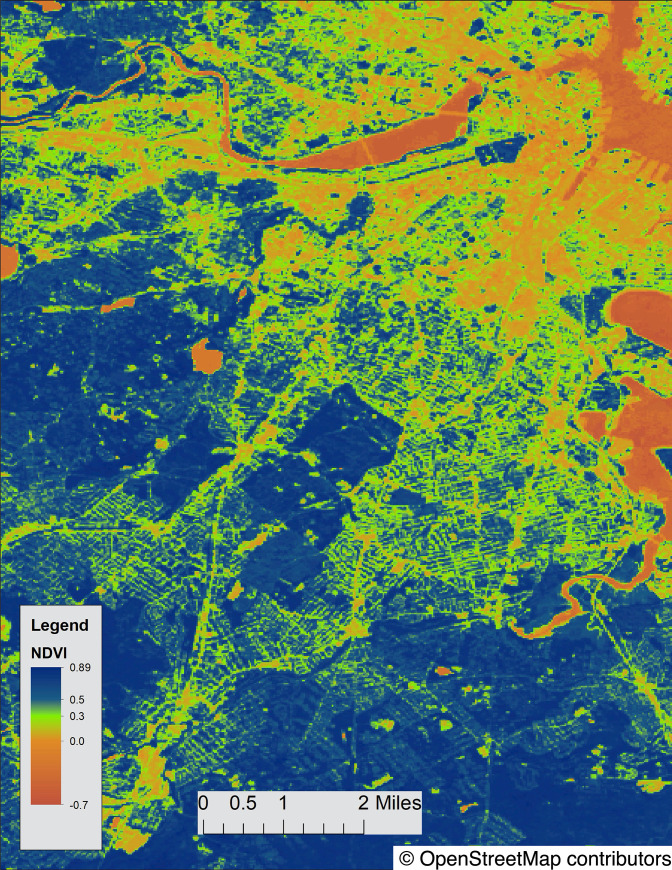
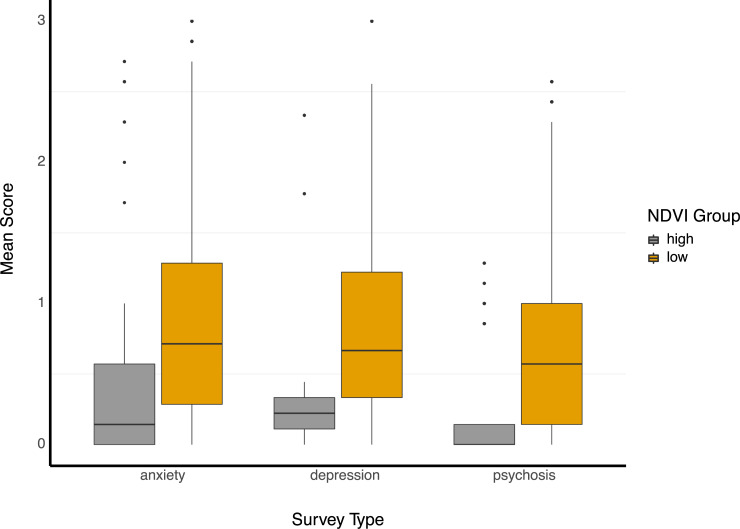
There are currently many tools available for capturing and defining the context of one's environment. Digital phenotyping, the use of technology and sensors to capture moment-to-moment behavior, has shown potential in quantifying the lived experience of mental illness and in the identification of individualized targets related to recovery. Environmental data suggests that greenspace may have a restorative capacity on mental health. In this paper, we explore the relationship of greenspace derived from geolocation with self-reported symptomatology from individuals with schizophrenia as well as healthy controls. Individuals with schizophrenia had less exposure to greenspace than controls, but their exposure demonstrated a dosage effect: high greenspace environments were associated with lower symptoms for anxiety (Cohen's d = -0.70), depression (d = -0.97), and psychosis (d = -0.94), whereas effect sizes for healthy controls were all negligible or small (d < 0.38). The notion that greenspace may have a more pronounced effect on individuals with mental illness presents both potential areas for recovery as well as implications for health care policy, especially in cities with a broad range of greenspace environments.
目前有许多工具可用于捕捉和定义环境背景。数字表型学是指使用技术和传感器来捕捉瞬间行为,它在量化精神疾病的实际体验以及确定与康复相关的个体化目标方面显示出了潜力。环境数据表明,绿色空间可能对心理健康具有恢复能力。在本文中,我们探讨了从地理位置获得的绿色空间与精神分裂症患者及健康对照者的自我报告症状之间的关系。与对照组相比,精神分裂症患者的绿色空间暴露量较少,但他们的暴露量呈现出剂量效应:高绿色空间环境与焦虑(Cohen's d = -0.70)、抑郁(d = -0.97)和精神病(d = -0.94)症状呈负相关,而健康对照组的所有效应大小均可以忽略不计或较小(d < 0.38)。绿色空间可能对精神疾病患者产生更显著影响的观点,既为康复提供了潜在领域,也对医疗保健政策提出了启示,特别是在绿色空间环境范围广泛的城市。