Department of Kinesiology and Health Sciences, Virginia Commonwealth University, Richmond, Virginia, United States of America.
Department of Kinesiology, University of Texas at San Antonio, San Antonio, Texas, United States of America.
PLoS One. 2020 Sep 3;15(9):e0238721. doi: 10.1371/journal.pone.0238721. eCollection 2020.
Adolescence is a vulnerable period for experiencing poor sleep health. Growing studies have demonstrated lifestyle behaviors including physical activity (PA), screen time (SCT), and sedentary behaviors (SED) as the potential factors associated with sleep health in adolescents; yet, the evidence is inconclusive and the directionality of temporal associations across school days are not well understood. This study examined the day-to-day bidirectional associations of lifestyle behaviors with sleep health parameters in adolescents.
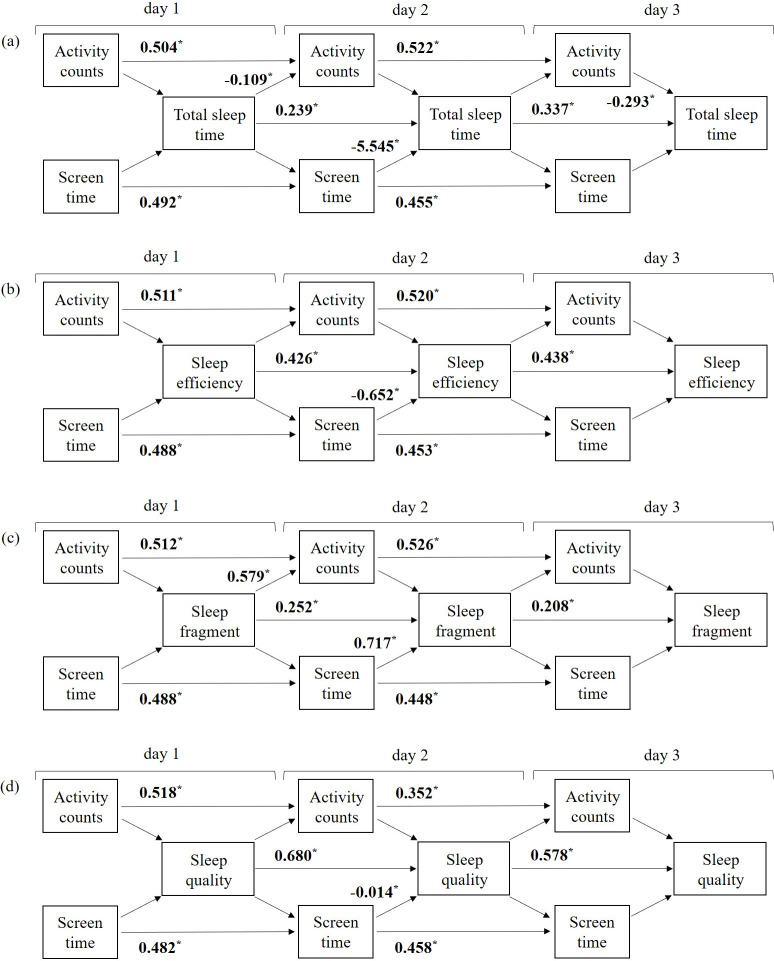
A total of 263 adolescents (58% boys) in 6th - 8th grades wore an accelerometer for 24-hour across the three consecutive school days and completed recording SCT in time-diary and answering sleep quality (SQ) questions for each day. Sleep-wake patterns as well as time spent in moderate- and vigorous-intensity PA (MVPA) and SED were objectively quantified from the wrist-worn accelerometry data across the two segments of the day (during and after school hours). Mixed model analyses were conducted to test bidirectional associations between lifestyle factors and sleep health parameters in each temporal direction across the days. Additionally, indirect associations across the days were tested using an autoregressive cross-lagged model analysis in the framework of path analysis.
MVPA minutes in a day did not predict sleep health parameters that night. The bidirectional associations were partially observed between SED and sleep health, but the significance and direction of the associations largely varied by the time segment of a day as well as types of sleep health parameters. Additionally, greater SCT during the day was associated with lower SQ that night (b = -0.010; P = .018), and greater SQ was associated with greater MVPA during school hours (b = 6.45; P = .028) and lower SED after school hours (b = -39.85; P = .029) the next day. Lastly, there were significant indirect associations of SCT with sleep health parameters across the days indicating multi-day lagged effects of SCT on sleep health the later nights.
This study highlights the importance of lowering SCT for better sleep health in adolescents during school days. Additionally, perceived SQ is shown to be a potential significant predictor promoting healthy behaviors the next day independent of sleep-wake patterns. Further studies are warranted to confirm the observed temporal associations between SCT, SQ, and behavioral outcomes in this vulnerable population.
青春期是经历睡眠健康不良的脆弱时期。越来越多的研究表明,包括身体活动(PA)、屏幕时间(SCT)和久坐行为(SED)在内的生活方式行为是与青少年睡眠健康相关的潜在因素;然而,证据并不明确,且在整个上学日期间,这些因素之间的时间关联方向尚不清楚。本研究旨在检验青少年生活方式行为与睡眠健康参数之间的日际双向关联。
共有 263 名(58%为男性)6 至 8 年级的青少年在三个连续的上学日佩戴了 24 小时的加速度计,并在每天记录 SCT 的时间日记和回答睡眠质量(SQ)问题。从腕戴加速度计数据中客观地量化了睡眠-觉醒模式以及在上学时间和放学后时间内进行的中高强度 PA(MVPA)和 SED 时间。使用混合模型分析在日际方向上测试生活方式因素与睡眠健康参数之间的双向关联。此外,在路径分析框架中,使用自回归交叉滞后模型分析测试了日间的间接关联。
一天中的 MVPA 分钟数当晚并不预测睡眠健康参数。SED 和睡眠健康之间存在部分双向关联,但关联的显著性和方向在很大程度上取决于一天的时间段以及睡眠健康参数的类型。此外,白天 SCT 增加与当晚 SQ 降低相关(b = -0.010;P =.018),而 SQ 增加与上学时间内的 MVPA 增加(b = 6.45;P =.028)和放学后的 SED 降低相关(b = -39.85;P =.029)次日。最后,SCT 与睡眠健康参数之间存在显著的间接关联,表明 SCT 对随后几天晚上睡眠健康的多日滞后影响。
本研究强调了在上学日期间降低 SCT 对青少年更好睡眠健康的重要性。此外,研究表明,感知到的 SQ 是促进第二天健康行为的潜在重要预测因素,独立于睡眠-觉醒模式。需要进一步的研究来证实这一弱势群体中 SCT、SQ 和行为结果之间观察到的时间关联。