Microbiology and Immunology Department, Faculty of Pharmacy, Mansoura University, Mansoura, Egypt.
PLoS One. 2020 Sep 3;15(9):e0238747. doi: 10.1371/journal.pone.0238747. eCollection 2020.
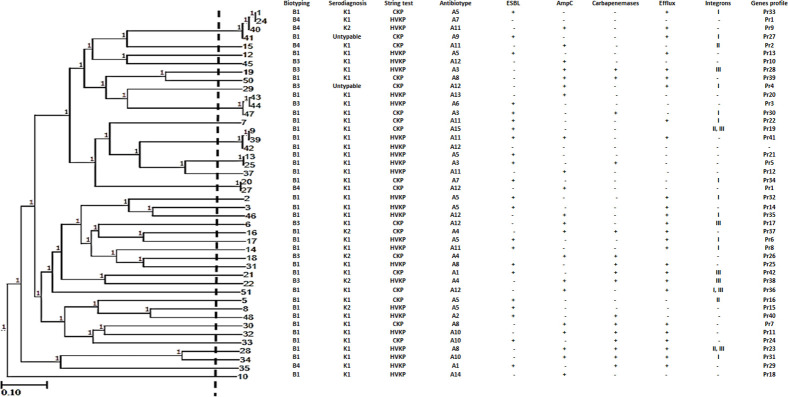
K. pneumoniae was known as a nosocomial infection that causes human diseases. It is considered as one of the food-borne pathogens as it causes septicemia and diarrhea in humans. This study aims to characterize K. pneumoniae strains isolated from ready to eat processed meat phenotypically and genetically. Three hundred and fifty ready to eat processed meat (Luncheon-meat) samples were collected. Forty-four (12.6%) K. pneumoniae strains were isolated and bio-typed, where the majority were identified to belong to biotype B1. K1 and K2 serotypes were detected and strains were classified as hypermucoviscous K. pneumoniae (HVKP) and classic K. pneumoniae (CKP) (26 and 18 isolates, respectively). The isolates were resistant to several classes of β-lactam antibiotics, ceftazidim and cefotaxime (95.5%), cefoxitin (93.2%), ertapenem (90.9%) and amoxicillin-clavulanic acid (86.4%). They were classified as extended spectrum β-lactamases (ESBLs), AmpC or carbapenemase-producers phenotypically. Eighteen β-lactamase genes were investigated by PCR. The most prominent genes were SHV (63.6%), TEM (52.2%), CTX-M15 (50%), AMPC (47.7%), CIT-M (45.5%) and VIM (43.2%). Co-detection of β-lactam resistance genes revealed 42 gene profiles. Twenty-four isolates had the complete efflux system (AcrAB-ToƖC). Besides, Integrons (I, II, III) were detected in 20 isolates. Molecular typing by ERIC-PCR showed high genetic diversity between isolates as 34 different patterns were identified. Overall, this study confirmed the hazards posed by the presence of multiple resistance genes in the same isolate and this should not be undervalued. Besides, the horizontal transfer of plasmid harboring resistance genes between isolates in food represents potential health risks for consumers in Egypt and so the control and inhibition plans are necessary.
肺炎克雷伯菌是一种引起人类疾病的医院感染病原体。它被认为是食源性病原体之一,因为它会导致人类败血症和腹泻。本研究旨在从即食加工肉中分离出的肺炎克雷伯菌菌株进行表型和遗传特征分析。共收集了 350 份即食加工肉(午餐肉)样品。分离出 44 株(12.6%)肺炎克雷伯菌并进行生物分型,其中大部分被鉴定为生物型 B1。检测到 K1 和 K2 血清型,菌株被分类为高黏液型肺炎克雷伯菌(HVKP)和经典肺炎克雷伯菌(CKP)(分别为 26 株和 18 株)。这些分离株对几类β-内酰胺类抗生素、头孢他啶和头孢噻肟(95.5%)、头孢西丁(93.2%)、厄他培南(90.9%)和阿莫西林-克拉维酸(86.4%)具有耐药性。它们被归类为表型产超广谱β-内酰胺酶(ESBLs)、AmpC 或碳青霉烯酶的菌株。通过 PCR 检测了 18 种β-内酰胺酶基因。最常见的基因是 SHV(63.6%)、TEM(52.2%)、CTX-M15(50%)、AMPC(47.7%)、CIT-M(45.5%)和 VIM(43.2%)。β-内酰胺类耐药基因的共检测显示有 42 种基因谱。24 株分离株具有完整的外排系统(AcrAB-ToƖC)。此外,20 株分离株中检测到整合子(I、II、III)。ERIC-PCR 分子分型显示分离株之间存在较高的遗传多样性,共鉴定出 34 种不同的模式。总之,本研究证实了同一分离株中存在多种耐药基因所带来的危害,这一点不容忽视。此外,食源性病原体中携带耐药基因的质粒在分离株之间的水平转移对埃及消费者的健康构成潜在风险,因此需要制定控制和抑制计划。