Shao Lijian, Elujoba-Bridenstine Adedamola, Zink Katherine E, Sanchez Laura M, Cox Brian J, Pollok Karen E, Sinn Anthony L, Bailey Barbara J, Sims Emily C, Cooper Scott H, Broxmeyer Hal E, Pajcini Kostandin V, Tamplin Owen J
Department of Pharmacology, University of Illinois at Chicago, Chicago, IL.
Department of Occupational Health and Toxicology, School of Public Health, Nanchang University, Nanchang, People's Republic of China.
Blood. 2021 Feb 11;137(6):775-787. doi: 10.1182/blood.2019004415.
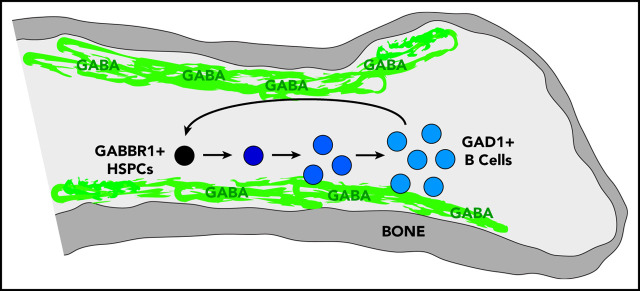
Hematopoietic and nervous systems are linked via innervation of bone marrow (BM) niche cells. Hematopoietic stem/progenitor cells (HSPCs) express neurotransmitter receptors, such as the γ-aminobutyric acid (GABA) type B receptor subunit 1 (GABBR1), suggesting that HSPCs could be directly regulated by neurotransmitters like GABA that directly bind to GABBR1. We performed imaging mass spectrometry and found that the endogenous GABA molecule is regionally localized and concentrated near the endosteum of the BM niche. To better understand the role of GABBR1 in regulating HSPCs, we generated a constitutive Gabbr1-knockout mouse model. Analysis revealed that HSPC numbers were significantly reduced in the BM compared with wild-type littermates. Moreover, Gabbr1-null hematopoietic stem cells had diminished capacity to reconstitute irradiated recipients in a competitive transplantation model. Gabbr1-null HSPCs were less proliferative under steady-state conditions and upon stress. Colony-forming unit assays demonstrated that almost all Gabbr1-null HSPCs were in a slow or noncycling state. In vitro differentiation of Gabbr1-null HSPCs in cocultures produced fewer overall cell numbers with significant defects in differentiation and expansion of the B-cell lineage. To determine whether a GABBR1 agonist could stimulate human umbilical cord blood (UCB) HSPCs, we performed brief ex vivo treatment prior to transplant into immunodeficient mice, with significant increases in long-term engraftment of HSPCs compared with GABBR1 antagonist or vehicle treatments. Our results indicate a direct role for GABBR1 in HSPC proliferation, and identify a potential target to improve HSPC engraftment in clinical transplantation.
造血系统和神经系统通过骨髓(BM)龛细胞的神经支配相联系。造血干/祖细胞(HSPCs)表达神经递质受体,如γ-氨基丁酸(GABA)B型受体亚基1(GABBR1),这表明HSPCs可能受到像GABA这样直接与GABBR1结合的神经递质的直接调节。我们进行了成像质谱分析,发现内源性GABA分子在BM龛的骨内膜附近区域定位并聚集。为了更好地理解GABBR1在调节HSPCs中的作用,我们构建了一个组成型Gabbr1基因敲除小鼠模型。分析显示,与野生型同窝小鼠相比,BM中的HSPC数量显著减少。此外,在竞争性移植模型中,Gabbr1基因缺失的造血干细胞重建受辐照受体的能力减弱。在稳态条件下和应激状态下,Gabbr1基因缺失的HSPCs增殖能力较低。集落形成单位分析表明,几乎所有Gabbr1基因缺失的HSPCs都处于缓慢或非循环状态。在共培养中,Gabbr1基因缺失的HSPCs的体外分化产生的细胞总数较少,B细胞谱系的分化和扩增存在明显缺陷。为了确定GABBR1激动剂是否能刺激人脐带血(UCB)HSPCs,我们在移植到免疫缺陷小鼠之前进行了短暂的体外处理,与GABBR1拮抗剂或赋形剂处理相比,HSPCs的长期植入显著增加。我们的结果表明GABBR1在HSPC增殖中起直接作用,并确定了一个在临床移植中改善HSPC植入的潜在靶点。