Arrieta Marina P, Leonés Gil Adrián, Yusef Maysa, Kenny José M, Peponi Laura
Instituto de Ciencia y Tecnología de Polímeros (ICTP-CSIC), C/Juan de la Cierva 3, 28006 Madrid, Spain.
Facultad de Óptica y Optometría, Universidad Complutense de Madrid (UCM), Arcos de Jalón 118, 28037 Madrid, Spain.
Materials (Basel). 2020 Sep 1;13(17):3853. doi: 10.3390/ma13173853.
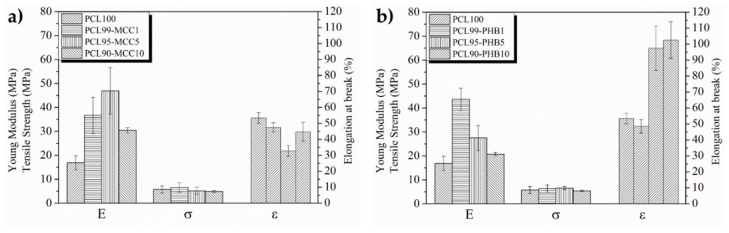
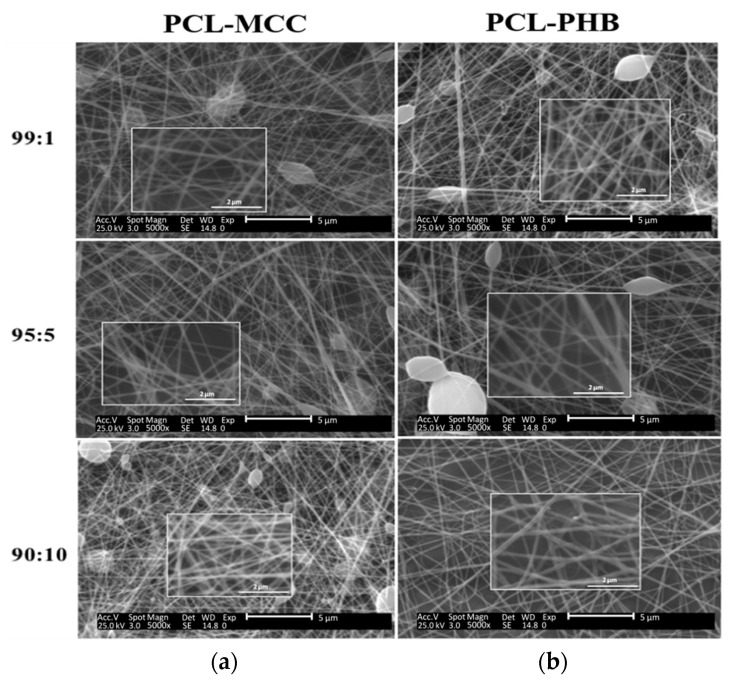
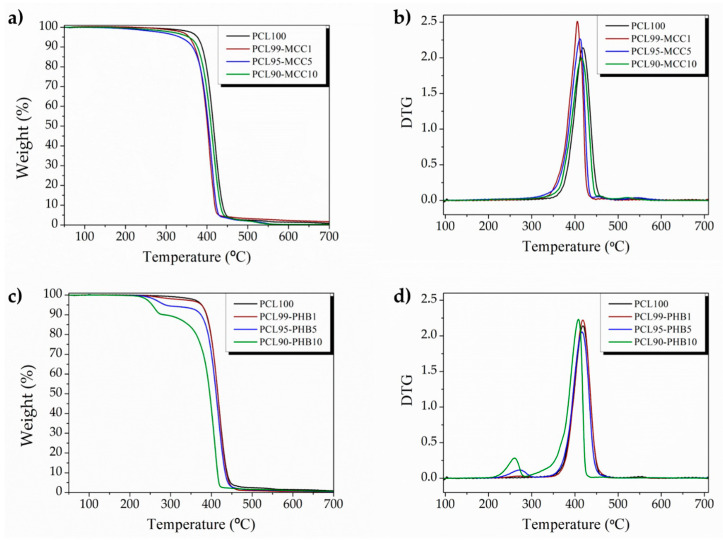
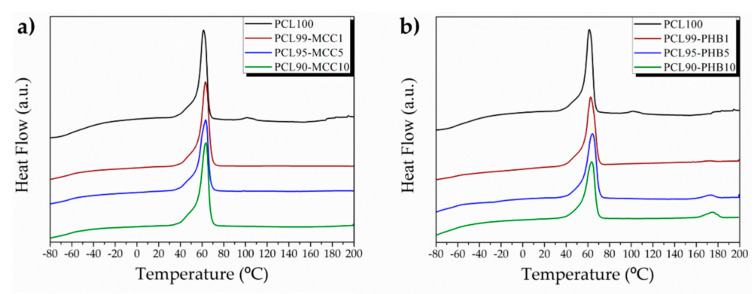
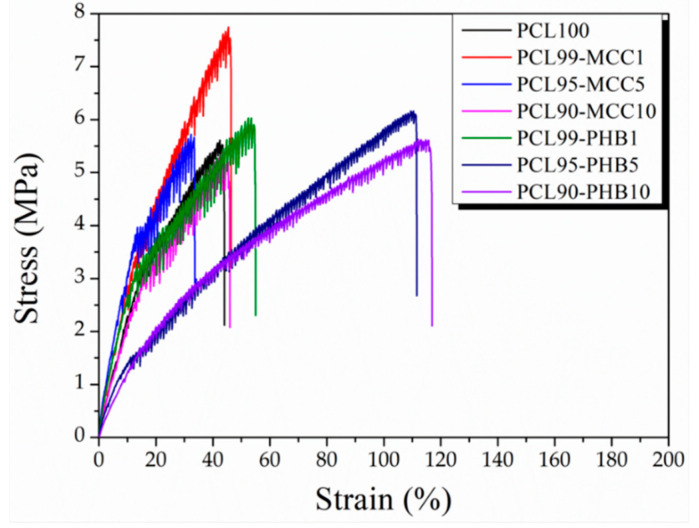
In this work poly(ε-caprolactone) (PCL) based electrospun mats were prepared by blending PCL with microcrystalline cellulose (MCC) and poly(3-hydroxybutyrate) (PHB). The electrospinning processing parameters were firstly optimized with the aim to obtain scalable PCL-based electrospun mats to be used in the industrial sector. Neat PCL as well as PCL-MCC and PCL-PHB based mats in different proportions (99:1; 95:5; 90:10) were prepared. A complete morphological, thermal and mechanical characterization of the developed materials was carried out. Scanning electron microscopy (SEM) observations showed that the addition of PHB to the PCL matrix considerably reduced the formation of beads. Both the addition of MCC and PHB reduced the thermal stability of PCL, but obtained materials with enough thermal stability for the intended use. The electrospun PCL fibers show greatly reduced flexibility with respect to the PCL bulk material, however when PCL is blended with PHB their stretchability is increased, changing their elongation at break from 35% to 70% when 10 wt% of PHB is blended with PCL. However, the mechanical response of the different blends increases with respect to the neat electrospun PCL, offering the possibility to modulate their properties according to the required industrial applications.
在本研究中,通过将聚(ε-己内酯)(PCL)与微晶纤维素(MCC)和聚(3-羟基丁酸酯)(PHB)共混制备了基于PCL的电纺垫。首先对静电纺丝工艺参数进行了优化,目的是获得可用于工业领域的可扩展的基于PCL的电纺垫。制备了不同比例(99:1;95:5;90:10)的纯PCL以及基于PCL-MCC和PCL-PHB的垫子。对所制备材料进行了完整的形态、热学和力学表征。扫描电子显微镜(SEM)观察表明,向PCL基体中添加PHB可显著减少珠粒的形成。添加MCC和PHB均降低了PCL的热稳定性,但所制备的材料具有足够的热稳定性以满足预期用途。与PCL块状材料相比,电纺PCL纤维的柔韧性大大降低,然而,当PCL与PHB共混时,其拉伸性增加,当10 wt%的PHB与PCL共混时,其断裂伸长率从35%变为70%。然而,不同共混物的力学响应相对于纯电纺PCL有所增加,这为根据所需的工业应用调节其性能提供了可能性。