NYU Grossman School of Medicine, New York, USA.
Wright State University, Boonshoft School of Medicine, Dayton, OH, USA.
Trials. 2020 Sep 3;21(1):761. doi: 10.1186/s13063-020-04684-6.
As the USA grapples with an opioid epidemic, medical emergency departments (EDs) have become a critical setting for intervening with opioid-dependent patients. Brief interventions designed to bridge the gap from acute ED care to longer-term treatment have shown limited efficacy for this population. Strength-based case management (SBCM) has shown strong effects on treatment linkage among patients with substance use disorders in other healthcare settings. This study aimed to investigate whether SBCM is an effective model for linking opioid-dependent ED patients with addiction treatment and pharmacotherapy. Here, we describe the implementation and challenges of adapting SBCM for the ED (SBCM-ED). Study rationale, design, and baseline characteristics are also described.
This study compared the effects of SBCM-ED to screening, assessment, and referral alone (SAR) on treatment linkage, substance use, and functioning. We recruited participants from a public hospital in NYC. Working alliance between case managers and participants and the feasibility of SBCM implementation were evaluated. Baseline data from the randomized sample were analyzed for group equivalency. Outcomes analyses are forthcoming.
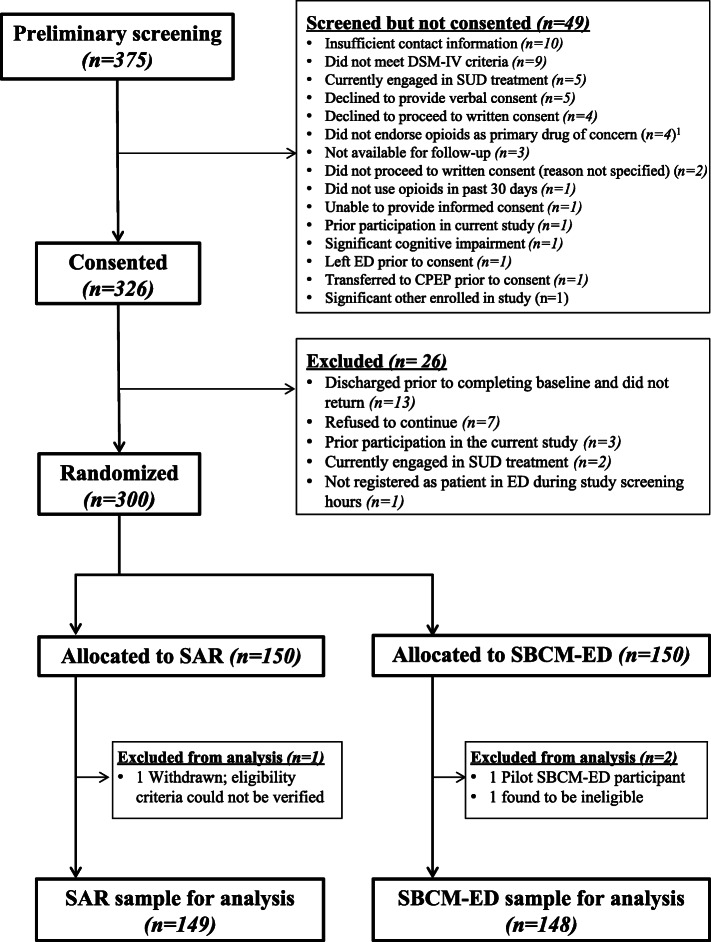
Three hundred adult participants meeting DSM-IV criteria for opioid dependence were randomly assigned to either SBCM, in which they received a maximum of six case management sessions within 90 days of enrollment, or SAR, in which they received a comprehensive referral list and pamphlet outlining drug use consequences. No significant differences were found between groups at baseline on demographic or substance use characteristics. All SAR participants and 92.6% of SBCM-ED participants initiated their assigned intervention. Over half of SBCM-ED first sessions occurred in the ED on the day of enrollment. Case managers developed a strong working alliance with SBCM-ED participants after just one session.
Interventions that exceed SBIRT were accepted by an opioid-dependent patient population seen in an urban medical ED. At the time of study funding, this trial was one of the first to focus specifically on this population in this challenging setting. The successful implementation of SBCM demonstrates its adaptability to the ED and may serve as a potential model for EDs seeking to adopt an intervention that overcomes the barrier between the ED encounter and more intensive treatment.
ClinicalTrials.gov NCT02586896 . Registered on 27 October 2015.
随着美国应对阿片类药物泛滥问题,医疗急救部门(ED)已成为干预阿片类药物依赖患者的重要场所。旨在弥补从急性 ED 护理到长期治疗之间差距的简短干预措施,对该人群的疗效有限。在其他医疗保健环境中,基于优势的病例管理(SBCM)已显示出对药物滥用障碍患者治疗联系的强大影响。本研究旨在探讨 SBCM 是否是将阿片类药物依赖的 ED 患者与成瘾治疗和药物治疗联系起来的有效模式。在这里,我们描述了 SBCM 用于 ED(SBCM-ED)的实施和挑战。还描述了研究的理由、设计和基线特征。
本研究比较了 SBCM-ED 与筛查、评估和转介(SAR)对治疗联系、物质使用和功能的影响。我们从纽约市的一家公立医院招募参与者。评估病例经理与参与者之间的工作联盟以及 SBCM 实施的可行性。对随机样本的基线数据进行分析以评估组间的等效性。即将进行结果分析。
300 名符合 DSM-IV 标准的阿片类药物依赖成年参与者被随机分配到 SBCM 组或 SAR 组,前者在入组后 90 天内最多接受 6 次病例管理,后者接受全面的转介名单和药物使用后果小册子。在基线时,两组在人口统计学或物质使用特征方面无显著差异。SAR 组的所有参与者和 92.6%的 SBCM-ED 参与者均开始接受其指定的干预措施。超过一半的 SBCM-ED 首次治疗是在入组当天在 ED 进行的。在仅仅一个疗程后,病例经理与 SBCM-ED 参与者建立了强大的工作联盟。
在城市医疗 ED 中接受了超出 SBIRT 的干预措施的阿片类药物依赖患者群体。在研究资金到位时,这项试验是首批专门针对这一人群在这一具有挑战性的环境中进行的试验之一。SBCM 的成功实施证明了它对 ED 的适应性,并且可以作为 ED 采用克服 ED 遇到的障碍与更强化治疗之间障碍的潜在模式。
ClinicalTrials.gov NCT02586896。注册于 2015 年 10 月 27 日。