Lenferink Lonneke, de Keijser Jos, Eisma Maarten, Smid Geert, Boelen Paul
Clinical Psychology and Experimental Psychopathology, University of Groningen, Groningen, The Netherlands
Clinical Psychology, Utrecht University, Utrecht, The Netherlands.
BMJ Open. 2020 Sep 3;10(9):e035050. doi: 10.1136/bmjopen-2019-035050.
The traumatic death of a loved one, such as death due to a traffic accident, can precipitate persistent complex bereavement disorder (PCBD) and comorbid post-traumatic stress disorder (PTSD) and depression. Waitlist-controlled trials have shown that grief-specific cognitive-behavioural therapy (CBT) is an effective treatment for such mental health problems. This is the first study that will examine the effectiveness of online CBT (vs waitlist controls) in a sample exclusively comprised of people bereaved by a traumatic death. Our primary hypothesis is that people allocated to the online CBT condition will show larger reductions in PCBD, PTSD and depression symptom levels at post-treatment than people allocated to a waitlist. We further expect that reductions in symptom levels during treatment are associated with reductions of negative cognitions and avoidance behaviours and the experience of fewer accident-related stressors. Moreover, the effect of the quality of the therapeutic alliance on treatment effects and drop-out rates will be explored.
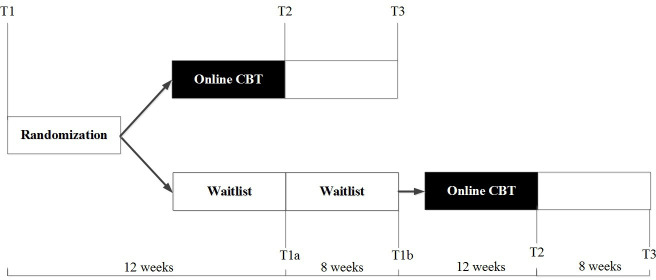
A two-arm (online CBT vs waiting list) open-label parallel randomised controlled trial will be conducted. Participants will complete questionnaires at pretreatment and 12 and 20 weeks after study enrolment. Eligible for participation are Dutch adults who lost a loved one at least 1 year earlier due to a traffic accident and report clinically relevant levels of PCBD, PTSD and/or depression. Multilevel modelling will be used.
Ethics approval has been received by the Medical Ethics Review Board of the University Medical Center Groningen (METc UMCG: M20.252121). This study will provide new insights in the effectiveness of online CBT for traumatically bereaved people. If the treatment is demonstrated to be effective, it will be made publicly accessible. Findings will be disseminated among lay people (eg, through newsletters and media performances), our collaborators (eg, through presentations at support organisations), and clinicians and researchers (eg, through conference presentations and scientific journal articles).
NL7497.
亲人的创伤性死亡,如因交通事故导致的死亡,可能会引发持续性复杂丧亲障碍(PCBD)以及共病的创伤后应激障碍(PTSD)和抑郁症。等待名单对照试验表明,针对悲伤的认知行为疗法(CBT)是治疗此类心理健康问题的有效方法。这是第一项专门针对因创伤性死亡而丧亲的人群样本,研究在线CBT(与等待名单对照)有效性的研究。我们的主要假设是,分配到在线CBT组的人在治疗后,其PCBD、PTSD和抑郁症状水平的降低幅度将大于分配到等待名单组的人。我们进一步预期,治疗期间症状水平的降低与负面认知和回避行为的减少以及与事故相关的应激源经历减少有关。此外,还将探讨治疗联盟质量对治疗效果和脱落率的影响。
将进行一项双臂(在线CBT与等待名单)开放标签平行随机对照试验。参与者将在治疗前以及入组研究后的12周和20周完成问卷调查。符合参与条件的是荷兰成年人,他们在至少1年前因交通事故失去了亲人,且报告有临床相关水平的PCBD、PTSD和/或抑郁症。将使用多水平模型。
格罗宁根大学医学中心医学伦理审查委员会(METc UMCG:M20.252121)已批准该研究的伦理申请。本研究将为在线CBT对创伤性丧亲者的有效性提供新的见解。如果该治疗方法被证明有效,将向公众开放。研究结果将在普通人群中传播(例如,通过时事通讯和媒体报道)、与我们的合作者分享(例如,通过在支持组织的演讲)以及向临床医生和研究人员传播(例如,通过会议演讲和科学期刊文章)。
NL7497。