Lenferink Lonneke I M, de Keijser Jos, Wessel Ineke, Boelen Paul A
1Department of Clinical Psychology and Experimental Psychopathology, Faculty of Behavioural and Social Sciences, University of Groningen, Grote Kruisstraat 2/1, 9712 TS Groningen, the Netherlands.
2Department of Clinical Psychology, Faculty of Social Sciences, Utrecht University, P.O. Box 80140, 3508 TC Utrecht, the Netherlands.
Pilot Feasibility Stud. 2019 Jul 20;5:93. doi: 10.1186/s40814-019-0472-z. eCollection 2019.
Relatives of long-term missing persons need to deal with uncertainties related to the disappearance. These uncertainties may give rise to ruminative thinking about the causes and consequences of the loss. Focusing on tolerating uncertainties in treatment of relatives of missing persons might foster recovery. Adding mindfulness to cognitive behavioural therapy might serve this aim. The feasibility and potential effectiveness of cognitive behavioural therapy with mindfulness were evaluated in a pilot study. We aimed to detect changes in symptom levels and mindfulness from pre-treatment to 1 week, 12 weeks, and 24 weeks post-treatment.
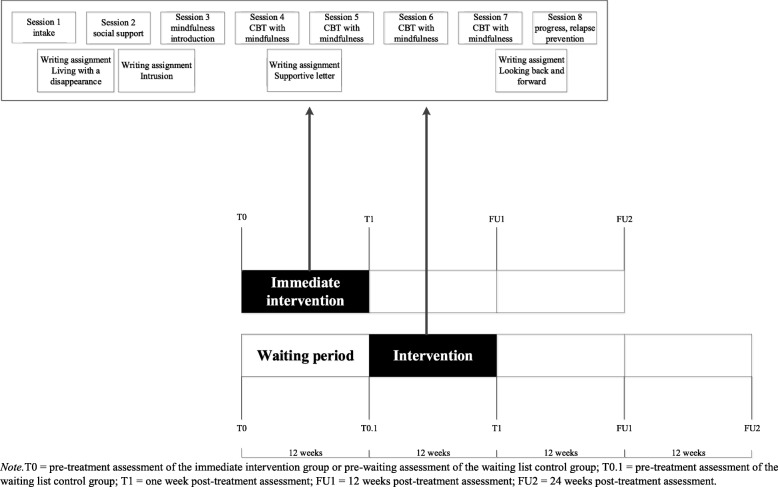
Dutch adults who experienced the disappearance of a significant other more than 3 months earlier and scored above clinical thresholds for psychological distress were eligible to participate. Participants were recruited from January 2015 to July 2016. Participants in the immediate treatment group started treatment after 1 week after randomization, whereas waiting list controls started the treatment after 12 weeks of waiting. Data from self-report measures as well as clinical diagnostic interviews (tapping persistent complex bereavement disorder, major depressive disorder, and posttraumatic stress disorder) were gathered among 17 relatives of missing persons with elevated symptom levels.
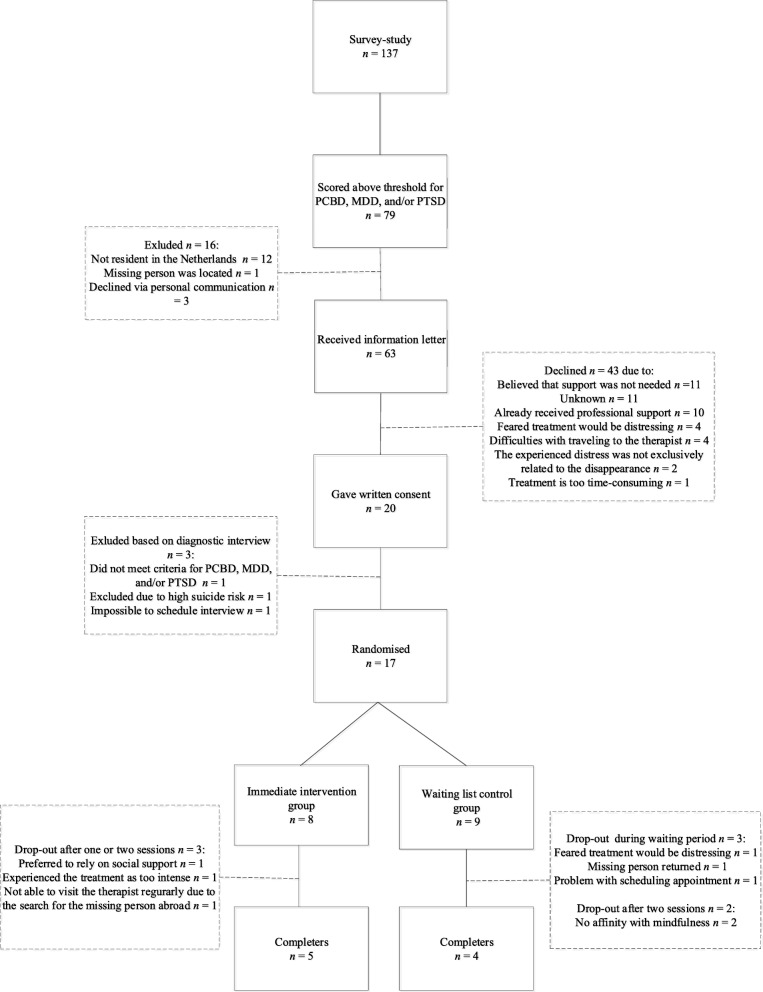
The response rate (31.7%) was low, and dropout rate (47.1%) high. Cognitive behavioural therapy with mindfulness coincided with changes in psychopathology levels (Hedges' 0.35-1.09) and mindfulness (Hedges' - 0.10-0.41). Participants completing the treatment were satisfied with treatment quality and reported high treatment compliance.
Because of the limited research about effective treatments for relatives of missing persons and promising results of small and/or uncontrolled trials examining the effect of mindfulness-based treatment to target grief-related complaints, it seems valuable to continue investigating the effects of cognitive behavioural therapy with mindfulness on reducing post-loss psychopathology in future research. However, in order to increase the feasibility of future trials among relatives of missing persons, we recommend collaborating internationally and/or extending duration of recruitment phase, to maximize the sample size.
The Netherlands National Trial Register, NTR4732.
长期失踪人员的亲属需要应对与失踪相关的不确定性。这些不确定性可能引发对失踪原因和后果的反复思考。在失踪人员亲属的治疗中注重容忍不确定性可能有助于康复。在认知行为疗法中加入正念可能有助于实现这一目标。在一项试点研究中评估了正念认知行为疗法的可行性和潜在有效性。我们旨在检测从治疗前到治疗后1周、12周和24周症状水平和正念的变化。
荷兰成年人在3个多月前经历了重要他人的失踪,且心理困扰得分高于临床阈值,符合参与条件。参与者于2015年1月至2016年7月招募。立即治疗组的参与者在随机分组后1周开始治疗,而等待名单对照组在等待12周后开始治疗。收集了17名症状水平较高的失踪人员亲属的自我报告测量数据以及临床诊断访谈数据(涉及持续性复杂丧亲障碍、重度抑郁症和创伤后应激障碍)。
应答率(31.7%)较低,脱落率(47.1%)较高。正念认知行为疗法与精神病理学水平变化(赫奇斯效应量0.35 - 1.09)和正念变化(赫奇斯效应量 -0.10 - 0.41)同时出现。完成治疗的参与者对治疗质量满意,并报告治疗依从性高。
由于对失踪人员亲属有效治疗的研究有限,且小型和/或非对照试验对基于正念的治疗针对悲伤相关症状的效果有 promising 结果,在未来研究中继续调查正念认知行为疗法对减少丧亲后精神病理学的影响似乎很有价值。然而,为了提高未来在失踪人员亲属中进行试验的可行性,我们建议进行国际合作和/或延长招募阶段的持续时间,以最大化样本量。
荷兰国家试验注册库,NTR4732 。