Department of Epidemiology and Biostatistics, Imperial College London, Norfolk Place, St Mary's Campus, London, W2 1PG, UK.
MRC Centre for Transplantation, King's College London, Great Maze Pond, London, SE1 9RT, UK.
Sci Rep. 2020 Sep 3;10(1):14541. doi: 10.1038/s41598-020-71302-5.
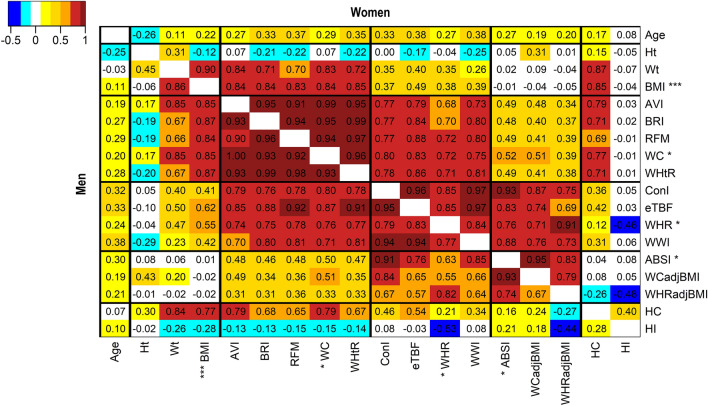
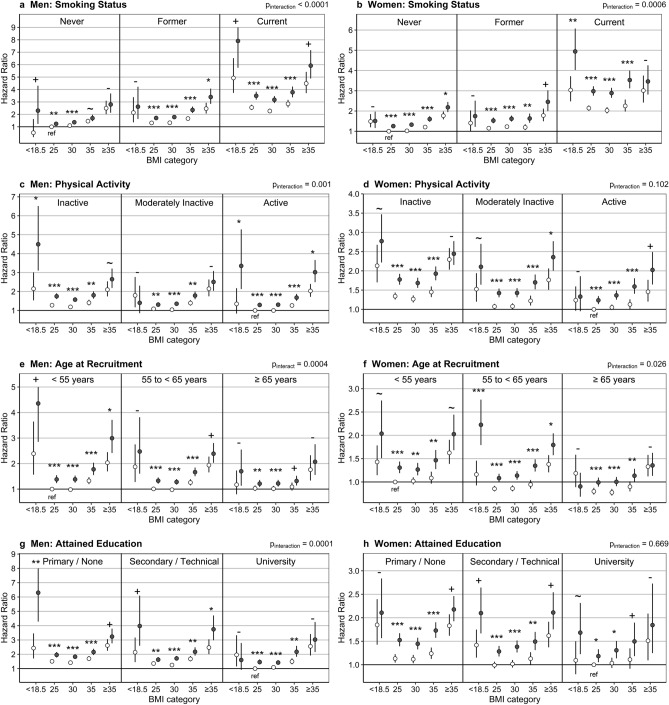
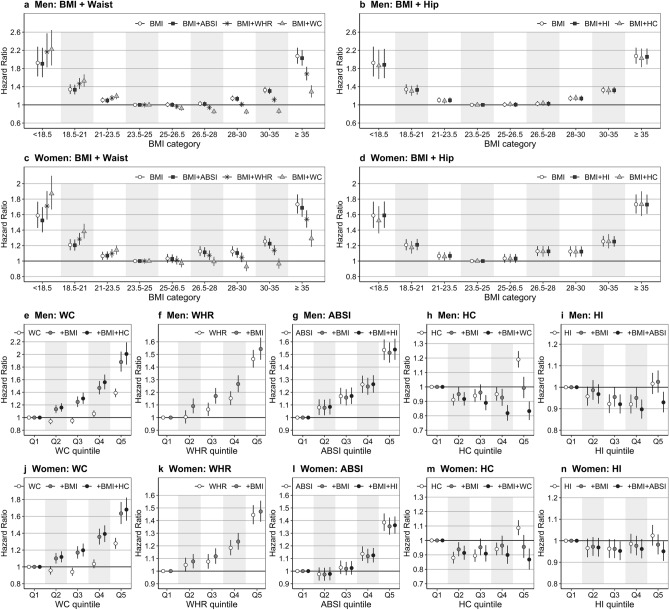
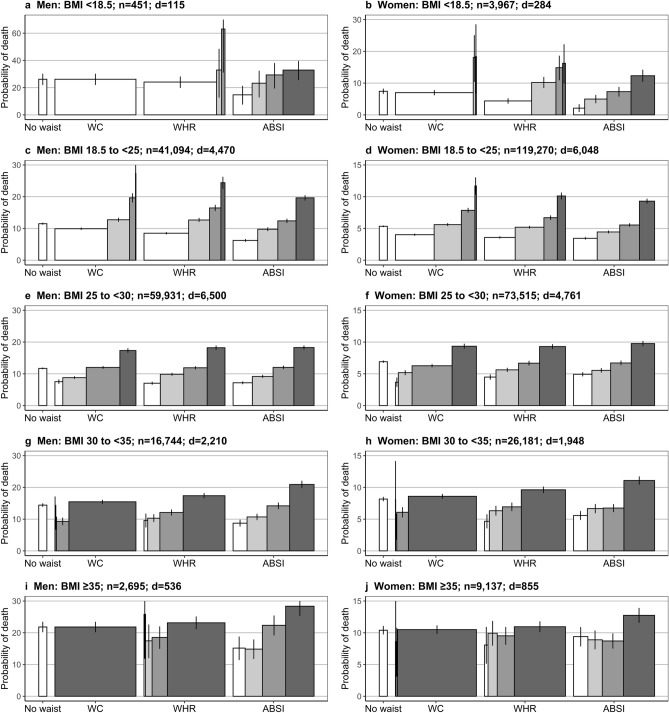
Abdominal and general adiposity are independently associated with mortality, but there is no consensus on how best to assess abdominal adiposity. We compared the ability of alternative waist indices to complement body mass index (BMI) when assessing all-cause mortality. We used data from 352,985 participants in the European Prospective Investigation into Cancer and Nutrition (EPIC) and Cox proportional hazards models adjusted for other risk factors. During a mean follow-up of 16.1 years, 38,178 participants died. Combining in one model BMI and a strongly correlated waist index altered the association patterns with mortality, to a predominantly negative association for BMI and a stronger positive association for the waist index, while combining BMI with the uncorrelated A Body Shape Index (ABSI) preserved the association patterns. Sex-specific cohort-wide quartiles of waist indices correlated with BMI could not separate high-risk from low-risk individuals within underweight (BMI < 18.5 kg/m) or obese (BMI ≥ 30 kg/m) categories, while the highest quartile of ABSI separated 18-39% of the individuals within each BMI category, which had 22-55% higher risk of death. In conclusion, only a waist index independent of BMI by design, such as ABSI, complements BMI and enables efficient risk stratification, which could facilitate personalisation of screening, treatment and monitoring.
腹部和全身肥胖与死亡率独立相关,但对于如何最好地评估腹部肥胖仍存在争议。我们比较了替代腰围指数在评估全因死亡率方面对 BMI 的补充能力。我们使用了欧洲癌症前瞻性调查和营养(EPIC)中 352985 名参与者的数据,并使用 Cox 比例风险模型对其他风险因素进行了调整。在平均 16.1 年的随访期间,有 38178 名参与者死亡。在一个模型中同时结合 BMI 和高度相关的腰围指数改变了与死亡率的关联模式,BMI 与死亡率呈负相关,腰围指数与死亡率呈正相关,而将 BMI 与不相关的 A 体型指数(ABSI)结合则保留了关联模式。按性别划分的腰围指数队列全人群四分位数与 BMI 相关,但无法在体重过轻(BMI<18.5kg/m)或肥胖(BMI≥30kg/m)人群中区分高风险和低风险个体,而 ABSI 的最高四分位数则在每个 BMI 类别中区分了 18-39%的个体,这些个体的死亡风险高 22-55%。总之,只有设计上与 BMI 独立的腰围指数(如 ABSI)才能补充 BMI,并实现有效的风险分层,这有助于个性化筛查、治疗和监测。