Helmholtz Zentrum München, German Research Center for Environmental Health, Institute of Epidemiology, Neuherberg, Germany.
Institute for Medical Informatics, Biometry and Epidemiology; LMU Munich, Munich, Germany.
BMC Public Health. 2018 Apr 2;18(1):427. doi: 10.1186/s12889-018-5350-8.
A number of prior studies have examined the association between anthropometric measures and mortality, but studies investigating the sex-specific predictive value of novel anthropometric measures on mortality are scarce so far. Therefore, we investigated the sex-specific relevance of the new anthropometric measures body adiposity index (BAI) and waist to height ratio (WHtR) as well as the common measures body mass index (BMI), waist circumference (WC), and waist to hip ratio (WHR) for cause-specific mortality risk.
The analysis was based on data from the German population based KORA (Cooperative Health Research in the Region of Augsburg) Augsburg cohort study. A total of 6670 men and 6637 women aged 25 to 74 years at baseline examination were included. During a mean follow-up period of 15.4 years, 2409 persons died. Via Cox proportional hazard regression, the associations between the different anthropometric measures and all cause-, cardiovascular disease (CVD)- and cancer mortality were assessed.
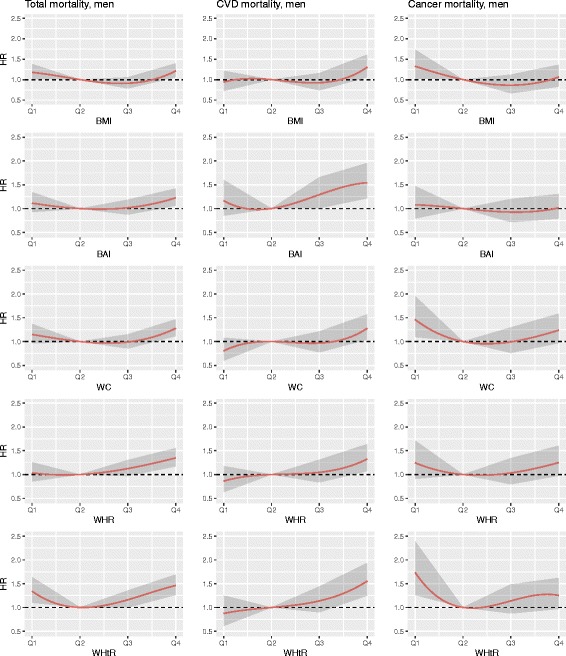
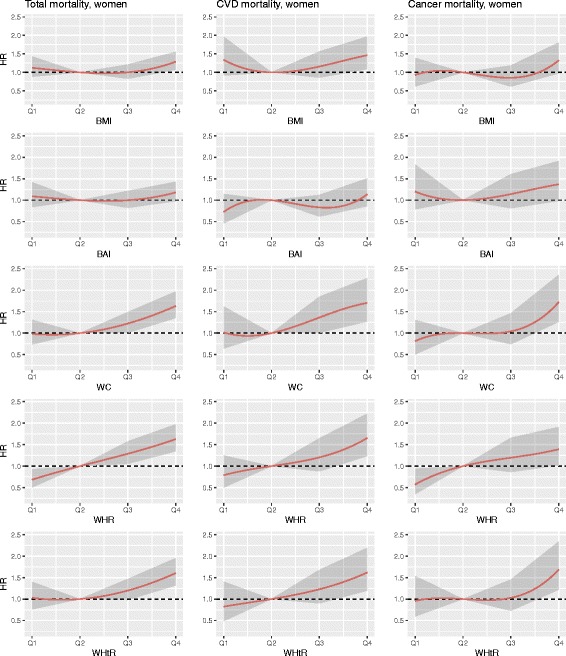
BMI, WC, and WHR were significantly associated with all-cause and CVD-mortality in both sexes. WC and WHR were particularly associated with higher all-cause and CVD-mortality risk in women, while in men especially WHtR and BAI were strongly related to these outcomes. Females with WC, WHtR, and WHR measures in the 4th quartile compared with women in the 2nd quartile had a higher risk of death from cancer. Contrary, men in the lowest quartile of WC and WHtR in comparison to men in the 2nd quartile had a significantly elevated cancer mortality risk. BAI was no risk predictor for all-cause and cause-specific mortality in women.
Central obesity reflects higher all-cause and CVD-mortality risk particularly in women. BAI and WHtR seem to be valid as risk predictors for all-cause and especially CVD mortality in men but not women. There are marked sex-differences regarding cancer mortality risk for the different anthropometric measures.
许多先前的研究都探讨了人体测量指标与死亡率之间的关系,但到目前为止,关于新的人体测量指标在死亡率方面的性别特异性预测价值的研究还很少。因此,我们研究了新的人体测量指标身体脂肪指数(BAI)和腰高比(WHtR)以及常见的人体测量指标体重指数(BMI)、腰围(WC)和腰臀比(WHR)对特定原因死亡率的性别特异性相关性。
该分析基于德国人群基础 KORA(奥格斯堡合作健康研究)奥格斯堡队列研究的数据。共纳入了 6670 名男性和 6637 名基线检查时年龄在 25 至 74 岁之间的女性。在平均 15.4 年的随访期间,有 2409 人死亡。通过 Cox 比例风险回归,评估了不同人体测量指标与全因、心血管疾病(CVD)和癌症死亡率之间的关系。
BMI、WC 和 WHR 与两性的全因和 CVD 死亡率均显著相关。WC 和 WHR 与女性全因和 CVD 死亡率的相关性尤其高,而男性中 WHtR 和 BAI 与这些结果密切相关。与第 2 四分位的女性相比,第 4 四分位的 WC、WHtR 和 WHR 女性的全因和 CVD 死亡率更高。相反,与第 2 四分位的男性相比,第 1 四分位的 WC 和 WHtR 男性的癌症死亡率显著升高。BAI 不是女性全因和特定原因死亡率的风险预测因子。
中心性肥胖反映了全因和 CVD 死亡率的风险较高,尤其是在女性中。BAI 和 WHtR 似乎是男性全因和特别是 CVD 死亡率的有效风险预测因子,但不是女性的风险预测因子。不同人体测量指标对癌症死亡率的风险存在明显的性别差异。