Bae Ka Ryeong, Kang Danbee, Yi Jae Yoon, Ahn Yeojin, Kim Im-Ryung, Kweon Sun-Seog, Ahn Jin Seok, Nam Seok Jin, Shim Young Mog, Chun Mison, Heo Jaesung, Cho Juhee
Department of Clinical Research Design & Evaluation, SAIHST, Sungkyunkwan University, Seoul, South Korea.
Cancer Education Center, Samsung Medical Center, Sungkyunkwan University School of Medicine, Seoul, South Korea.
Contemp Clin Trials Commun. 2020 Aug 12;19:100633. doi: 10.1016/j.conctc.2020.100633. eCollection 2020 Sep.
This study describes the protocol for the design and evaluation of a self-assessment based educational program supporting cancer patients' return-to-work (RTW), prior to its complete and ongoing implementation.
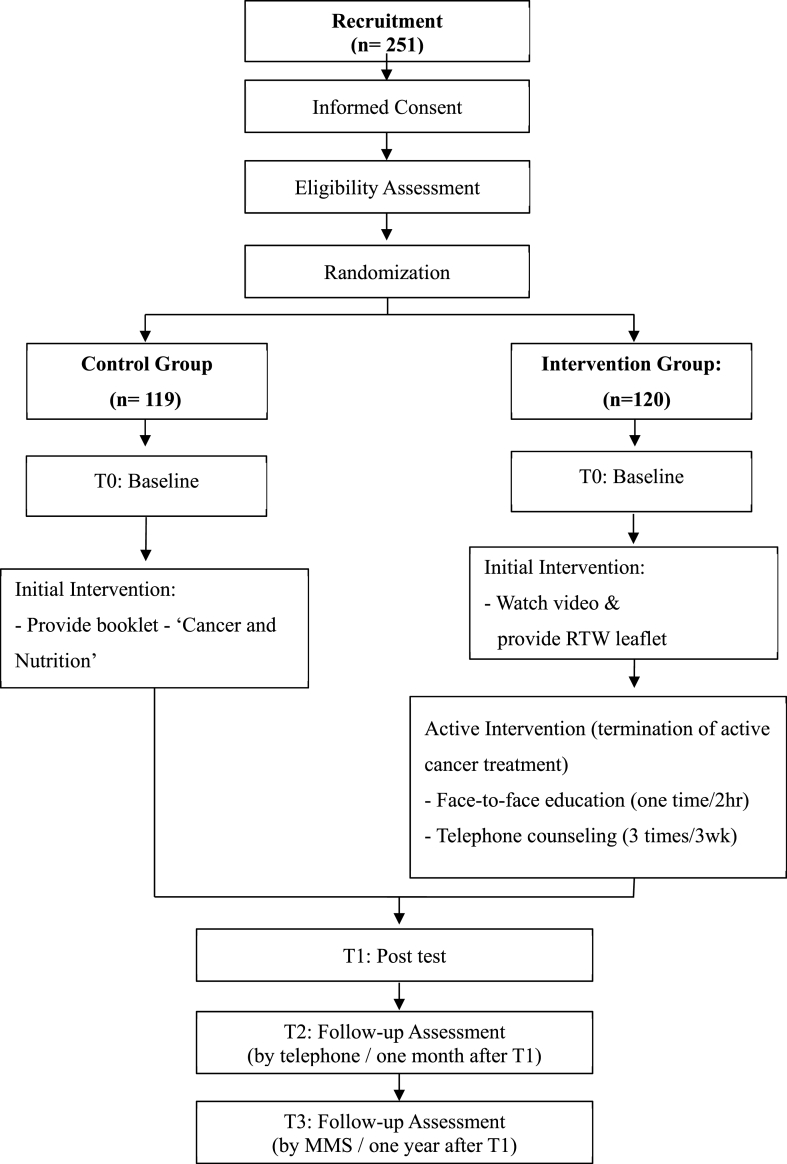
We designed a multi-center, randomized controlled trial with three follow-up points. The study population (N = 239) includes recently diagnosed cancer patients who plan to receive active treatment at two university hospitals in Korea. A pre-test is conducted at the point of enrollment for both groups. The intervention group receives a leaflet clarifying misconceptions about RTW and is shown a video clip of patient interviews concerning RTW. The control group receives a booklet about cancer and nutrition, and is not provided with further intervention. After active treatment, the intervention group receives a one-time, face-to-face education session with an oncology nurse. Following the education session, both groups receive three follow-up phone calls. The first follow-up call occurs at the end of intervention and at the end of active treatment for intervention and control groups, respectively. The next two follow-up calls will be conducted one month and a year following the post-test. The primary outcome is whether the patient has RTW or has plans to RTW, and the secondary outcome is knowledge of RTW.
As of April 2020, 239 patients have been enrolled in the trial. Statistical analyses will be conducted upon trial completion in December 2020.
We hypothesize that the provision of RTW education near diagnosis will not only enhance patients' intentions to RTW, but also effectively encourage them to RTW.
本研究描述了一项基于自我评估的教育项目的设计与评估方案,该项目旨在支持癌症患者恢复工作,目前该项目尚未全面持续实施。
我们设计了一项多中心随机对照试验,有三个随访点。研究人群(N = 239)包括近期被诊断出癌症且计划在韩国两家大学医院接受积极治疗的患者。两组在入组时都进行了预测试。干预组收到一份澄清对恢复工作误解的传单,并观看一段关于恢复工作的患者访谈视频。对照组收到一本关于癌症与营养的手册,未接受进一步干预。积极治疗后,干预组与一名肿瘤护士进行一次面对面的教育课程。教育课程结束后,两组都接受三次随访电话。第一次随访电话分别在干预结束时以及干预组和对照组积极治疗结束时进行。接下来的两次随访电话将在测试后一个月和一年进行。主要结局是患者是否已恢复工作或有恢复工作的计划,次要结局是恢复工作的知识。
截至2020年4月,已有239名患者入组该试验。将于2020年12月试验完成后进行统计分析。
我们假设在诊断时提供恢复工作教育不仅会增强患者恢复工作的意愿,还会有效鼓励他们恢复工作。