Department of Clinical Research Design & Evaluation, SAIHST, SungkyunKwan University, Seoul, Korea.
Center for Clinical Epidemiology, Samsung Medical Center, Seoul, Korea.
Cancer Res Treat. 2023 Apr;55(2):419-428. doi: 10.4143/crt.2022.939. Epub 2022 Nov 8.
We developed a comprehensive return to work (RTW) intervention covering physical, psycho-social and practical issues for patients newly diagnosed and evaluated its efficacy in terms of RTW.
A multi-center randomized controlled trial was done to evaluate the efficacy of the intervention conducted at two university-based cancer centers in Korea. The intervention program comprised educational material at diagnosis, a face-to-face educational session at completion of active treatment, and three individualized telephone counseling sessions. The control group received other education at enrollment.
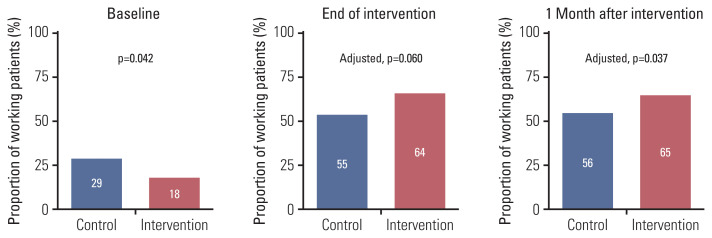
At 1-month post-intervention (T2), the intervention group was more likely to be working compared to the control group after controlling working status at diagnosis (65.4% vs. 55.9%, p=0.037). Among patients who did not work at baseline, the intervention group was 1.99-times more likely to be working at T2. The mean of knowledge score was higher in the intervention group compared to the control group (7.4 vs. 6.8, p=0.029). At the 1-year follow-up, the intervention group was 65% (95% confidence interval, 0.78 to 3.48) more likely to have higher odds for having work.
The intervention improved work-related knowledge and was effective in facilitating cancer patients' RTW.
我们开发了一种综合的重返工作岗位(RTW)干预措施,涵盖了新诊断和评估的患者的身体、心理社会和实际问题,并评估了其在 RTW 方面的疗效。
在韩国的两家大学癌症中心进行了一项多中心随机对照试验,以评估该干预措施的疗效。干预方案包括诊断时的教育材料、积极治疗完成时的面对面教育课程,以及三次个体化电话咨询。对照组在入组时接受其他教育。
在干预后 1 个月(T2),在控制诊断时的工作状态后,干预组比对照组更有可能在工作(65.4%比 55.9%,p=0.037)。在基线时没有工作的患者中,干预组在 T2 时工作的可能性是对照组的 1.99 倍。与对照组相比,干预组的知识得分更高(7.4 比 6.8,p=0.029)。在 1 年随访时,干预组有更高的工作机会的可能性是对照组的 65%(95%置信区间,0.78 至 3.48)。
该干预措施提高了与工作相关的知识,有效促进了癌症患者的 RTW。