Department of Health Law, Policy, and Management, School of Public Health, Boston University, Boston, Massachusetts, United States of America.
Department of Health Policy, School of Medicine, Vanderbilt University, Nashville, Tennessee, United States of America.
PLoS One. 2020 Sep 4;15(9):e0238100. doi: 10.1371/journal.pone.0238100. eCollection 2020.
The Affordable Care Act led to improvements in reporting a usual source of care, but it is unclear whether patients are changing their usual source of care in response to coverage gains. We assess whether prior insurance instability is associated with changes in use of emergency and office-based care after the Marketplace and Medicaid expansion were introduced.
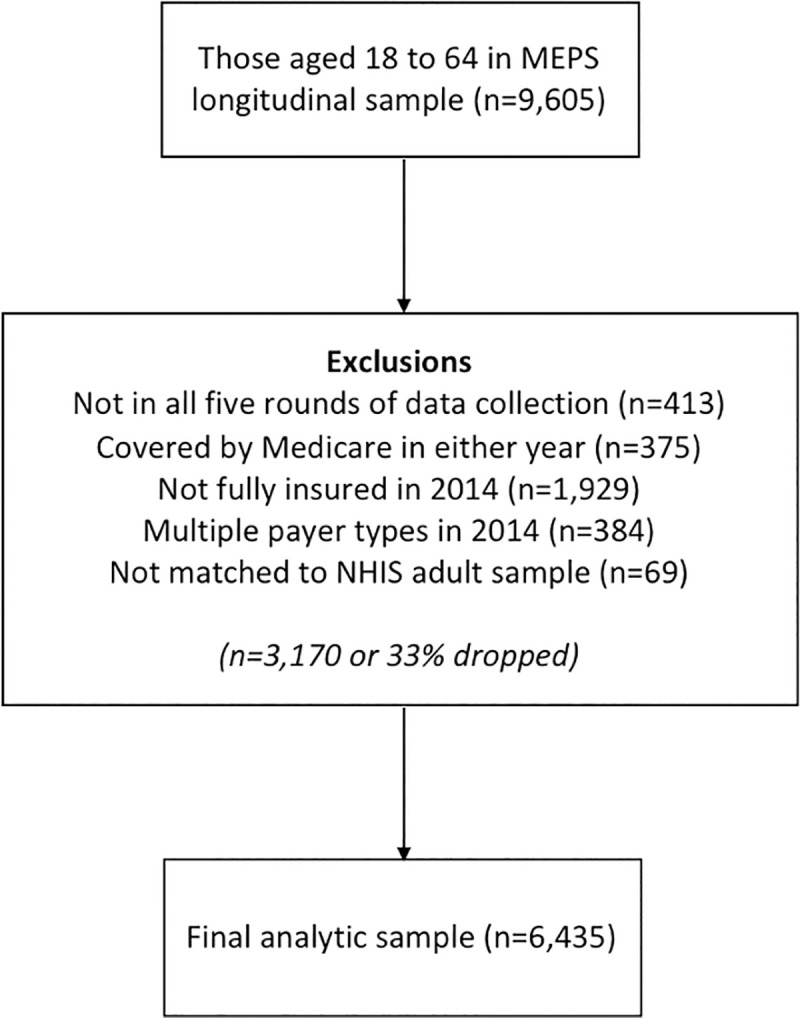
Our study draws from the 2013-14 Medical Expenditure Panel Survey, identifying a cohort of non-elderly adults with full-year health insurance coverage in 2014. We use linear and multinomial logistic regression to assess the relationship between insurance instability prior to 2014 (uninsured for 1-11 months, ≥12 months) and person-level changes in use of health care after gaining coverage (change in ED and office visits from 2013 to 2014) with continuously insured individuals serving as a comparison group.
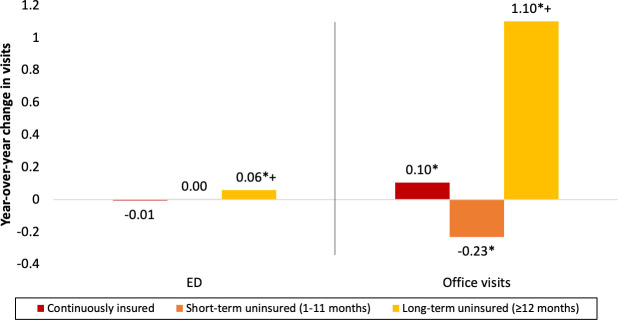
Being uninsured for at least one year prior to gaining full-year coverage in 2014 was associated with a 33% increase in ED visits (0.06 visits, p<0.01) and a 47% increase in office visits (1.10 visits, p<0.01), driven by those gaining public coverage. We found no evidence of substitution across settings in the short term, often a stated goal of expansion.
The long-term uninsured may have substantial health needs and pent-up demand for health care, seeing more physicians across multiple settings in the year after gaining coverage as they seek to get unmanaged conditions under control. Closing the gap in primary care use between the previously uninsured and those with health insurance coverage may help improve long-term health outcomes.
《平价医疗法案》(Affordable Care Act)推动了常规就诊医疗机构报告的改善,但尚不清楚患者是否会因覆盖范围的扩大而改变常规就诊医疗机构。我们评估了在市场和医疗补助扩大实施后,先前的保险不稳定是否与急诊和门诊服务使用的变化有关。
我们的研究基于 2013-14 年医疗支出调查,确定了一组在 2014 年全年拥有医疗保险的非老年成年人队列。我们使用线性和多项逻辑回归来评估 2014 年之前(1-11 个月未参保,≥12 个月未参保)保险不稳定与参保后个人医疗保健使用变化(2013 年至 2014 年急诊和门诊就诊次数变化)之间的关系,以持续参保个体作为对照组。
在 2014 年获得全年覆盖之前至少有一年未参保与急诊就诊次数增加 33%(0.06 次,p<0.01)和门诊就诊次数增加 47%(1.10 次,p<0.01)有关,这主要是由于获得公共保险的人群。我们没有发现短期内跨环境替代的证据,这通常是扩张的一个既定目标。
长期未参保者可能有较大的健康需求和对医疗保健的积压需求,在获得保险后的一年中会更多地去看医生,在多个环境中就诊,以控制未得到管理的疾病。缩小先前未参保者和有医疗保险者之间初级保健使用差距,可能有助于改善长期健康结果。