Cancer Institute, The Affiliated Hospital of Qingdao University, Qingdao University, Qingdao Cancer Institute, Qingdao, 266071, Shandong, China.
Department of Spine Surgery, The Affiliated Hospital of Qingdao University, Qingdao, 266071, Shandong, China.
Mol Med. 2020 Sep 7;26(1):84. doi: 10.1186/s10020-020-00213-y.
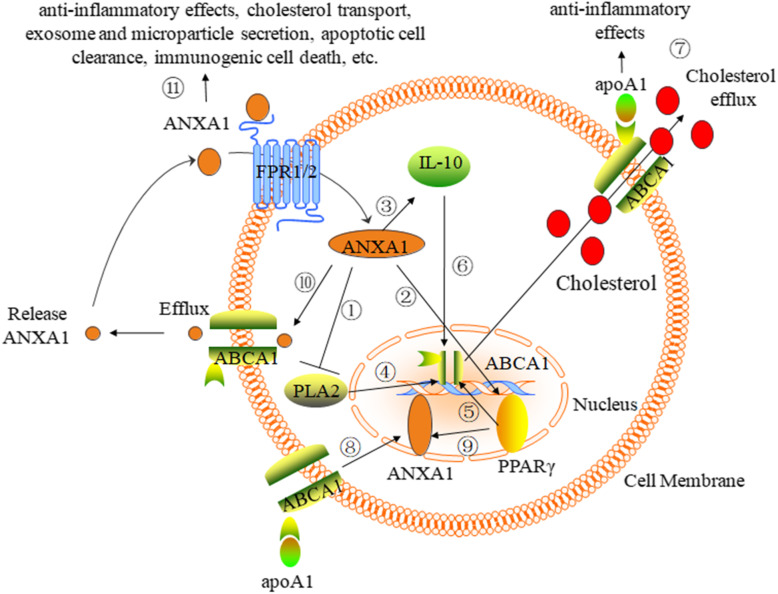
Atherosclerosis, characterized by the formation of fat-laden plaques, is a chronic inflammatory disease. ABCA1 promotes cholesterol efflux, reduces cellular cholesterol accumulation, and regulates anti-inflammatory activities in an apoA-I- or ANXA1-dependent manner. The latter activity occurs by mediating the efflux of ANXA1, which plays a critical role in anti-inflammatory effects, cholesterol transport, exosome and microparticle secretion, and apoptotic cell clearance. ApoA-I increases ANXA1 expression via the ERK, p38MAPK, AKT, and PKC pathways. ApoA-I regulates the signaling pathways by binding to ABCA1, suggesting that apoA-I increases ANXA1 expression by binding to ABCA1. Furthermore, ANXA1 may increase ABCA1 expression. ANXA1 increases PPARγ expression by modulating STAT6 phosphorylation. PPARγ also increases ANXA1 expression by binding to the promoter of ANXA1. Therefore, ABCA1, PPARγ, and ANXA1 may form a feedback loop and regulate each other. Interestingly, the ANXA1 needs to be externalized to the cell membrane or secreted into the extracellular fluids to exert its anti-inflammatory properties. ABCA1 transports ANXA1 from the cytoplasm to the cell membrane by regulating lipidization and serine phosphorylation, thereby mediating ANXA1 efflux, likely by promoting microparticle and exosome release. The direct role of ABCA1 expression and ANXA1 release in atherosclerosis has been unclear. In this review, we focus on the role of ANXA1 in atheroprogression and its novel interaction with ABCA1, which may be useful for providing basic knowledge for the development of novel therapeutic targets for atherosclerosis and cardiovascular disease.
动脉粥样硬化的特征是形成富含脂肪的斑块,是一种慢性炎症性疾病。ABCA1 通过依赖 apoA-I 或 ANXA1 的方式促进胆固醇外流、减少细胞内胆固醇积累,并调节抗炎活性。后者的活性通过介导 ANXA1 的流出来实现,这在抗炎作用、胆固醇转运、外泌体和微粒体分泌以及凋亡细胞清除中起着关键作用。ApoA-I 通过 ERK、p38MAPK、AKT 和 PKC 通路增加 ANXA1 的表达。ApoA-I 通过与 ABCA1 结合来调节信号通路,这表明 apoA-I 通过与 ABCA1 结合来增加 ANXA1 的表达。此外,ANXA1 可能会增加 ABCA1 的表达。ANXA1 通过调节 STAT6 磷酸化来增加 PPARγ 的表达。PPARγ 通过与 ANXA1 启动子结合也增加 ANXA1 的表达。因此,ABCA1、PPARγ 和 ANXA1 可能形成一个反馈回路并相互调节。有趣的是,ANXA1 需要外化到细胞膜或分泌到细胞外液中才能发挥其抗炎特性。ABCA1 通过调节脂质化和丝氨酸磷酸化将 ANXA1 从细胞质转运到细胞膜,从而介导 ANXA1 外流,可能通过促进微粒体和外泌体的释放来实现。ABCA1 表达和 ANXA1 释放与动脉粥样硬化的直接作用尚不清楚。在这篇综述中,我们重点介绍了 ANXA1 在动脉粥样硬化进展中的作用及其与 ABCA1 的新相互作用,这可能有助于为动脉粥样硬化和心血管疾病的新型治疗靶点的开发提供基础知识。