Hong Eun-Hye, Song Jae-Hyoung, Kim Seong-Ryeol, Cho Jaewon, Jeong Birang, Yang Heejung, Jeong Jae-Hyeon, Ahn Jae-Hee, Jeong Hyunjin, Kim Seong-Eun, Chang Sun-Young, Ko Hyun-Jeong
Laboratory of Microbiology and Immunology, College of Pharmacy, Kangwon National University, Chuncheon 24341, Korea.
Kangwon Institute of Inclusive Technology, Kangwon National University, Chuncheon 24341, Korea.
Immune Netw. 2020 Jul 15;20(4):e32. doi: 10.4110/in.2020.20.e32. eCollection 2020 Aug.
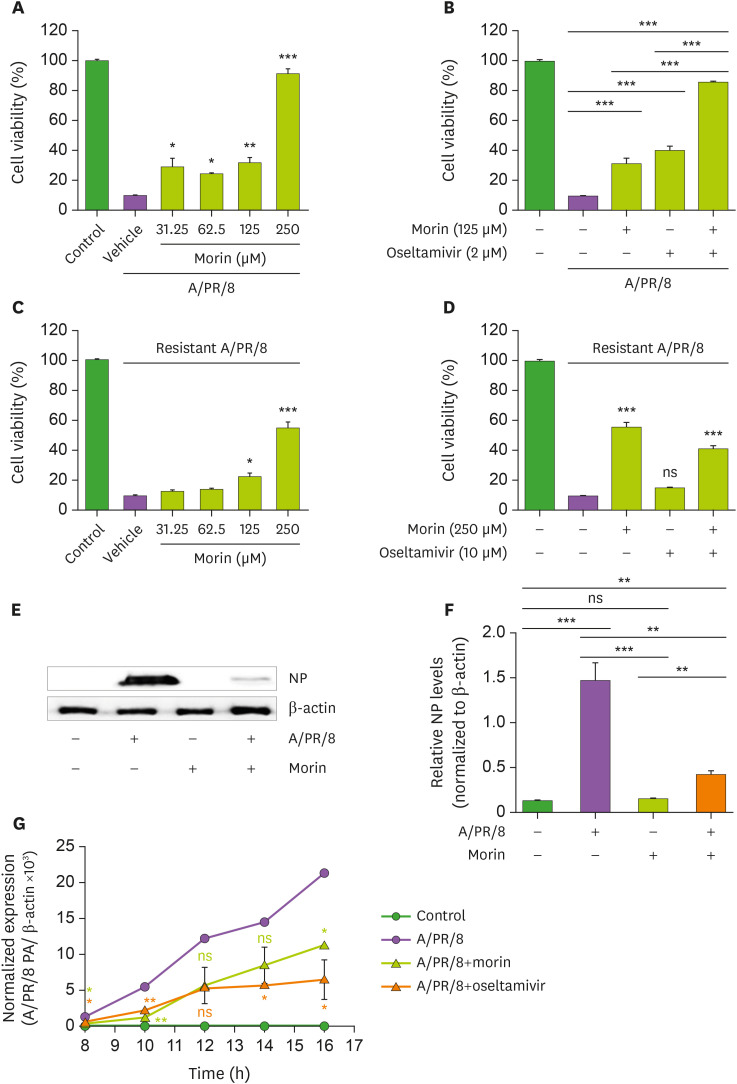
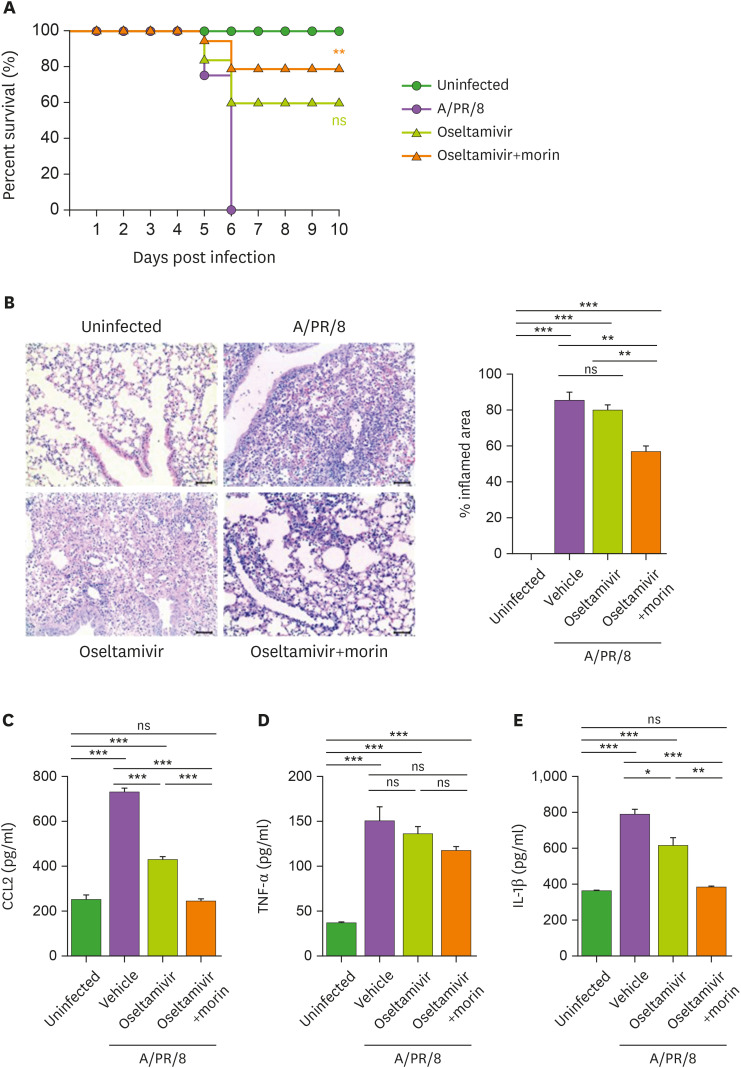
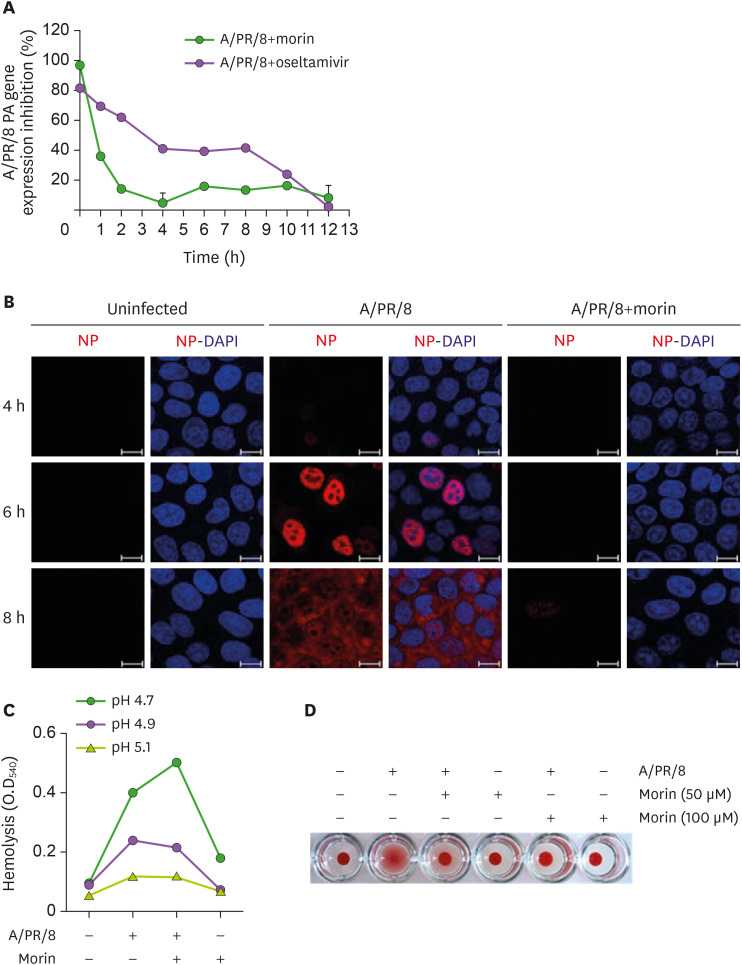
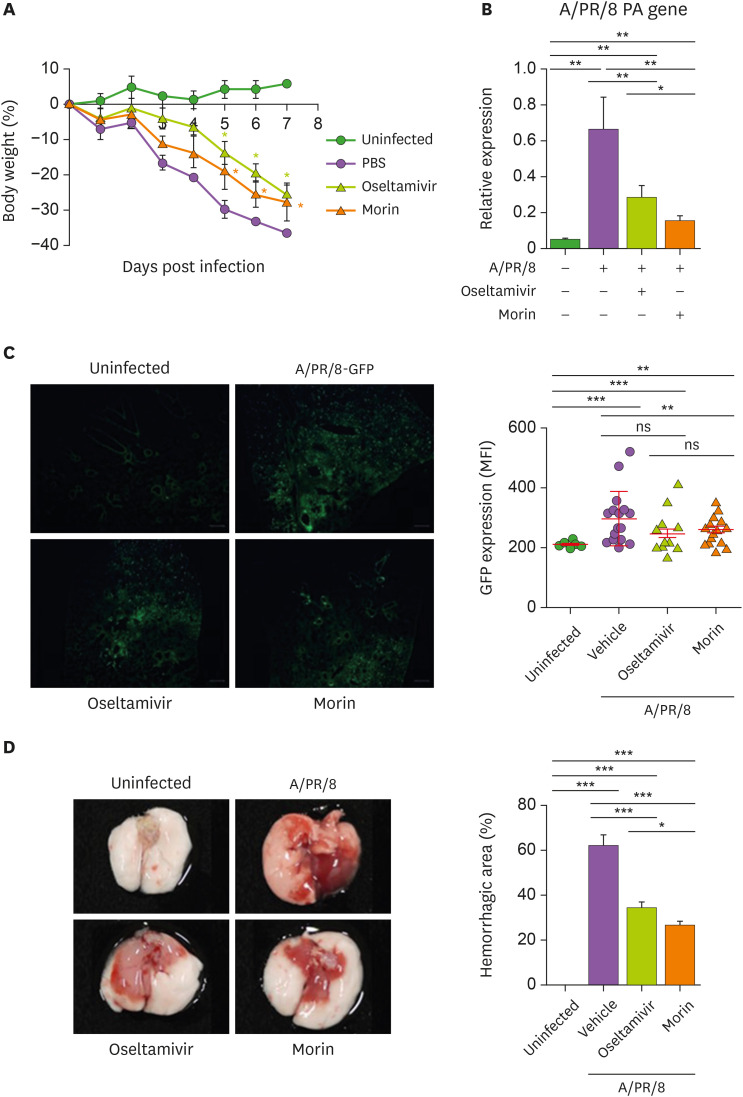
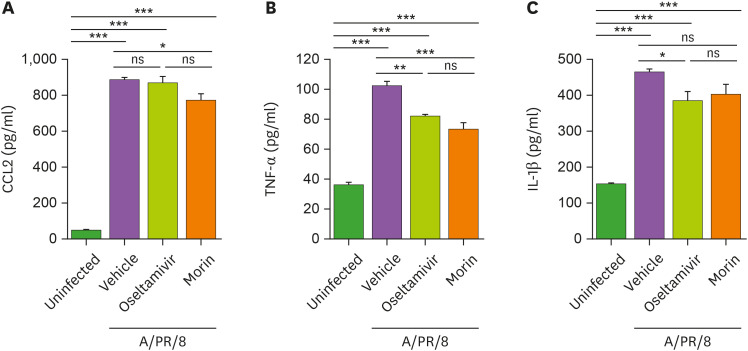
Influenza virus is the major cause of seasonal and pandemic flu. Currently, oseltamivir, a potent and selective inhibitor of neuraminidase of influenza A and B viruses, is the drug of choice for treating patients with influenza virus infection. However, recent emergence of oseltamivir-resistant influenza viruses has limited its efficacy. Morin hydrate (3,5,7,2',4'-pentahydroxyflavone) is a flavonoid isolated from L. It has antioxidant, anti-inflammatory, neuroprotective, and anticancer effects partly by the inhibition of the NF-кB signaling pathway. However, its effects on influenza virus have not been studied. We evaluated the antiviral activity of morin hydrate against influenza A/Puerto Rico/8/1934 (A/PR/8; H1N1) and oseltamivir-resistant A/PR/8 influenza viruses . To determine its mode of action, we carried out time course experiments, and time of addition, hemolysis inhibition, and hemagglutination assays. The effects of the co-administration of morin hydrate and oseltamivir were assessed using the murine model of A/PR/8 infection. We found that morin hydrate reduced hemagglutination by A/PR/8 . It alleviated the symptoms of A/PR/8-infection, and reduced the levels of pro-inflammatory cytokines and chemokines, such as TNF-α and CCL2, in infected mice. Co-administration of morin hydrate and oseltamivir phosphate reduced the virus titers and attenuated pulmonary inflammation. Our results suggest that morin hydrate exhibits antiviral activity by inhibiting the entry of the virus.
流感病毒是季节性流感和大流行性流感的主要病因。目前,奥司他韦是甲型和乙型流感病毒神经氨酸酶的一种强效且选择性抑制剂,是治疗流感病毒感染患者的首选药物。然而,最近出现的对奥司他韦耐药的流感病毒限制了其疗效。水合桑色素(3,5,7,2',4'-五羟基黄酮)是从[植物名称未给出]中分离出的一种黄酮类化合物。它具有抗氧化、抗炎、神经保护和抗癌作用,部分是通过抑制NF-κB信号通路实现的。然而,其对流感病毒的作用尚未得到研究。我们评估了水合桑色素对甲型流感病毒/波多黎各/8/1934(A/PR/8;H1N1)和对奥司他韦耐药的A/PR/8流感病毒的抗病毒活性。为确定其作用方式,我们进行了时间进程实验、添加时间实验、溶血抑制实验和血凝实验。使用A/PR/8感染的小鼠模型评估了水合桑色素与奥司他韦联合给药的效果。我们发现水合桑色素降低了A/PR/8的血凝作用。它减轻了A/PR/8感染的症状,并降低了感染小鼠体内促炎细胞因子和趋化因子(如TNF-α和CCL2)的水平。水合桑色素与磷酸奥司他韦联合给药降低了病毒滴度并减轻了肺部炎症。我们的结果表明,水合桑色素通过抑制病毒进入表现出抗病毒活性。