Schmidt Keith T, Huitema Alwin D R, Dorlo Thomas P C, Peer Cody J, Cordes Lisa M, Sciuto Linda, Wroblewski Susan, Pommier Yves, Madan Ravi A, Thomas Anish, Figg William D
Clinical Pharmacology Program, Center for Cancer Research, National Cancer Institute, National Institutes of Health, 9000 Rockville Pike, Building 10/Room 5A03, Bethesda, MD, 20892, USA.
Department Pharmacy and Pharmacology, Netherlands Cancer Institute, Amsterdam, The Netherlands.
Cancer Chemother Pharmacol. 2020 Oct;86(4):475-486. doi: 10.1007/s00280-020-04134-9. Epub 2020 Sep 8.
NLG207 (formerly CRLX101) is a nanoparticle-drug conjugate (NDC) of the potent topoisomerase I inhibitor, camptothecin (CPT). The present study sought to characterize the complex pharmacokinetics (PK) of NLG207 and better describe CPT release from nanoparticles using a population PK (popPK) model.
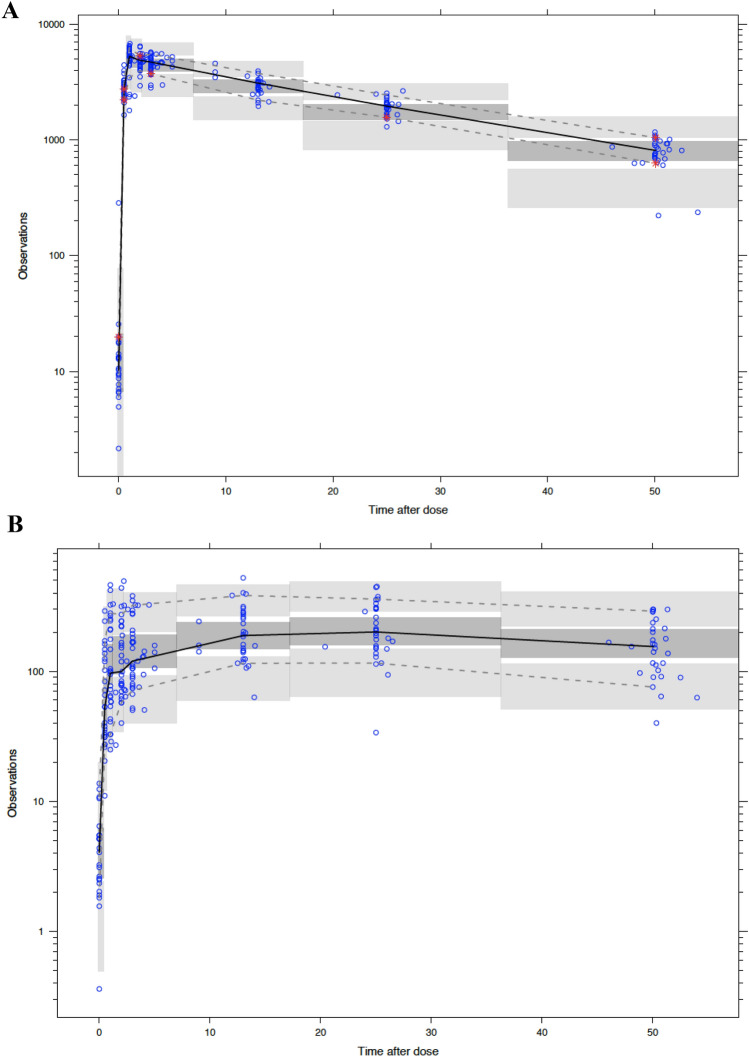
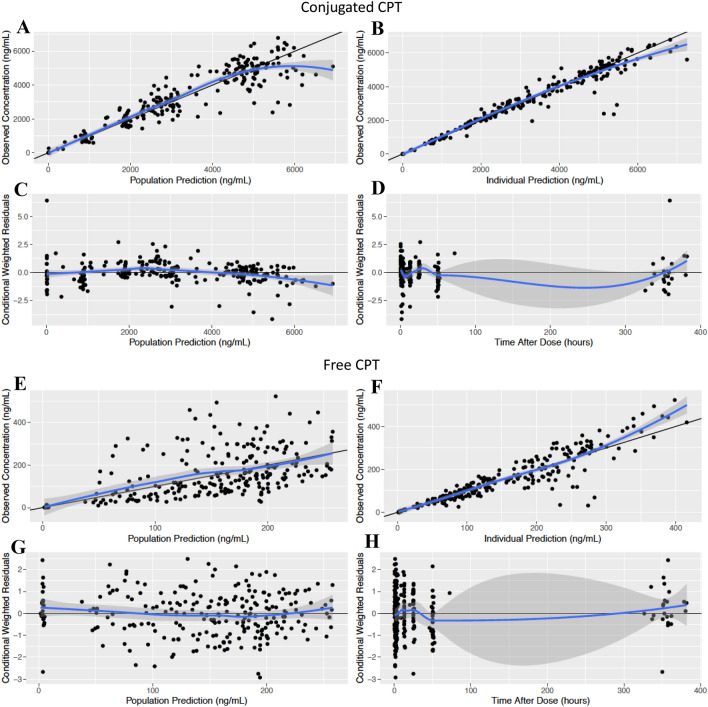
From 27 patients enrolled on two phase II clinical trials (NCT02769962 and NCT03531827), dense sampling was performed up to 48 h post-administration of NLG207 during cycle one and six of treatment; samples were also collected at ~ 360 h post-dose. Conjugated and free CPT concentrations were quantified from each sample, resulting in 477 observations to build a popPK model using non-linear mixed-effects modeling.
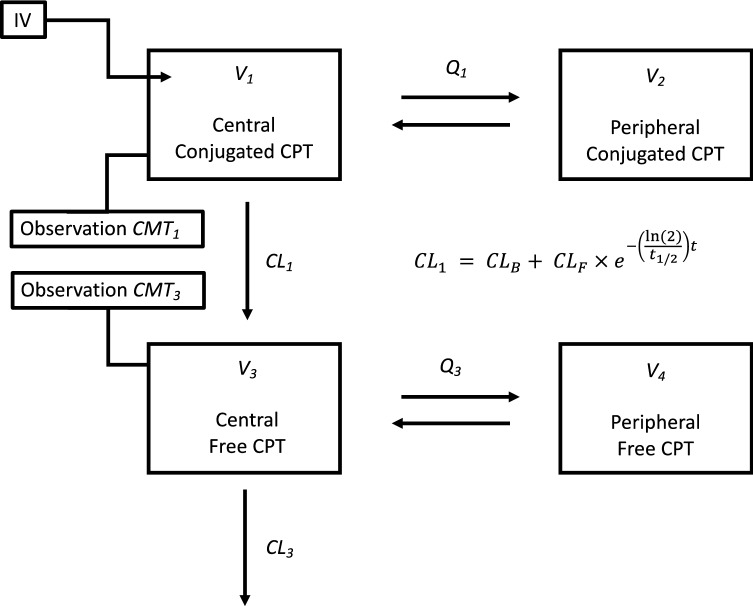
The PK of NLG207 was characterized by combining two linear two-compartment models with first-order kinetics each to describe nanoparticle-bound (conjugated) and free CPT. Allometric scaling based on body weight provided the best body-size descriptor for all PK parameters. The typical volumes of distribution of the conjugated CPT central and free CPT central compartments were 3.16 L (BSV CV%; 18.1%) and 21.1 L (CV%; 79.8%), respectively. CPT release from the nanoparticle formulation was characterized via an initial rapid clearance of 5.71 L/h (CV%; 62.6%), which decreased via first-order decay (estimated half-life of 0.307 h) to the steady-state value of 0.0988 L/h (CV%; 33.5%) by ~ 4 h after end of infusion. Renal clearance of free CPT was 0.874 L/h (CV%; 42.2%).
The popPK model confirmed nanoparticle behavior of conjugated CPT and mechanistically characterized CPT release from NLG207. The current analysis provides a strong foundation for future study as a potential predictive tool in ongoing NLG207 clinical trials.
NLG207(原名CRLX101)是一种强效拓扑异构酶I抑制剂喜树碱(CPT)的纳米颗粒药物偶联物(NDC)。本研究旨在表征NLG207复杂的药代动力学(PK),并使用群体药代动力学(popPK)模型更好地描述纳米颗粒中CPT的释放情况。
从参与两项II期临床试验(NCT02769962和NCT03531827)的27名患者中,在治疗的第一周期和第六周期给予NLG207后长达48小时进行密集采样;在给药后约360小时也采集样本。对每个样本中的偶联CPT和游离CPT浓度进行定量,共获得477个观测值,用于使用非线性混合效应建模构建popPK模型。
NLG207的PK特征为结合两个各具有一级动力学的线性二室模型,分别描述纳米颗粒结合(偶联)的CPT和游离CPT。基于体重的异速缩放为所有PK参数提供了最佳的体型描述符。偶联CPT中央室和游离CPT中央室的典型分布容积分别为3.16 L(BSV CV%;18.1%)和21.1 L(CV%;79.8%)。纳米颗粒制剂中CPT的释放特征为初始快速清除率为5.71 L/h(CV%;62.6%),通过一级衰变(估计半衰期为0.307小时)下降,至输注结束后约4小时达到稳态值0.0988 L/h(CV%;33.5%)。游离CPT的肾清除率为0.874 L/h(CV%;42.2%)。
popPK模型证实了偶联CPT的纳米颗粒行为,并从机制上表征了NLG207中CPT的释放。当前分析为未来研究作为正在进行的NLG207临床试验中的潜在预测工具奠定了坚实基础。