Islam Md Aminul, Noguchi Yoko, Taniguchi Shin, Yonekura Shinichi
Graduate School of Medicine, Science and Technology, Shinshu University, Kamiina, Nagano 399-4598, Japan.
Neopharma Japan Co., Ltd. Tokyo 102-0071, Japan.
Anim Biosci. 2021 Jun;34(6):1006-1013. doi: 10.5713/ajas.20.0349. Epub 2020 Aug 24.
Cells have increased susceptibility to activation of apoptosis when suffering heat stress (HS). An effective supplementation strategy to mimic heat-induced apoptosis of bovine mammary epithelial cells (MECs) is necessary to maintain optimal milk production. This study aimed to investigate possible protective effects of the anti-apoptotic activity of 5-aminolevulinic acid (5-ALA) against HS-induced damage of bovine MECs.
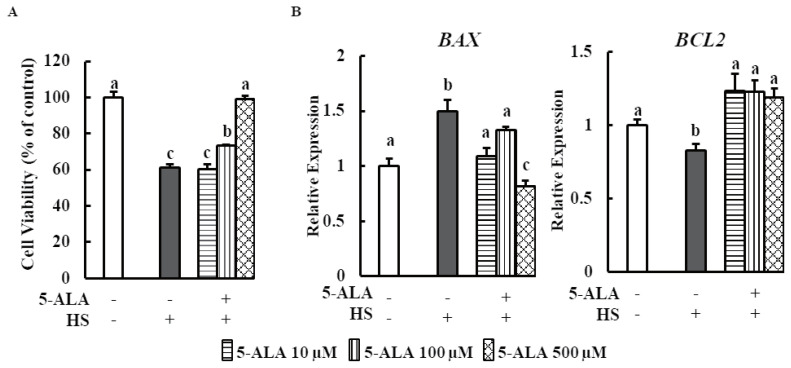
Bovine MECs were pretreated with or without 5-ALA at concentrations of 10, 100, and 500 μM for 24 h followed by HS (42.5°C for 24 h and 48 h). Cell viability was measured with 3-(4,5-dimethylthiazol-2-yl)-2,5-diphenyltetrazolium bromide assays. Real-time quantitative polymerase chain reaction and Western blotting were used to explore the regulation of genes associated with apoptosis, oxidative stress, and endoplasmic reticulum (ER) stress genes.
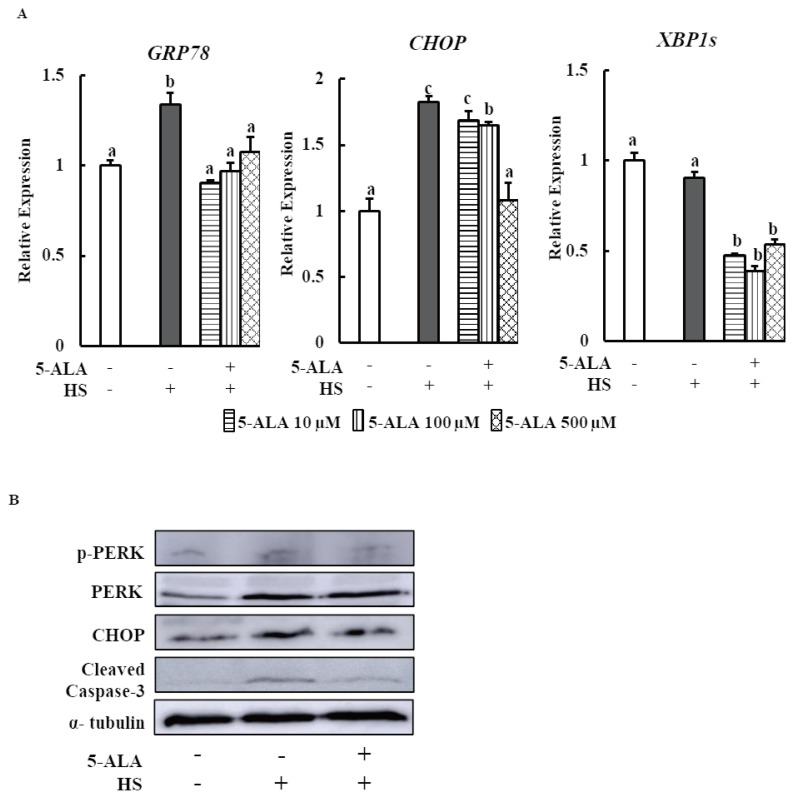
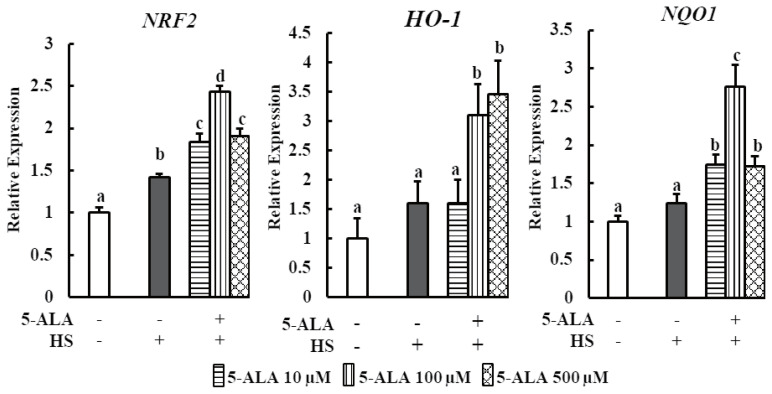
We found that 5-ALA induces cytoprotection via inhibition of apoptosis markers after HS-induced damage. Pretreatment of bovine MECs with 5-ALA resulted in dramatic upregulation of mRNA for nuclear factor erythroid-derived 2-like factor 2, heme oxygenase-1, and NAD(P)H quinone oxidoreductase 1, all of which are antioxidant stress genes. Moreover, 5-ALA pretreatment significantly suppressed HS-induced ER stress-associated markers, glucose-regulated protein 78, and C/EBP homologous protein expression levels.
5-ALA can ameliorate the ER stress in heat stressed bovine MEC via enhancing the expression of antioxidant gene.
细胞在遭受热应激(HS)时对凋亡激活的敏感性增加。为维持最佳产奶量,需要一种有效的补充策略来模拟热诱导的牛乳腺上皮细胞(MECs)凋亡。本研究旨在探讨5-氨基乙酰丙酸(5-ALA)的抗凋亡活性对热应激诱导的牛MECs损伤的可能保护作用。
牛MECs在浓度为10、100和500μM的5-ALA存在或不存在的情况下预处理24小时,然后进行热应激(42.5°C处理24小时和48小时)。用3-(4,5-二甲基噻唑-2-基)-2,5-二苯基四氮唑溴盐法测定细胞活力。采用实时定量聚合酶链反应和蛋白质免疫印迹法探讨与凋亡、氧化应激和内质网(ER)应激相关基因的调控。
我们发现5-ALA通过抑制热应激诱导损伤后的凋亡标志物来诱导细胞保护。用5-ALA预处理牛MECs导致核因子红细胞衍生2样因子2、血红素加氧酶-1和NAD(P)H醌氧化还原酶1的mRNA显著上调,所有这些都是抗氧化应激基因。此外,5-ALA预处理显著抑制了热应激诱导的内质网应激相关标志物、葡萄糖调节蛋白78和C/EBP同源蛋白的表达水平。
5-ALA可通过增强抗氧化基因的表达来改善热应激牛MECs的内质网应激。