Sammarco Giuseppe, Gallo Gaetano, Vescio Giuseppina, Picciariello Arcangelo, De Paola Gilda, Trompetto Mario, Currò Giuseppe, Ammendola Michele
Department of Health Sciences, University of Catanzaro, Viale Europa, 88100 Catanzaro, Italy.
Department of Medical and Surgical Sciences, University of Catanzaro, Viale Europa, 88100 Catanzaro, Italy.
J Clin Med. 2020 Sep 3;9(9):2852. doi: 10.3390/jcm9092852.
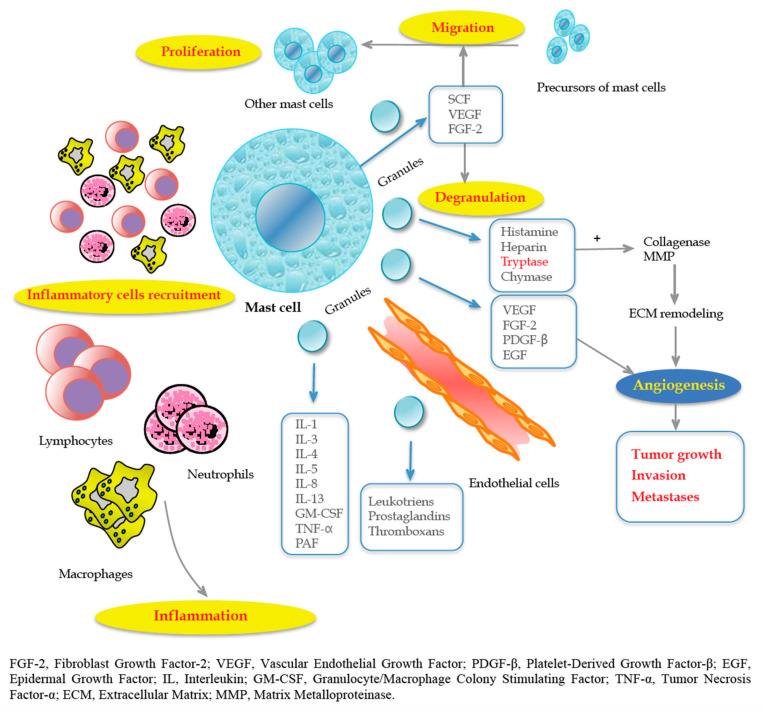
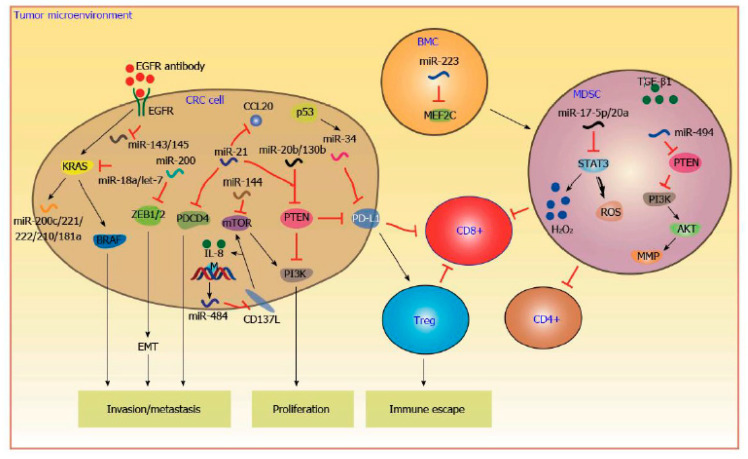
Colorectal cancer (CRC) is a heterogeneous disease, molecularly and anatomically, that develops in a multi-step process requiring the accumulation of several genetic or epigenetic mutations that lead to the gradual transformation of normal mucosa into cancer. In fact, tumorigenesis is extremely complex, with many immunologic and non-immunologic factors present in the tumor microenvironment that can influence tumorigenesis. In the last few years, a role for mast cells (MCs), microRNAs (miRNAs), Kirsten rat sarcoma (KRAS) and v-raf murine sarcoma viral oncogene homologue B (BRAF) in cancer development and progression has been suggested, and numerous efforts have been made to thoroughly assess their correlation with CRC to improve patient survival and quality of life. The identification of easily measurable, non-invasive and cost-effective biomarkers, the so-called "ideal biomarkers", for CRC screening and treatment remains a high priority. The aim of this review is to discuss the emerging role of mast cells (MCs), microRNAs (miRNAs), KRAS and BRAF as diagnostic and prognostic biomarkers for CRC, evaluating their influence as potential therapy targets in the forthcoming era of precision medicine.
结直肠癌(CRC)在分子和解剖学上是一种异质性疾病,它通过多步骤过程发展而来,需要积累多种遗传或表观遗传突变,这些突变导致正常黏膜逐渐转变为癌症。事实上,肿瘤发生极其复杂,肿瘤微环境中存在许多免疫和非免疫因素,它们可影响肿瘤发生。在过去几年中,已有人提出肥大细胞(MCs)、微小RNA(miRNAs)、 Kirsten大鼠肉瘤病毒癌基因(KRAS)和v-raf鼠肉瘤病毒癌基因同源物B(BRAF)在癌症发展和进展中发挥作用,并且已做出诸多努力来全面评估它们与结直肠癌的相关性,以提高患者生存率和生活质量。识别用于结直肠癌筛查和治疗的易于测量、非侵入性且具有成本效益的生物标志物,即所谓的“理想生物标志物”,仍然是重中之重。本综述的目的是讨论肥大细胞(MCs)、微小RNA(miRNAs)、KRAS和BRAF作为结直肠癌诊断和预后生物标志物的新作用,评估它们在即将到来的精准医学时代作为潜在治疗靶点的影响。