Experimental Neuroinflammation Laboratory, Department of Experimental Medical Science, Lund University, Sölvegatan 19, 221 84 Lund, Sweden.
Departamento de Bioquímica y Biología Molecular, Facultad de Farmacia, Universidad de Sevilla/Instituto de Biomedicina de Sevilla-Hospital Universitario Virgen del Rocío/CSIC/Universidad de Sevilla, 41012 Sevilla, Spain.
Int J Mol Sci. 2020 Sep 3;21(17):6429. doi: 10.3390/ijms21176429.
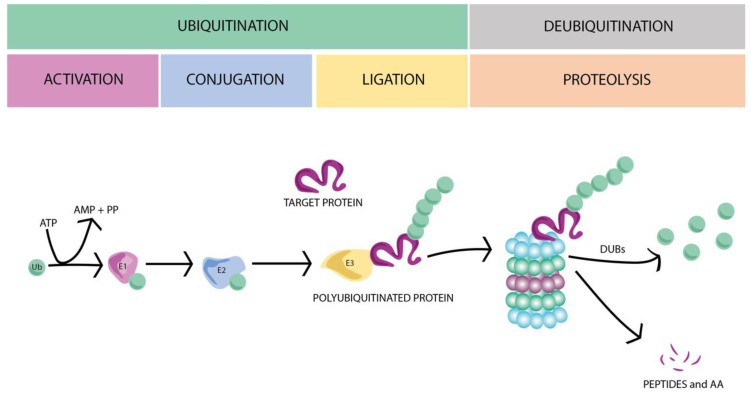
Neuromuscular disorders (NMDs) affect 1 in 3000 people worldwide. There are more than 150 different types of NMDs, where the common feature is the loss of muscle strength. These disorders are classified according to their neuroanatomical location, as motor neuron diseases, peripheral nerve diseases, neuromuscular junction diseases, and muscle diseases. Over the years, numerous studies have pointed to protein homeostasis as a crucial factor in the development of these fatal diseases. The ubiquitin-proteasome system (UPS) plays a fundamental role in maintaining protein homeostasis, being involved in protein degradation, among other cellular functions. Through a cascade of enzymatic reactions, proteins are ubiquitinated, tagged, and translocated to the proteasome to be degraded. Within the ubiquitin system, we can find three main groups of enzymes: E1 (ubiquitin-activating enzymes), E2 (ubiquitin-conjugating enzymes), and E3 (ubiquitin-protein ligases). Only the ubiquitinated proteins with specific chain linkages (such as K48) will be degraded by the UPS. In this review, we describe the relevance of this system in NMDs, summarizing the UPS proteins that have been involved in pathological conditions and neuromuscular disorders, such as Spinal Muscular Atrophy (SMA), Charcot-Marie-Tooth disease (CMT), or Duchenne Muscular Dystrophy (DMD), among others. A better knowledge of the processes involved in the maintenance of proteostasis may pave the way for future progress in neuromuscular disorder studies and treatments.
神经肌肉疾病(NMDs)影响全球每 3000 人中的 1 人。有超过 150 种不同类型的 NMD,其共同特征是肌肉力量丧失。这些疾病根据其神经解剖位置进行分类,包括运动神经元疾病、周围神经疾病、神经肌肉接头疾病和肌肉疾病。多年来,大量研究指出蛋白质平衡是这些致命疾病发展的关键因素。泛素蛋白酶体系统(UPS)在维持蛋白质平衡方面起着至关重要的作用,参与蛋白质降解等细胞功能。通过一系列酶促反应,蛋白质被泛素化、标记并转运到蛋白酶体进行降解。在泛素系统中,我们可以找到三个主要的酶组:E1(泛素激活酶)、E2(泛素结合酶)和 E3(泛素蛋白连接酶)。只有具有特定链连接(如 K48)的泛素化蛋白才会被 UPS 降解。在这篇综述中,我们描述了该系统在 NMD 中的相关性,总结了 UPS 蛋白在病理条件和神经肌肉疾病中的作用,如脊髓性肌萎缩症(SMA)、遗传性运动感觉神经病(CMT)或杜氏肌营养不良症(DMD)等。对维持蛋白质平衡所涉及的过程有更好的了解,可能为神经肌肉疾病研究和治疗的未来进展铺平道路。