Department of Biomedical Science and Environmental Biology, PhD Program in Life Science, College of Life Science, Kaohsiung Medical University, Kaohsiung 80708, Taiwan.
School of Dentistry, College of Dental Medicine, Kaohsiung Medical University, Kaohsiung 80708, Taiwan.
Int J Mol Sci. 2020 Sep 3;21(17):6443. doi: 10.3390/ijms21176443.
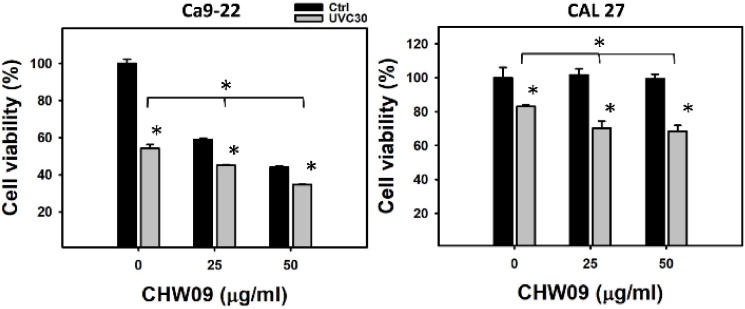
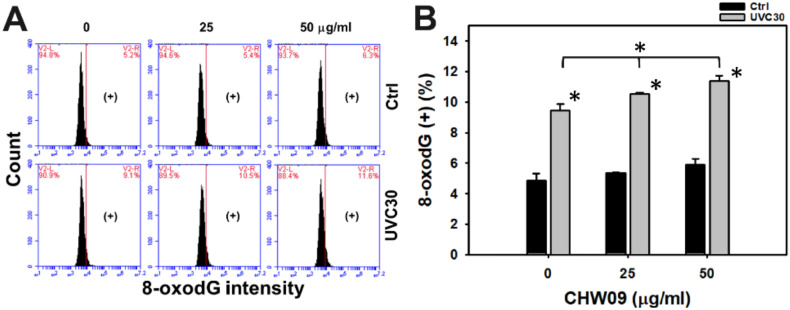
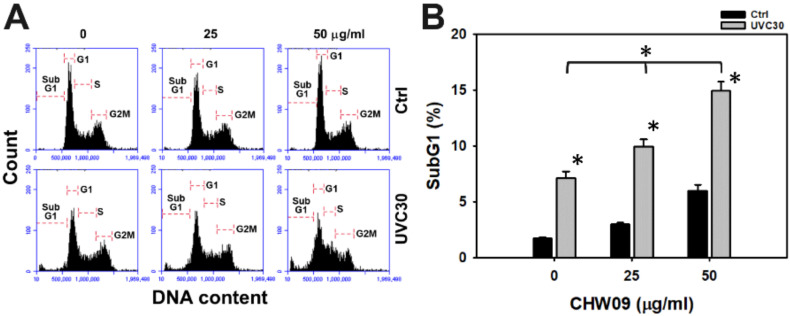
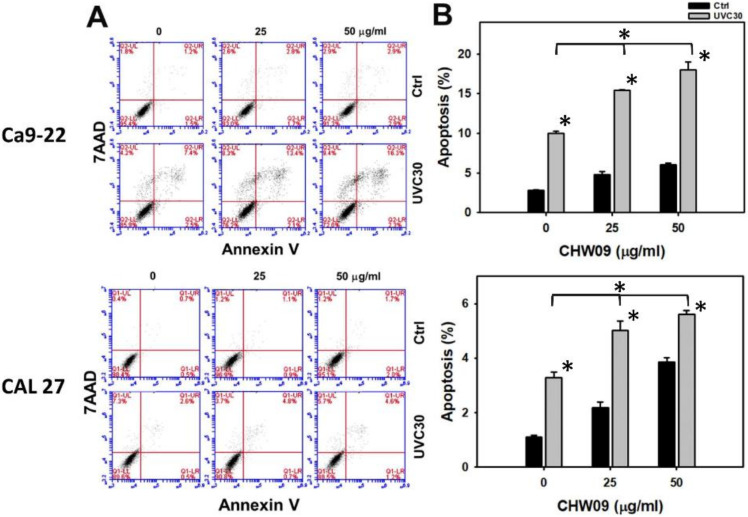
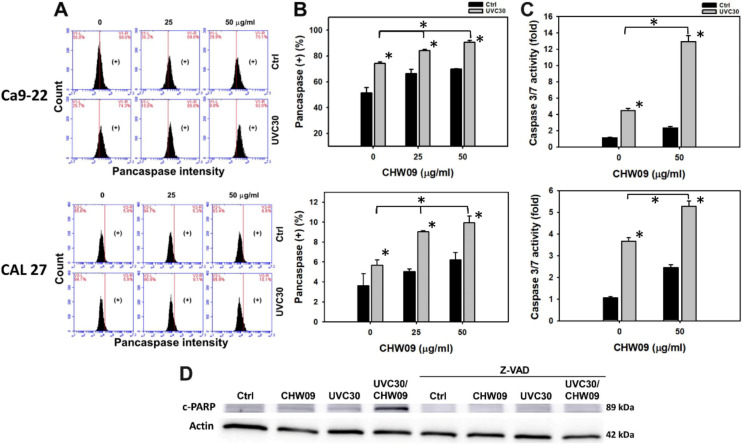
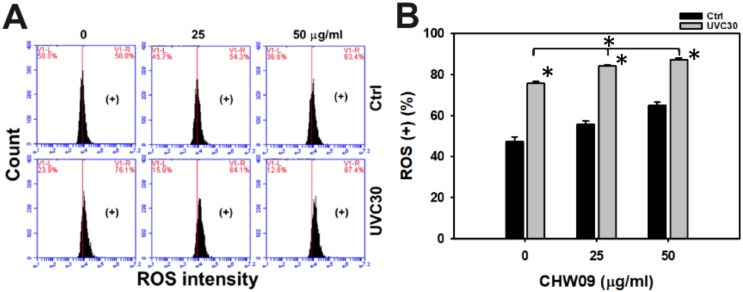
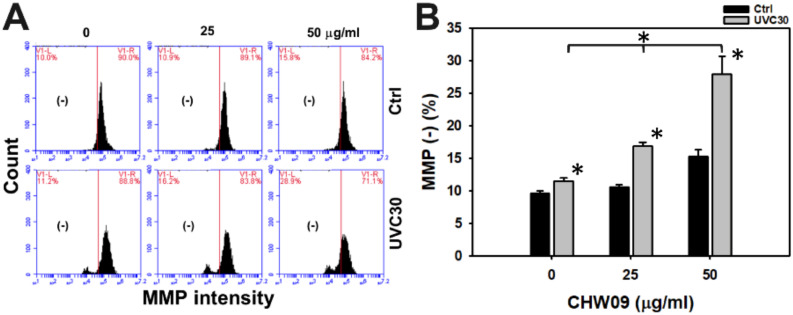
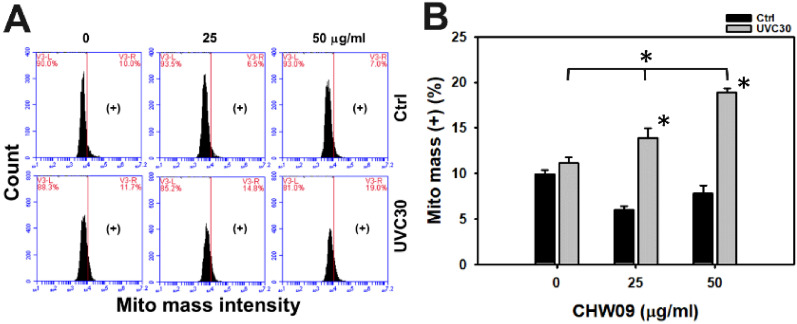
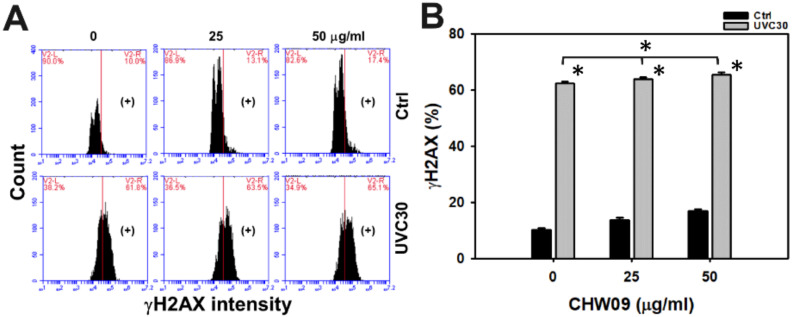
The sensitizing effect of chromone-derived compounds on UVC-induced proliferation inhibition has not been comprehensively investigated so far. The subject of this study was to examine the proliferation change of oral cancer cells while using the combined treatment of UVC (254 nm) with our previously developed sulfonyl chromen-4-ones (CHW09), namely UVC/CHW09. Cell viability, apoptosis, oxidative stress, and DNA damage for the individual and combined treatments for UVC and/or CHW09 were examined in oral cancer Ca9-22 cells. In 24 h MTS assay, UVC (30 J/m; UVC30), or CHW09 (25 and 50 µg/mL; namely, CHW09-25 and CHW09-50) show 54%, 59%, and 45% viability. The combined treatment (UVC30/CHW09-25 and UVC30/CHW09-50) show lower cell viability (45% and 35%). Mechanistically, UVC/CHW09 induced higher apoptosis than individual treatments and untreated control, which were supported by the evidence of flow cytometry for subG1, annexin V/7-aminoactinomycin D, pancaspase and caspases 3/7 activity, and western blotting for cleaved poly(ADP-ribose) polymerase. Moreover, this cleaved PARP expression was downregulated by pancaspase inhibitor Z-VAD-FMK. UVC/CHW09 showed higher oxidative stress than individual treatments and untreated control in terms of flow cytometry for reactive oxygen species, mitochondrial membrane potential, and mitochondrial mass. Furthermore, UVC/CHW09 showed higher DNA damage than individual treatments and untreated control in terms of flow cytometry for H2A histone family member X and 8-oxo-2'-deoxyguanosine. In conclusion, combined treatment UVC/CHW09 suppresses proliferation, and promotes apoptosis, oxidative stress, and DNA damage against oral cancer cells, providing a novel application of sulfonyl chromen-4-ones in order to sensitize UVC induced proliferation inhibition for oral cancer therapy.
迄今为止,尚未全面研究色酮衍生化合物对 UVC 诱导的增殖抑制的敏化作用。本研究的主题是研究口腔癌细胞在使用我们先前开发的磺酰基色烯-4-酮(CHW09)与 UVC(254nm)联合治疗(UVC/CHW09)时的增殖变化。在口腔癌细胞 Ca9-22 中检查了单独和联合使用 UVC 和/或 CHW09 治疗时的细胞活力、凋亡、氧化应激和 DNA 损伤。在 24 小时 MTS 测定中,UVC(30J/m;UVC30)或 CHW09(25 和 50μg/mL;即 CHW09-25 和 CHW09-50)显示 54%、59%和 45%的活力。联合治疗(UVC30/CHW09-25 和 UVC30/CHW09-50)显示出较低的细胞活力(45%和 35%)。从机制上讲,UVC/CHW09 诱导的凋亡高于单独治疗和未处理对照,这得到了流式细胞术检测亚 G1、膜联蛋白 V/7-氨基放线菌素 D、多半胱氨酸酶和半胱天冬酶 3/7 活性以及 Western 印迹检测切割的多聚(ADP-核糖)聚合酶的证据的支持。此外,这种切割的 PARP 表达被多半胱氨酸酶抑制剂 Z-VAD-FMK 下调。与单独治疗和未处理对照相比,UVC/CHW09 在流式细胞术检测活性氧、线粒体膜电位和线粒体质量方面显示出更高的氧化应激。此外,与单独治疗和未处理对照相比,UVC/CHW09 在流式细胞术检测 H2A 组蛋白家族成员 X 和 8-氧-2'-脱氧鸟苷方面显示出更高的 DNA 损伤。总之,UVC/CHW09 联合治疗抑制了口腔癌细胞的增殖,并促进了凋亡、氧化应激和 DNA 损伤,为磺酰基色烯-4-酮在口腔癌治疗中敏化 UVC 诱导的增殖抑制提供了新的应用。