Research Unit for the Analysis of Mortality and Health Statistics, Department of Community Nursing, Preventive Medicine, Public Health and History of Science, University of Alicante, 03080 Alicante, Spain.
Área de Desigualdades en Salud, Fundación para el Fomento de la Investigación Sanitaria y Biomédica de la Comunitat Valenciana (FISABIO), 46035 Valencia, Spain.
Int J Environ Res Public Health. 2020 Sep 6;17(18):6489. doi: 10.3390/ijerph17186489.
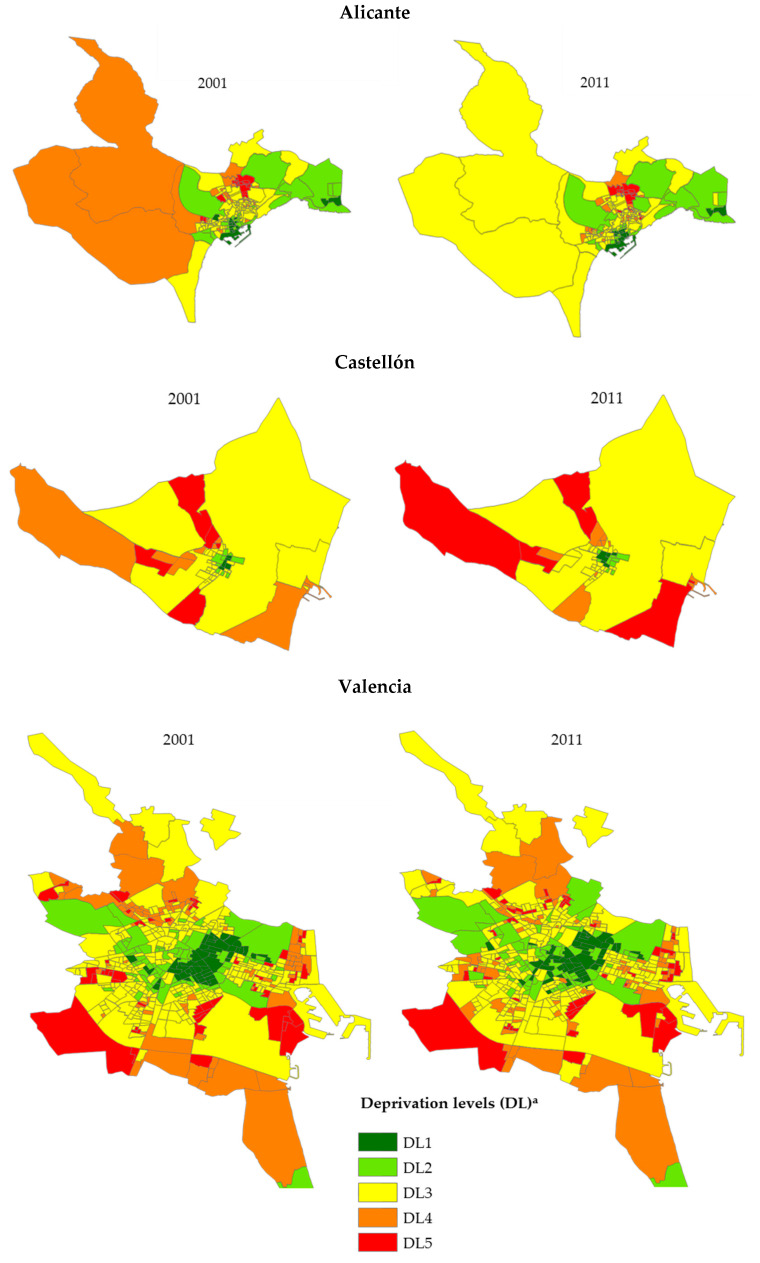
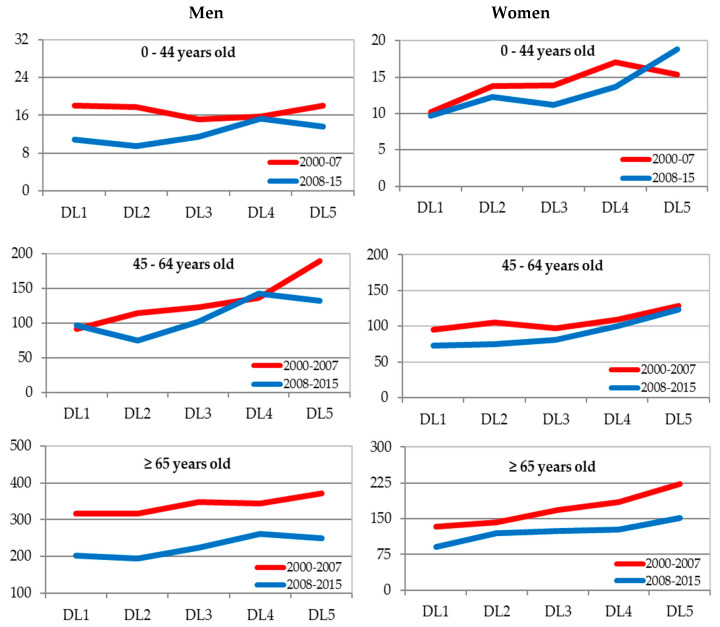
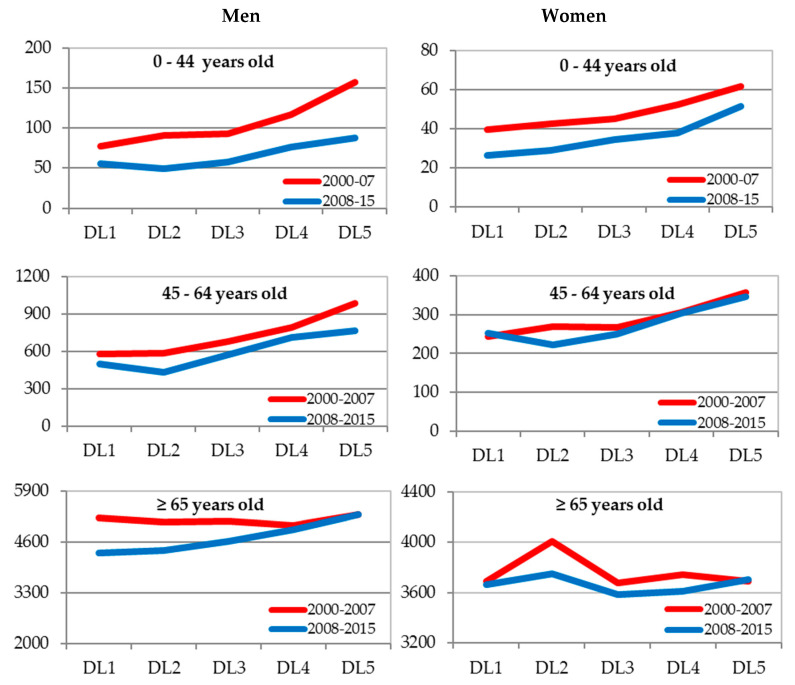
Several studies have described a decreasing trend in amenable mortality, as well as the existence of socioeconomic inequalities that affect it. However, their evolution, particularly in small urban areas, has largely been overlooked. The aim of this study is to analyse the socioeconomic inequalities in amenable mortality in three cities of the Valencian Community, namely, Alicante, Castellon, and Valencia, as well as their evolution before and after the start of the economic crisis (2000-2007 and 2008-2015). The units of analysis have been the census tracts and a deprivation index has been calculated to classify them according to their level of socioeconomic deprivation. Deaths and population were also grouped by sex, age group, period, and five levels of deprivation. The specific rates by sex, age group, deprivation level, and period were calculated for the total number of deaths due to all causes and amenable mortality and Poisson regression models were adjusted in order to estimate the relative risk. This study confirms that the inequalities between areas of greater and lesser deprivation in both all-cause mortality and amenable mortality persisted along the two study periods in the three cities. It also shows that these inequalities appear with greater risk of death in the areas of greatest deprivation, although not uniformly. In general, the risks of death from all causes and amenable mortality have decreased significantly from one period to the other, although not in all the groups studied. The evolution of death risks from before the onset of the crisis to the period after presented, overall, a general pro-cyclical trend. However, there are population subgroups for which the trend was counter-cyclical. The use of the deprivation index has made it possible to identify specific geographical areas with vulnerable populations in all three cities and, at the same time, to identify the change in the level of deprivation (ascending or descending) of the geographical areas throughout the two periods. It is precisely these areas where more attention is needed in order to reduce inequalities.
多项研究描述了可避免死亡率呈下降趋势,以及存在影响死亡率的社会经济不平等现象。然而,这些变化,特别是在小城市地区,在很大程度上被忽视了。本研究旨在分析瓦伦西亚自治区三个城市(阿利坎特、卡斯特利翁和巴伦西亚)的可避免死亡率的社会经济不平等现象,以及在经济危机开始前后(2000-2007 年和 2008-2015 年)的演变情况。分析单位为人口普查区,并计算了一个剥夺指数,以根据其社会经济剥夺程度对其进行分类。还按性别、年龄组、时期和五个剥夺水平对死亡人数和人口进行了分组。根据所有原因和可避免死亡率的总死亡人数、性别、年龄组、剥夺水平和时期计算了特定的死亡率,并调整了泊松回归模型以估计相对风险。本研究证实,在三个城市的两个研究期间,在所有原因死亡率和可避免死亡率方面,较富裕和较贫困地区之间的不平等现象仍然存在。它还表明,在最贫困地区,这些不平等现象与更高的死亡风险相关,尽管并非均匀分布。一般来说,从一个时期到另一个时期,所有原因和可避免死亡率的死亡风险都显著下降,尽管并非在所有研究组中都是如此。从危机前到危机后的时期,死亡风险的演变总体上呈现出顺周期性趋势。然而,对于一些人群群体,趋势是反周期性的。剥夺指数的使用使得能够识别出所有三个城市中脆弱人群的特定地理区域,同时还可以识别出两个时期内地理区域的剥夺程度(上升或下降)的变化。正是这些地区需要更多关注,以减少不平等现象。