Department of Epidemiology and Biostatistics, School of Medicine, University of California, San Francisco, 550 16th Street, Box 1224, San Francisco, CA, 94153-1224, USA.
Department of Public Health, School of Social Sciences, Humanities & Arts, University of California, Merced, Merced, CA, USA.
J Urban Health. 2020 Dec;97(6):831-844. doi: 10.1007/s11524-020-00445-7.
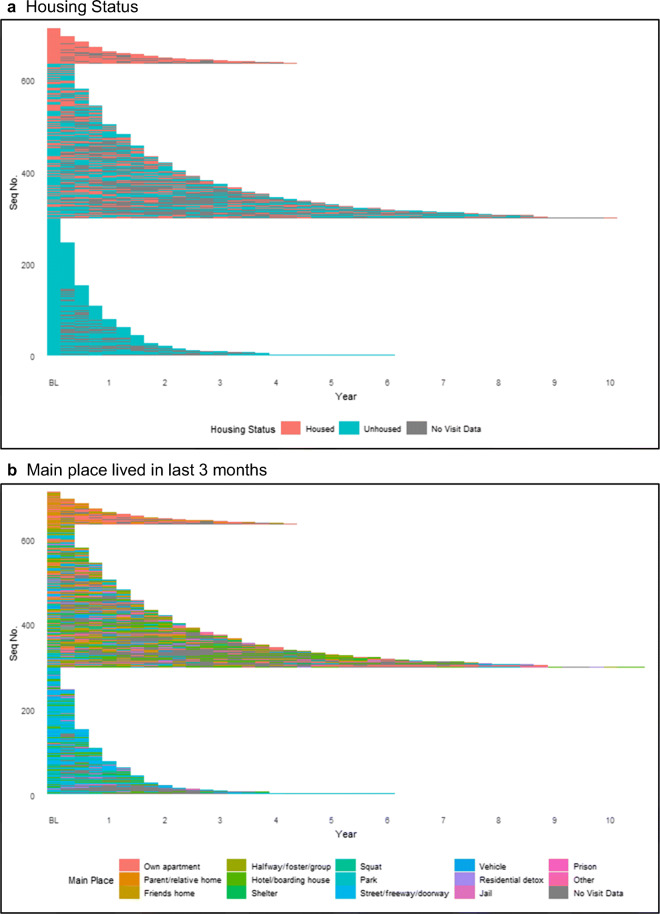
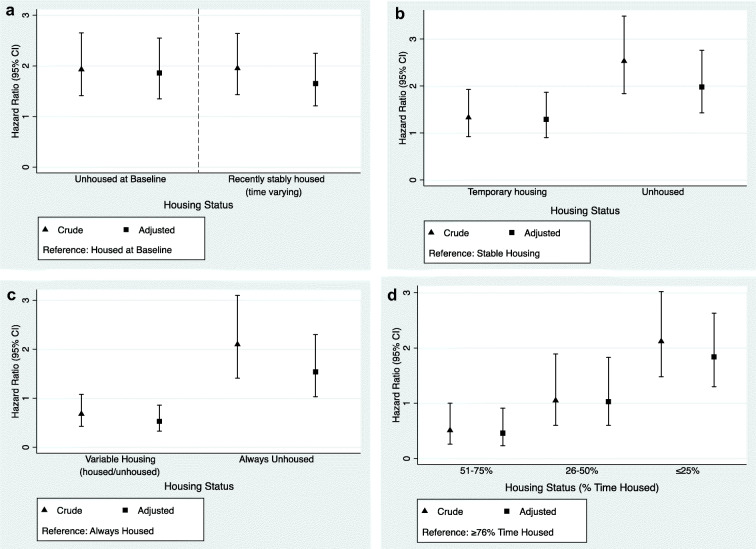
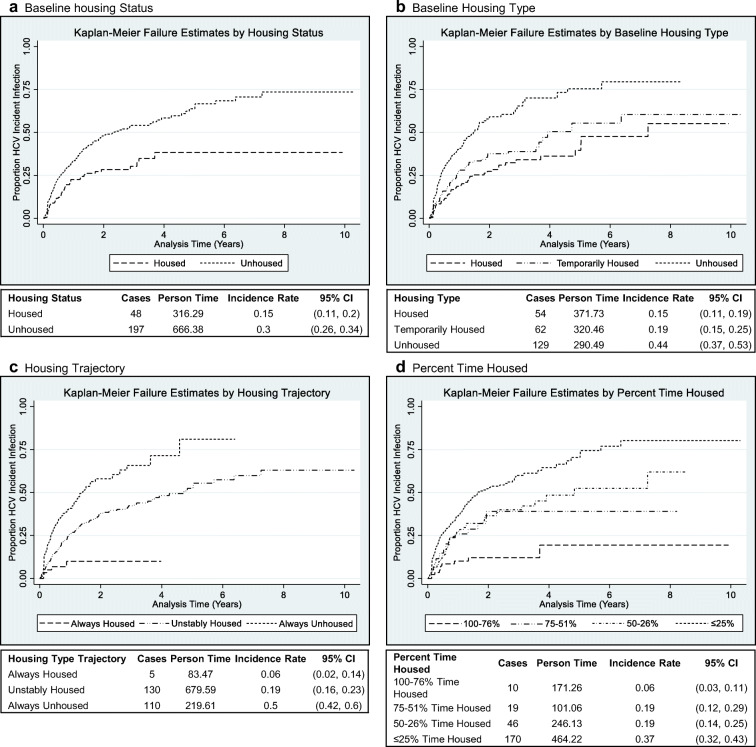
Housing status affects drug using behaviors, but less is known about the relationship between housing patterns and hepatitis C virus (HCV) infection. HCV-negative young people who inject drugs (PWID) were enrolled into a prospective cohort (2003-2019) with quarterly study visits. We used Cox regression to estimate the independent association of recent housing status (housed vs. unhoused, housing stability, and housing trajectory) on HCV incidence. Among 712 participants, 245 incident HCV infections occurred over 963.8 person-years (py) (cumulative incidence 24.4/100 py). An inverse relationship between time housed and HCV incidence was observed (always unhoused 45.0/100 py, 95% confidence interval (CI) 37.1, 54.5; variably housed 18.0/100 py, 95% CI 15.0, 21.3; and always housed 7.0/100 py, 95% CI 3.0, 17.3). In Cox regression models controlling for confounders, those unhoused versus housed at baseline had a 1.9-fold increased infection risk (95% CI 1.4, 2.6). Those always unhoused versus always housed had a 1.5 times greater risk of HCV (95% CI 1.0, 2.3), and those spending a portion of time in stable housing a lower risk (adjusted relative hazard 0.05, 95% CI 0.3, 0.9) with a similar trend for those being housed for less time. Young adult PWID experiencing both recent and chronic states of being unhoused are at elevated risk for HCV infection. Importantly for this group of PWID, our findings indicate that some frequency of residential housing significantly reduces HCV infection risk.
住房状况会影响药物使用行为,但人们对住房模式与丙型肝炎病毒(HCV)感染之间的关系知之甚少。我们招募了 HCV 阴性的年轻吸毒者(PWID)进入一个前瞻性队列(2003-2019 年),每季度进行一次研究访问。我们使用 Cox 回归来估计最近的住房状况(有房与无房、住房稳定性和住房轨迹)对 HCV 感染发生率的独立关联。在 712 名参与者中,963.8 人年(py)中发生了 245 例 HCV 感染(累积发病率为 24.4/100 py)。观察到有房时间与 HCV 发病率之间呈负相关(始终无房为 45.0/100 py,95%置信区间[CI] 37.1,54.5;有变化的住房为 18.0/100 py,95% CI 15.0,21.3;始终有房为 7.0/100 py,95% CI 3.0,17.3)。在控制混杂因素的 Cox 回归模型中,与基线时有房相比,无房者的感染风险增加了 1.9 倍(95% CI 1.4,2.6)。始终无房者比始终有房者感染 HCV 的风险高 1.5 倍(95% CI 1.0,2.3),而有一部分时间稳定住房的风险较低(调整后的相对危险度 0.05,95% CI 0.3,0.9),而有房时间较短的趋势相似。最近和长期无房的年轻成年 PWID 感染 HCV 的风险增加。对于这群 PWID 来说,重要的是,我们的发现表明,一定频率的居住住房显著降低了 HCV 感染风险。