Department of Entomology and Nematology, University of California, Davis, CA, 95616, USA.
Department of Evolution and Ecology, University of California, Davis, CA, 95616, USA.
Ecol Lett. 2020 Nov;23(11):1693-1714. doi: 10.1111/ele.13601. Epub 2020 Sep 9.
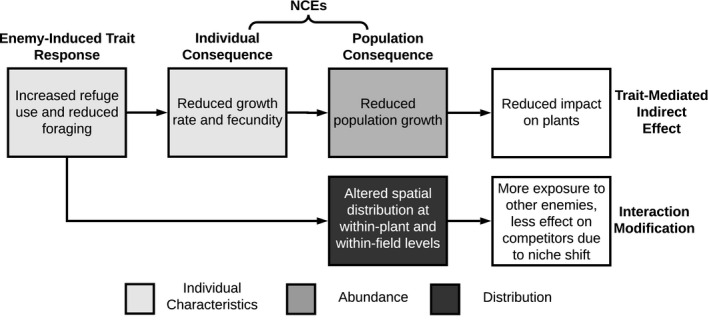
Enemy-risk effects, often referred to as non-consumptive effects (NCEs), are an important feature of predator-prey ecology, but their significance has had little impact on the conceptual underpinning or practice of biological control. We provide an overview of enemy-risk effects in predator-prey interactions, discuss ways in which risk effects may impact biocontrol programs and suggest avenues for further integration of natural enemy ecology and integrated pest management. Enemy-risk effects can have important influences on different stages of biological control programs, including natural enemy selection, efficacy testing and quantification of non-target impacts. Enemy-risk effects can also shape the interactions of biological control with other pest management practices. Biocontrol systems also provide community ecologists with some of the richest examples of behaviourally mediated trophic cascades and demonstrations of how enemy-risk effects play out among species with no shared evolutionary history, important topics for invasion biology and conservation. We conclude that the longstanding use of ecological theory by biocontrol practitioners should be expanded to incorporate enemy-risk effects, and that community ecologists will find many opportunities to study enemy-risk effects in biocontrol settings.
天敌风险效应,通常被称为非消费性效应(NCEs),是捕食者-猎物生态学的一个重要特征,但它们的重要性对生物防治的概念基础或实践几乎没有影响。我们概述了捕食者-猎物相互作用中的天敌风险效应,讨论了风险效应对生物防治计划可能产生的影响,并提出了进一步整合天敌生态学和综合害虫管理的途径。天敌风险效应可以对生物防治计划的不同阶段产生重要影响,包括天敌选择、功效测试和非靶标影响的量化。天敌风险效应还可以塑造生物防治与其他害虫管理实践的相互作用。生物防治系统还为社区生态学家提供了一些最丰富的行为介导的营养级联的例子,并展示了天敌风险效应对没有共同进化史的物种之间的作用方式,这些都是入侵生物学和保护的重要主题。我们的结论是,生物防治从业者长期以来对生态理论的应用应该扩大到包括天敌风险效应,社区生态学家将在生物防治环境中发现许多研究天敌风险效应的机会。