• 文献检索
  • 文档翻译
  • 深度研究
  • 学术资讯
  • Suppr Zotero 插件Zotero 插件
  • 邀请有礼
  • 套餐&价格
  • 历史记录
应用&插件
Suppr Zotero 插件Zotero 插件浏览器插件Mac 客户端Windows 客户端微信小程序
定价
高级版会员购买积分包购买API积分包
服务
文献检索文档翻译深度研究API 文档MCP 服务
关于我们
关于 Suppr公司介绍联系我们用户协议隐私条款
关注我们

Suppr 超能文献

核心技术专利:CN118964589B侵权必究
粤ICP备2023148730 号-1Suppr @ 2026

文献检索

告别复杂PubMed语法,用中文像聊天一样搜索,搜遍4000万医学文献。AI智能推荐,让科研检索更轻松。

立即免费搜索

文件翻译

保留排版,准确专业,支持PDF/Word/PPT等文件格式,支持 12+语言互译。

免费翻译文档

深度研究

AI帮你快速写综述,25分钟生成高质量综述,智能提取关键信息,辅助科研写作。

立即免费体验

一款为神经功能障碍患者设计的集成传感器的上身衣物——早期开发与评估。

An upper body garment with integrated sensors for people with neurological disorders - early development and evaluation.

作者信息

Alt Murphy Margit, Bergquist Filip, Hagström Bengt, Hernández Niina, Johansson Dongni, Ohlsson Fredrik, Sandsjö Leif, Wipenmyr Jan, Malmgren Kristina

机构信息

Department of Clinical Neuroscience, Institute of Neuroscience and Physiology, Sahlgrenska Academy, University of Gothenburg, Per Dubbsgatan 14, 3rd Floor, SE-41345 Gothenburg, Sweden.

Department of Pharmacology, Institute of Neuroscience and Physiology, Sahlgrenska Academy, University of Gothenburg, Gothenburg, Sweden.

出版信息

BMC Biomed Eng. 2019 Jan 30;1:3. doi: 10.1186/s42490-019-0002-3. eCollection 2019.

DOI:10.1186/s42490-019-0002-3
PMID:32903336
原文链接:https://pmc.ncbi.nlm.nih.gov/articles/PMC7412666/
Abstract

BACKGROUND

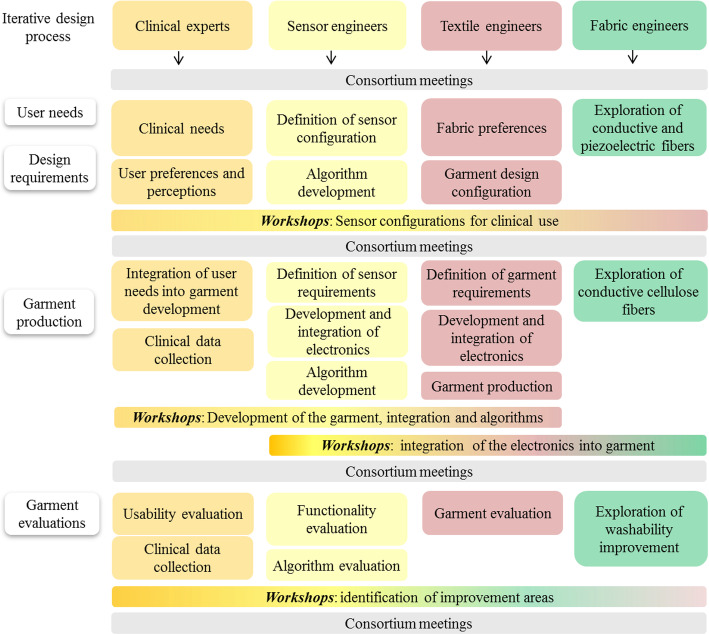
In neurology and rehabilitation the primary interest for using wearables is to supplement traditional patient assessment and monitoring in hospital settings with continuous data collection at home and in community settings. The aim of this project was to develop a novel wearable garment with integrated sensors designed for continuous monitoring of physiological and movement related variables to evaluate progression, tailor treatments and improve diagnosis in epilepsy, Parkinson's disease and stroke. In this paper the early development and evaluation of a prototype designed to monitor movements and heart rate is described. An iterative development process and evaluation of an upper body garment with integrated sensors included: identification of user needs, specification of technical and garment requirements, garment development and production as well as evaluation of garment design, functionality and usability. The project is a multidisciplinary collaboration with experts from medical, engineering, textile, and material science within the wearITmed consortium. The work was organized in regular meetings, task groups and hands-on workshops. User needs were identified using results from a mixed-methods systematic review, a focus group study and expert groups. Usability was evaluated in 19 individuals (13 controls, 6 patients with Parkinson's disease) using semi-structured interviews and qualitative content analysis.

RESULTS

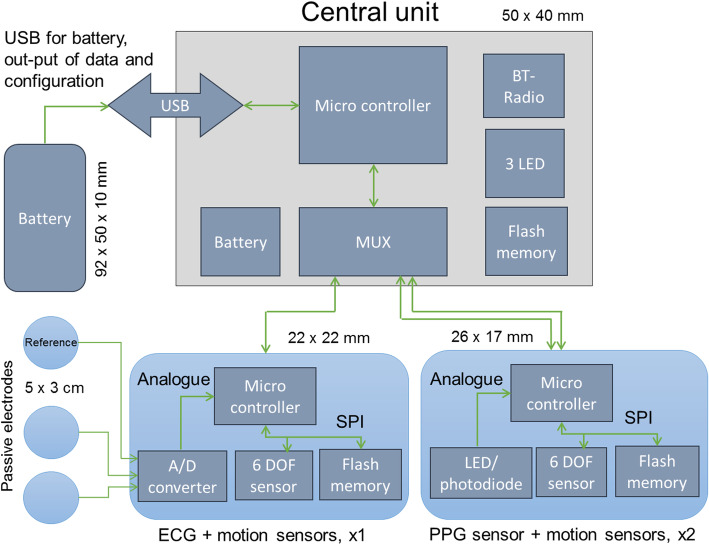
The garment was well accepted by the users regarding design and comfort, although the users were cautious about the technology and suggested improvements. All electronic components passed a washability test. The most robust data was obtained from accelerometer and gyroscope sensors while the electrodes for heart rate registration were sensitive to motion artefacts. The algorithm development within the wearITmed consortium has shown promising results.

CONCLUSIONS

The prototype was accepted by the users. Technical improvements are needed, but preliminary data indicate that the garment has potential to be used as a tool for diagnosis and treatment selection and could provide added value for monitoring seizures in epilepsy, fluctuations in PD and activity levels in stroke. Future work aims to improve the prototype further, develop algorithms, and evaluate the functionality and usability in targeted patient groups. The potential of incorporating blood pressure and heart-rate variability monitoring will also be explored.

摘要

背景

在神经病学和康复领域,使用可穿戴设备的主要目的是通过在家中和社区环境中持续收集数据,来补充医院环境中传统的患者评估和监测。本项目的目的是开发一种新型可穿戴服装,其集成了传感器,用于持续监测生理和与运动相关的变量,以评估癫痫、帕金森病和中风的病情进展、定制治疗方案并改善诊断。本文描述了一款旨在监测运动和心率的原型的早期开发与评估。一个集成了传感器的上身服装的迭代开发过程及评估包括:确定用户需求、明确技术和服装要求、服装开发与生产以及对服装设计、功能和可用性的评估。该项目是wearITmed联盟内医学、工程、纺织和材料科学领域专家的多学科合作。工作通过定期会议、任务小组和实践工作坊来组织开展。利用混合方法系统评价、焦点小组研究和专家组的结果确定用户需求。通过半结构化访谈和定性内容分析,对19名个体(13名对照者、6名帕金森病患者)的可用性进行了评估。

结果

尽管用户对该技术持谨慎态度并提出了改进建议,但该服装在设计和舒适度方面得到了用户的良好认可。所有电子组件均通过了可洗性测试。从加速度计和陀螺仪传感器获得的数据最为可靠,而用于心率记录的电极对运动伪影敏感。wearITmed联盟内的算法开发已显示出有前景的结果。

结论

该原型得到了用户的认可。虽然需要进行技术改进,但初步数据表明,该服装有潜力用作诊断和治疗选择的工具,并可为癫痫发作监测、帕金森病波动情况监测和中风患者活动水平监测提供附加价值。未来的工作旨在进一步改进原型、开发算法,并评估目标患者群体中的功能和可用性。还将探索纳入血压和心率变异性监测的潜力。

https://cdn.ncbi.nlm.nih.gov/pmc/blobs/3b7c/7412666/0004ae3af62b/42490_2019_2_Fig6_HTML.jpg
https://cdn.ncbi.nlm.nih.gov/pmc/blobs/3b7c/7412666/059200475d38/42490_2019_2_Fig1_HTML.jpg
https://cdn.ncbi.nlm.nih.gov/pmc/blobs/3b7c/7412666/3ced232ad8af/42490_2019_2_Fig2_HTML.jpg
https://cdn.ncbi.nlm.nih.gov/pmc/blobs/3b7c/7412666/56a7b5d60bb1/42490_2019_2_Fig3_HTML.jpg
https://cdn.ncbi.nlm.nih.gov/pmc/blobs/3b7c/7412666/d7cd073b88a3/42490_2019_2_Fig4_HTML.jpg
https://cdn.ncbi.nlm.nih.gov/pmc/blobs/3b7c/7412666/6722fb701ad1/42490_2019_2_Fig5_HTML.jpg
https://cdn.ncbi.nlm.nih.gov/pmc/blobs/3b7c/7412666/0004ae3af62b/42490_2019_2_Fig6_HTML.jpg
https://cdn.ncbi.nlm.nih.gov/pmc/blobs/3b7c/7412666/059200475d38/42490_2019_2_Fig1_HTML.jpg
https://cdn.ncbi.nlm.nih.gov/pmc/blobs/3b7c/7412666/3ced232ad8af/42490_2019_2_Fig2_HTML.jpg
https://cdn.ncbi.nlm.nih.gov/pmc/blobs/3b7c/7412666/56a7b5d60bb1/42490_2019_2_Fig3_HTML.jpg
https://cdn.ncbi.nlm.nih.gov/pmc/blobs/3b7c/7412666/d7cd073b88a3/42490_2019_2_Fig4_HTML.jpg
https://cdn.ncbi.nlm.nih.gov/pmc/blobs/3b7c/7412666/6722fb701ad1/42490_2019_2_Fig5_HTML.jpg
https://cdn.ncbi.nlm.nih.gov/pmc/blobs/3b7c/7412666/0004ae3af62b/42490_2019_2_Fig6_HTML.jpg

相似文献

1
An upper body garment with integrated sensors for people with neurological disorders - early development and evaluation.一款为神经功能障碍患者设计的集成传感器的上身衣物——早期开发与评估。
BMC Biomed Eng. 2019 Jan 30;1:3. doi: 10.1186/s42490-019-0002-3. eCollection 2019.
2
User Requirements and Perceptions of a Sensor System for Early Stress Detection in People With Dementia and People With Intellectual Disability: Qualitative Study.痴呆症患者和智力残疾者早期压力检测传感器系统的用户需求与认知:定性研究
JMIR Form Res. 2024 Jun 21;8:e52248. doi: 10.2196/52248.
3
Wearables in epilepsy and Parkinson's disease-A focus group study.可穿戴设备在癫痫和帕金森病中的应用——一项焦点小组研究。
Acta Neurol Scand. 2018 Feb;137(2):188-194. doi: 10.1111/ane.12798. Epub 2017 Jul 16.
4
Wearable sensors for clinical applications in epilepsy, Parkinson's disease, and stroke: a mixed-methods systematic review.可穿戴传感器在癫痫、帕金森病和中风临床应用中的研究:一项混合方法系统评价。
J Neurol. 2018 Aug;265(8):1740-1752. doi: 10.1007/s00415-018-8786-y. Epub 2018 Feb 9.
5
Multichannel ECG recording from waist using textile sensors.使用纺织传感器从腰部进行多通道心电图记录。
Biomed Eng Online. 2020 Jun 16;19(1):48. doi: 10.1186/s12938-020-00788-x.
6
End-user and clinician perspectives on the viability of wearable functional electrical stimulation garments after stroke and spinal cord injury.脑卒中与脊髓损伤后可穿戴功能性电刺激服的用户和临床医生观点。
Disabil Rehabil Assist Technol. 2021 Apr;16(3):241-250. doi: 10.1080/17483107.2019.1668974. Epub 2019 Oct 8.
7
Wearable Device to Monitor Back Movements Using an Inductive Textile Sensor.使用感应纺织传感器监测背部运动的可穿戴设备。
Sensors (Basel). 2020 Feb 8;20(3):905. doi: 10.3390/s20030905.
8
Interactive wearable systems for upper body rehabilitation: a systematic review.用于上肢康复的交互式可穿戴系统:一项系统综述。
J Neuroeng Rehabil. 2017 Mar 11;14(1):20. doi: 10.1186/s12984-017-0229-y.
9
Intelligent Medical Garments with Graphene-Functionalized Smart-Cloth ECG Sensors.具有石墨烯功能化智能织物 ECG 传感器的智能医疗服装。
Sensors (Basel). 2017 Apr 16;17(4):875. doi: 10.3390/s17040875.
10
Wearable technology for biomechanics: e-textile or micromechanical sensors?用于生物力学的可穿戴技术:电子纺织品还是微机械传感器?
IEEE Eng Med Biol Mag. 2010 May-Jun;29(3):37-43. doi: 10.1109/MEMB.2010.936555.

引用本文的文献

1
Wearable Sensors and Motion Analysis for Neurological Patient Support.用于神经科患者支持的可穿戴传感器与运动分析
Biosensors (Basel). 2024 Dec 19;14(12):628. doi: 10.3390/bios14120628.
2
Sensors: future tools for detecting young patient's stress during a dental invasive versus a non-invasive dental treatment-a pilot study.传感器:用于检测年轻患者在侵入性与非侵入性牙科治疗过程中压力的未来工具——一项试点研究。
Eur Arch Paediatr Dent. 2025 Feb;26(1):183-189. doi: 10.1007/s40368-024-00967-7. Epub 2024 Nov 14.
3
User Requirements and Perceptions of a Sensor System for Early Stress Detection in People With Dementia and People With Intellectual Disability: Qualitative Study.

本文引用的文献

1
Multimodal seizure detection: A review.多模态癫痫发作检测:综述。
Epilepsia. 2018 Jun;59 Suppl 1:42-47. doi: 10.1111/epi.14047.
2
Assistive technology products: a position paper from the first global research, innovation, and education on assistive technology (GREAT) summit.辅助技术产品:来自首届全球辅助技术研究、创新与教育(GREAT)峰会的立场文件。
Disabil Rehabil Assist Technol. 2018 Jul;13(5):473-485. doi: 10.1080/17483107.2018.1473895. Epub 2018 Jun 6.
3
Artificial intelligence in healthcare: past, present and future.人工智能在医疗保健中的应用:过去、现在和未来。
痴呆症患者和智力残疾者早期压力检测传感器系统的用户需求与认知:定性研究
JMIR Form Res. 2024 Jun 21;8:e52248. doi: 10.2196/52248.
4
Electronic textiles: New age of wearable technology for healthcare and fitness solutions.电子纺织品:用于医疗保健和健身解决方案的可穿戴技术新时代。
Mater Today Bio. 2023 Jan 28;19:100565. doi: 10.1016/j.mtbio.2023.100565. eCollection 2023 Apr.
5
Clinical Use of Surface Electromyography to Track Acute Upper Extremity Muscle Recovery after Stroke: A Descriptive Case Study of a Single Patient.表面肌电图在中风后急性上肢肌肉恢复追踪中的临床应用:单病例描述性研究
Appl Syst Innov. 2021 Jun;4(2). doi: 10.3390/asi4020032. Epub 2021 May 10.
6
Wearable Smart Textiles for Long-Term Electrocardiography Monitoring-A Review.可穿戴智能纺织品在长期心电图监测中的应用综述。
Sensors (Basel). 2021 Jun 17;21(12):4174. doi: 10.3390/s21124174.
7
"It's All Sort of Cool and Interesting…but What Do I Do With It?" A Qualitative Study of Stroke Survivors' Perceptions of Surface Electromyography.“这一切都挺酷且有趣的……但我该如何利用它呢?”一项关于中风幸存者对表面肌电图感知的定性研究
Front Neurol. 2020 Sep 17;11:1037. doi: 10.3389/fneur.2020.01037. eCollection 2020.
8
Integration and Testing of a Three-Axis Accelerometer in a Woven E-Textile Sleeve for Wearable Movement Monitoring.三轴加速度计在编织电子纺织品袖套中的集成和测试用于可穿戴运动监测。
Sensors (Basel). 2020 Sep 4;20(18):5033. doi: 10.3390/s20185033.
9
SnapKi-An Inertial Easy-to-Adapt Wearable Textile Device for Movement Quantification of Neurological Patients.SnapKi-一种用于神经疾病患者运动量化的惯性、易于适应的可穿戴纺织设备。
Sensors (Basel). 2020 Jul 11;20(14):3875. doi: 10.3390/s20143875.
Stroke Vasc Neurol. 2017 Jun 21;2(4):230-243. doi: 10.1136/svn-2017-000101. eCollection 2017 Dec.
4
Diagnostic challenges in epilepsy: seizure under-reporting and seizure detection.癫痫的诊断挑战:漏报发作和发作检测。
Lancet Neurol. 2018 Mar;17(3):279-288. doi: 10.1016/S1474-4422(18)30038-3.
5
Wearable sensors for clinical applications in epilepsy, Parkinson's disease, and stroke: a mixed-methods systematic review.可穿戴传感器在癫痫、帕金森病和中风临床应用中的研究:一项混合方法系统评价。
J Neurol. 2018 Aug;265(8):1740-1752. doi: 10.1007/s00415-018-8786-y. Epub 2018 Feb 9.
6
Global, regional, and national burden of neurological disorders during 1990-2015: a systematic analysis for the Global Burden of Disease Study 2015.1990 - 2015年全球、区域和国家神经系统疾病负担:全球疾病负担研究2015的系统分析
Lancet Neurol. 2017 Nov;16(11):877-897. doi: 10.1016/S1474-4422(17)30299-5. Epub 2017 Sep 17.
7
Motor Control Training for the Shoulder with Smart Garments.智能服装的肩部运动控制训练。
Sensors (Basel). 2017 Jul 22;17(7):1687. doi: 10.3390/s17071687.
8
Wearables in epilepsy and Parkinson's disease-A focus group study.可穿戴设备在癫痫和帕金森病中的应用——一项焦点小组研究。
Acta Neurol Scand. 2018 Feb;137(2):188-194. doi: 10.1111/ane.12798. Epub 2017 Jul 16.
9
Interactive wearable systems for upper body rehabilitation: a systematic review.用于上肢康复的交互式可穿戴系统:一项系统综述。
J Neuroeng Rehabil. 2017 Mar 11;14(1):20. doi: 10.1186/s12984-017-0229-y.
10
Free-living monitoring of Parkinson's disease: Lessons from the field.帕金森病的自由生活监测:来自现场的经验教训。
Mov Disord. 2016 Sep;31(9):1293-313. doi: 10.1002/mds.26718. Epub 2016 Jul 25.