Kanazawa Nodoka, Goto Mayuko, Harada Yumi, Takimoto Chiaki, Sasaki Yuuka, Uchikawa Tamaki, Kamei Yasuhiro, Matsuo Megumi, Fukamachi Shoji
Department of Chemical and Biological Sciences, Japan Women's University, Bunkyō, Japan.
National Institute for Basic Biology, Okazaki, Japan.
Front Genet. 2020 Aug 12;11:801. doi: 10.3389/fgene.2020.00801. eCollection 2020.
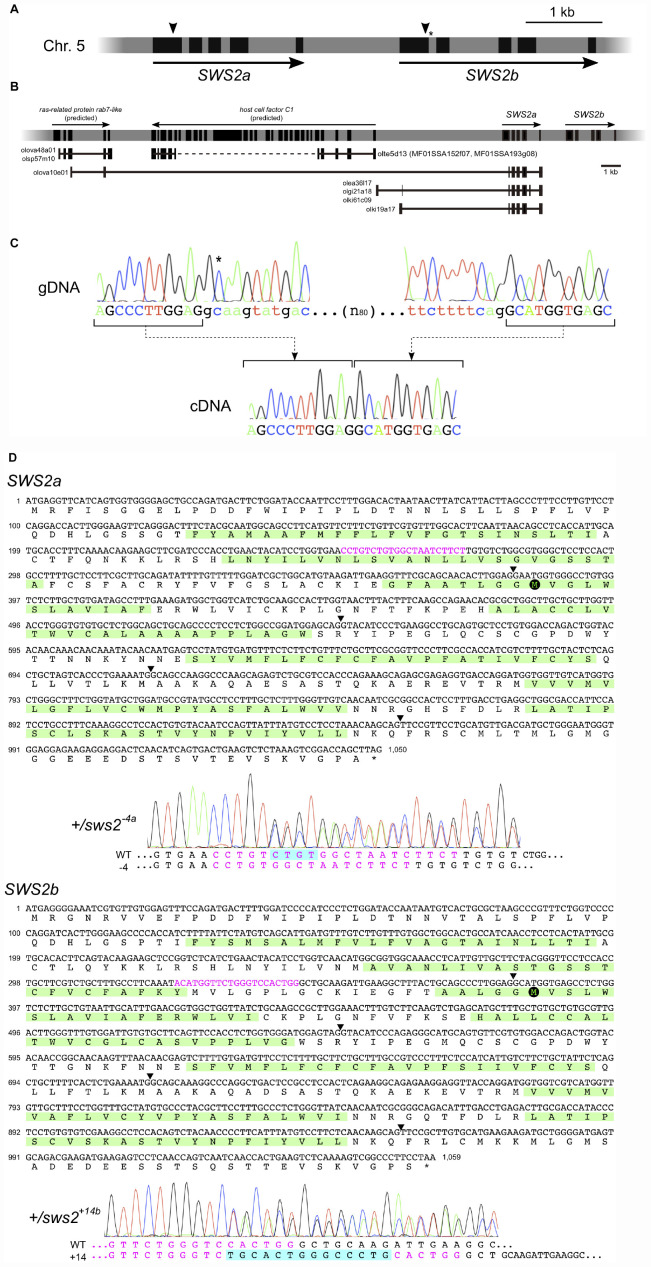
Common ancestors of vertebrates had four types of cone opsins: short-wavelength sensitive 1 (SWS1), SWS2, rhodopsin 2 (RH2), and long-wavelength sensitive (LWS) types. Whereas fish and birds retain all the types, mammals have lost two of them (SWS2 and RH2) possibly because of their nocturnal lifestyle during the Mesozoic Era. Considering that the loss of cone opsin types causes so-called color blindness in humans (e.g., protanopia), the ability to discriminate color by trichromatic humans could be lower than that in potentially tetrachromatic birds and fish. Behavioral studies using color-blind (-knockout) animals would be helpful to address such questions, but it is only recently that the genome-editing technologies have opened up this pathway. Using medaka as a model, we introduced frameshift mutations in ( and/or ) after detailed characterization of the loci , which unveiled the existence of a GC-AG intron and non-optic expressed-sequence-tags (ESTs) that include in part. Transcripts from the mutated loci are commonly reduced, suggesting that the -double mutants could produce, if any, severely truncated (likely dysfunctional) SWS2s in small amounts. The mutants exhibited weakened body color preferences during mate choice. However, the optomotor response (OMR) test under monochromatic light revealed that the mutants had no defect in spectral sensitivity, even at the absorbance maxima (λ) of SWS2s. Evolutionary diversification of cone opsins has often been discussed in relation to adaptation to dominating light in habitats (i.e., changes in the repertoire or λ are for increasing sensitivity to the dominating light). However, the present results seem to provide empirical evidence showing that acquiring or losing a type of cone opsin (or changes in λ) need not substantially affect photopic or mesopic sensitivity. Other points of view, such as color discrimination of species-specific mates/preys/predators against habitat-specific backgrounds, may be necessary to understand why cone opsin repertories are so various among animals.
短波敏感1型(SWS1)、SWS2、视紫红质2型(RH2)和长波敏感型(LWS)。鱼类和鸟类保留了所有这些类型,而哺乳动物失去了其中两种(SWS2和RH2),这可能是由于它们在中生代的夜行性生活方式。鉴于视锥蛋白类型的丧失会导致人类出现所谓的色盲(例如,红色盲),三色视觉的人类辨别颜色的能力可能低于潜在的四色视觉的鸟类和鱼类。使用色盲(基因敲除)动物进行的行为研究将有助于解决此类问题,但直到最近基因组编辑技术才开辟了这条途径。以青鳉为模型,我们在详细表征了相关位点后,在(和/或)中引入了移码突变,这揭示了一个GC-AG内含子和非视觉表达序列标签(EST)的存在,其中部分包含。来自突变位点的转录本通常会减少,这表明双突变体如果有任何产物,可能会少量产生严重截短(可能无功能)的SWS2。这些突变体在择偶过程中表现出对体色偏好的减弱。然而,在单色光下的视动反应(OMR)测试表明,即使在SWS2的吸收峰波长(λ)处,这些突变体的光谱敏感性也没有缺陷。视锥蛋白视蛋白的进化多样化经常与适应栖息地中的主导光有关(即,视蛋白库或λ的变化是为了提高对主导光的敏感性)。然而,目前的结果似乎提供了经验证据,表明获得或失去一种视锥蛋白视蛋白类型(或λ的变化)不一定会对明视觉或中间视觉敏感性产生实质性影响。为了理解为什么动物之间的视锥蛋白视蛋白库如此多样,可能需要从其他角度考虑,例如物种特异性配偶/猎物/捕食者针对栖息地特定背景的颜色辨别。