Department of Anesthesiology and Perioperative Medicine, Mayo Clinic, Rochester, MN, United States.
Department of Physiology and Biomedical Engineering, Mayo Clinic, Rochester, MN, United States.
Front Immunol. 2020 Aug 13;11:1798. doi: 10.3389/fimmu.2020.01798. eCollection 2020.
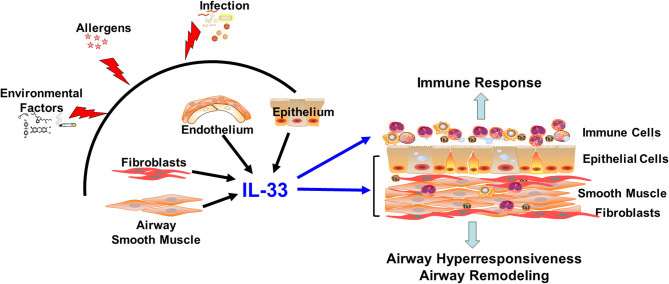
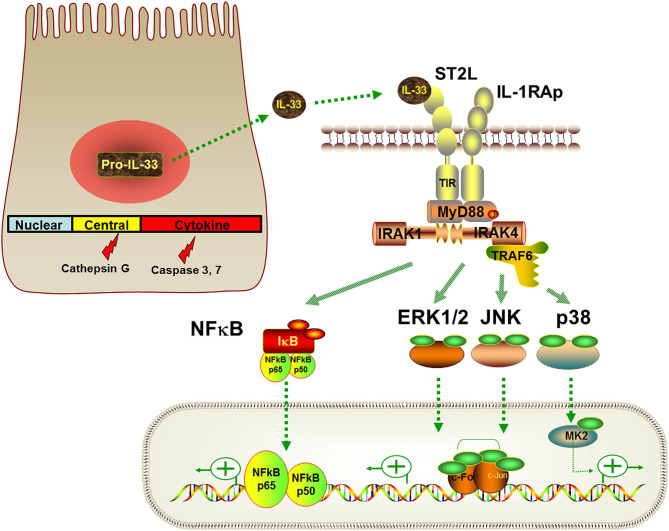
Interleukin (IL)-33 plays important roles in pulmonary immune responses and lung diseases including asthma and chronic obstructive pulmonary disease (COPD). There is substantial interest in identifying and characterizing cellular sources vs. targets of IL-33, and downstream signaling pathways involved in disease pathophysiology. While epithelial and immune cells have largely been the focus, in this review, we summarize current knowledge of expression, induction, and function of IL-33 and its receptor ST2 in non-hematopoietic lung cells in the context of health and disease. Under basal conditions, epithelial cells and endothelial cells are thought to be the primary resident cell types that express high levels of IL-33 and serve as ligand sources compared to mesenchymal cells (smooth muscle cells and fibroblasts). Under inflammatory conditions, IL-33 expression is increased in most non-hematopoietic lung cells, including epithelial, endothelial, and mesenchymal cells. In comparison to its ligand, the receptor ST2 shows low expression levels at baseline but similar to IL-33, ST2 expression is upregulated by inflammation in these non-hematopoietic lung cells which may then participate in chronic inflammation both as sources and autocrine/paracrine targets of IL-33. Downstream effects of IL-33 may occur via direct receptor activation or indirect interactions with the immune system, overall contributing to lung inflammation, airway hyper-responsiveness and remodeling (proliferation and fibrosis). Accordingly from a therapeutic perspective, targeting IL-33 and/or its receptor in non-hematopoietic lung cells becomes relevant.
白细胞介素 (IL)-33 在肺部免疫反应和疾病中发挥重要作用,包括哮喘和慢性阻塞性肺疾病 (COPD)。人们对鉴定和描述 IL-33 的细胞来源和靶细胞,以及涉及疾病病理生理学的下游信号通路非常感兴趣。虽然上皮细胞和免疫细胞一直是主要关注对象,但在本篇综述中,我们总结了 IL-33 及其受体 ST2 在健康和疾病状态下非造血肺细胞中的表达、诱导和功能的现有知识。在基础条件下,上皮细胞和内皮细胞被认为是主要的常驻细胞类型,它们表达高水平的 IL-33 并作为配体来源,而不是间充质细胞(平滑肌细胞和成纤维细胞)。在炎症条件下,大多数非造血肺细胞中的 IL-33 表达增加,包括上皮细胞、内皮细胞和间充质细胞。与配体相比,受体 ST2 在基线时的表达水平较低,但与 IL-33 相似,ST2 表达在这些非造血肺细胞中被炎症上调,这可能导致其作为 IL-33 的来源和自分泌/旁分泌靶细胞参与慢性炎症。IL-33 的下游效应可能通过直接受体激活或与免疫系统的间接相互作用发生,总体上导致肺部炎症、气道高反应性和重塑(增殖和纤维化)。因此,从治疗角度来看,针对非造血肺细胞中的 IL-33 和/或其受体变得相关。