State Key Laboratory of Oral Diseases, National Clinical Research Center for Oral Diseases, Department of Orthodontics, West China Hospital of Stomatology, Sichuan University, Chengdu, China.
Division of Oral and Craniofacial Health Sciences, University of North Carolina Adams School of Dentistry, Chapel Hill, NC, United States.
Front Immunol. 2020 Aug 13;11:1487. doi: 10.3389/fimmu.2020.01487. eCollection 2020.
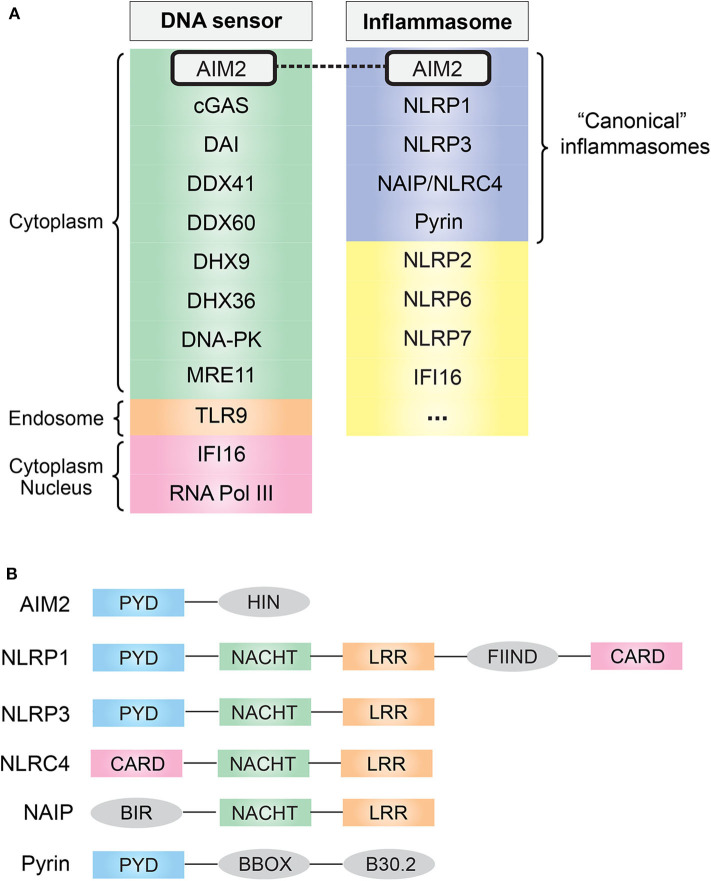
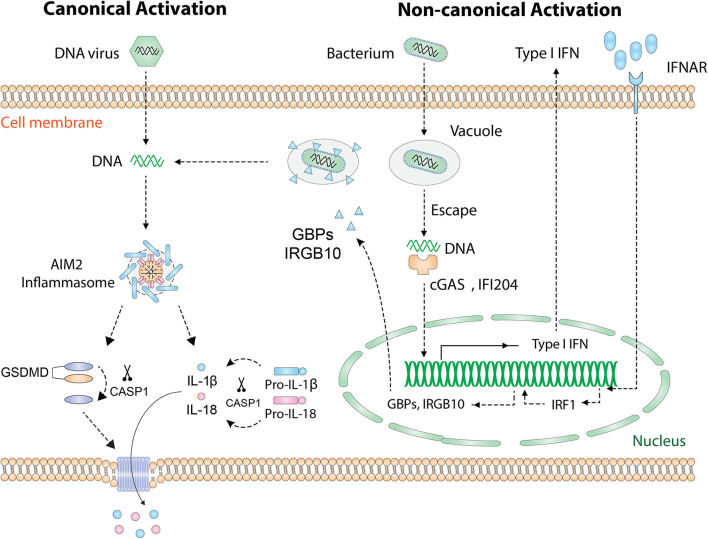
A common feature of many acute and chronic oral diseases is microbial-induced inflammation. Innate immune responses are the first line of defense against pathogenic microorganisms and are initiated by pattern recognition receptors (PRRs) that specifically recognize pathogen-associated molecular patterns and danger-associated molecular patterns. The activation of certain PRRs can lead to the assembly of macromolecular oligomers termed , which are responsible for pro-inflammatory cytokine maturation and secretion and thus activate host inflammatory responses. About 10 years ago, the absent in melanoma 2 (AIM2) was independently discovered by four research groups, and among the "canonical" inflammasomes [including AIM2, NLR family pyrin domain (NLRP)1, NLRP3, NLR family apoptosis inhibitory protein (NAIP)/NLR family, caspase activation and recruitment domain (CARD) containing (NLRC)4, and pyrin], AIM2 so far is the only one that simultaneously acts as a cytosolic DNA sensor due to its DNA-binding ability. Undoubtedly, such a double-faceted role gives AIM2 greater mission and more potential in the mediation of innate immune responses. Therefore, AIM2 has garnered much attention from the broad scientific community during its first 10 years of discovery (2009-2019). How the AIM2 inflammasome is related to oral diseases has aroused debate over the past few years and is under active investigation. AIM2 inflammasome may potentially be a key link between oral diseases and innate immunity. In this review, we highlight the current knowledge of the AIM2 inflammasome and its critical role in the pathogenesis of various oral diseases, which might offer future possibilities for disease prevention and targeted therapy utilizing this continued understanding.
许多急性和慢性口腔疾病的一个共同特征是微生物引起的炎症。先天免疫反应是抵御致病微生物的第一道防线,由专门识别病原体相关分子模式和危险相关分子模式的模式识别受体(PRRs)启动。某些 PRR 的激活会导致称为 的大分子寡聚体的组装,这些寡聚体负责促炎细胞因子的成熟和分泌,从而激活宿主炎症反应。大约 10 年前,黑色素瘤缺失 2(AIM2)被四个研究小组独立发现,在“经典”炎性小体[包括 AIM2、NLR 家族吡啶结构域(NLRP)1、NLRP3、NLR 家族凋亡抑制蛋白(NAIP)/NLR 家族、包含 caspase 激活和募集结构域(CARD)的(NLRC)4 和 pyrin]中,AIM2 迄今为止是唯一由于其 DNA 结合能力而同时充当细胞质 DNA 传感器的一种。毫无疑问,这种双重作用使 AIM2 在先天免疫反应的调节中具有更大的使命和更多的潜力。因此,AIM2 在其发现的头 10 年(2009-2019 年)引起了科学界的广泛关注。AIM2 炎性小体与口腔疾病的关系在过去几年中引起了争论,并正在积极研究中。AIM2 炎性小体可能是口腔疾病与先天免疫之间的关键联系。在这篇综述中,我们强调了 AIM2 炎性小体的当前知识及其在各种口腔疾病发病机制中的关键作用,这可能为利用这一持续理解进行疾病预防和靶向治疗提供未来的可能性。