York Joshua R, Yuan Tian, McCauley David W
Department of Biology, University of Oklahoma, Norman, OK, United States.
Oklahoma Center for Neuroscience, University of Oklahoma Health Sciences Center, Oklahoma City, OK, United States.
Front Physiol. 2020 Aug 13;11:986. doi: 10.3389/fphys.2020.00986. eCollection 2020.
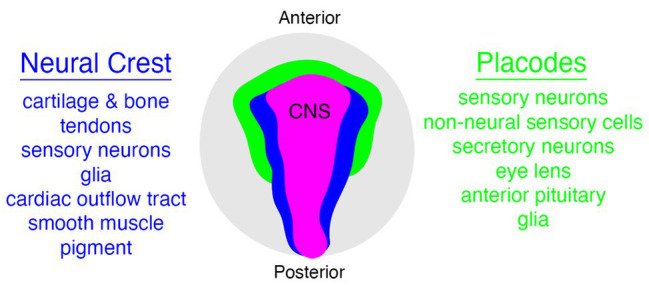
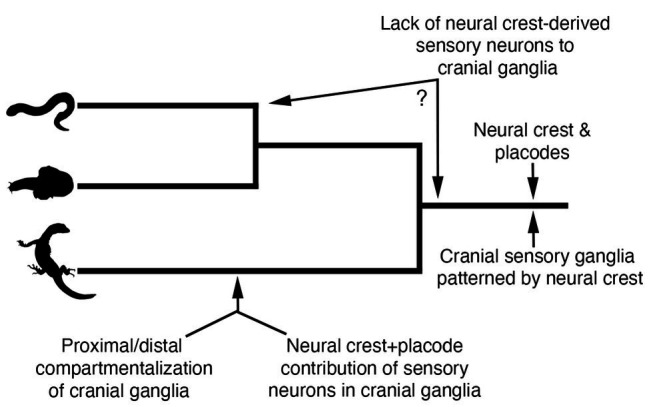
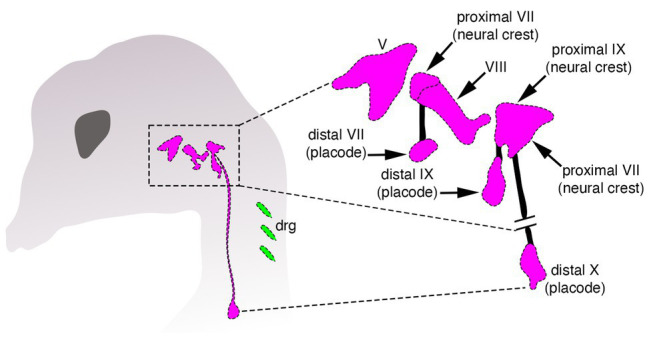
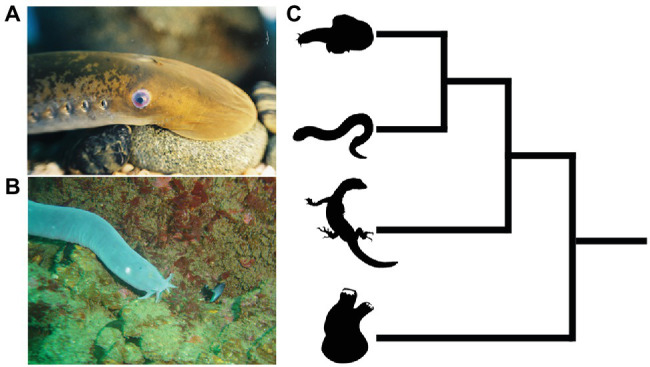
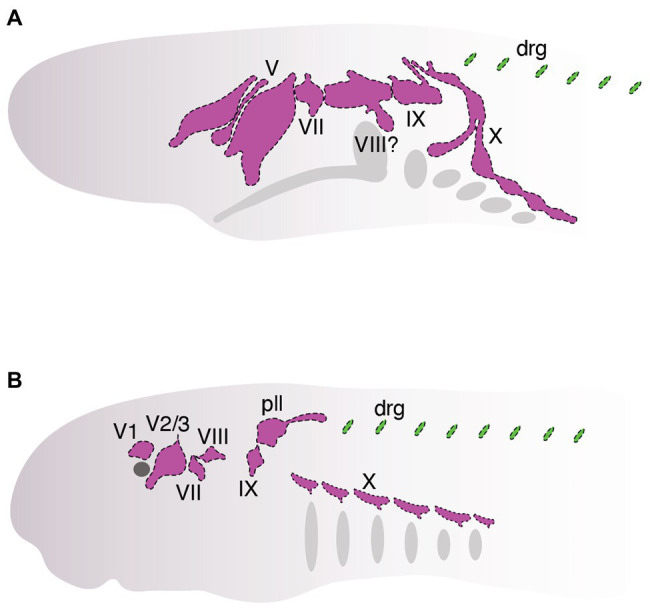
Neural crest and placodes are key innovations of the vertebrate clade. These cells arise within the dorsal ectoderm of all vertebrate embryos and have the developmental potential to form many of the morphological novelties within the vertebrate head. Each cell population has its own distinct developmental features and generates unique cell types. However, it is essential that neural crest and placodes associate together throughout embryonic development to coordinate the emergence of several features in the head, including almost all of the cranial peripheral sensory nervous system and organs of special sense. Despite the significance of this developmental feat, its evolutionary origins have remained unclear, owing largely to the fact that there has been little comparative (evolutionary) work done on this topic between the jawed vertebrates and cyclostomes-the jawless lampreys and hagfishes. In this review, we briefly summarize the developmental mechanisms and genetics of neural crest and placodes in both jawed and jawless vertebrates. We then discuss recent studies on the role of neural crest and placodes-and their developmental association-in the head of lamprey embryos, and how comparisons with jawed vertebrates can provide insights into the causes and consequences of this event in early vertebrate evolution.
神经嵴和基板是脊椎动物进化枝的关键创新。这些细胞出现在所有脊椎动物胚胎的背侧外胚层内,具有发育潜力,可形成脊椎动物头部的许多形态新奇特征。每个细胞群体都有其独特的发育特征,并产生独特的细胞类型。然而,至关重要的是,神经嵴和基板在整个胚胎发育过程中相互关联,以协调头部多种特征的出现,包括几乎所有的颅周感觉神经系统和特殊感觉器官。尽管这一发育壮举意义重大,但其进化起源仍不清楚,这主要是因为在有颌脊椎动物和圆口纲动物(无颌七鳃鳗和盲鳗)之间,关于这个主题的比较(进化)研究很少。在这篇综述中,我们简要总结了有颌和无颌脊椎动物中神经嵴和基板的发育机制及遗传学。然后,我们讨论了最近关于神经嵴和基板的作用及其发育关联在七鳃鳗胚胎头部的研究,以及与有颌脊椎动物的比较如何能为早期脊椎动物进化中这一事件的原因和后果提供见解。