Park Junghyung, Won Jinyoung, Seo Jincheol, Yeo Hyeon-Gu, Kim Keonwoo, Kim Yu Gyeong, Jeon Chang-Yeop, Kam Min Kyoung, Kim Young-Hyun, Huh Jae-Won, Lee Sang-Rae, Lee Dong-Seok, Lee Youngjeon
National Primate Research Center, Korea Research Institute of Bioscience and Biotechnology (KRIBB), Cheongju, South Korea.
Department of Functional Genomics, KRIBB School of Bioscience, Korea University of Science and Technology, Daejeon, South Korea.
Front Cell Neurosci. 2020 Aug 4;14:235. doi: 10.3389/fncel.2020.00235. eCollection 2020.
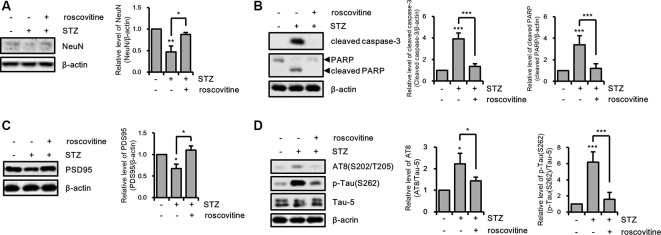
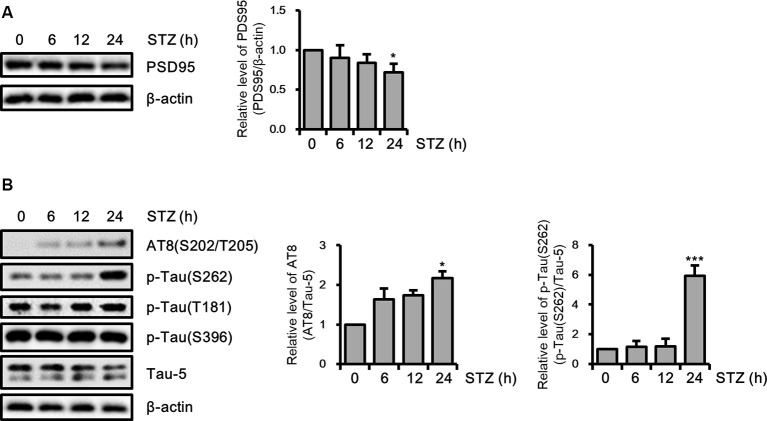
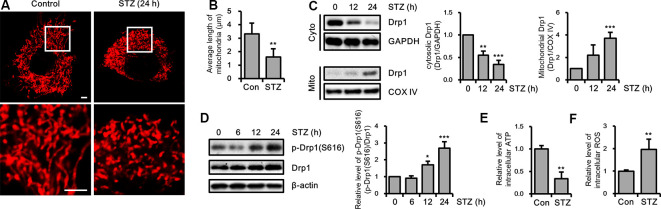
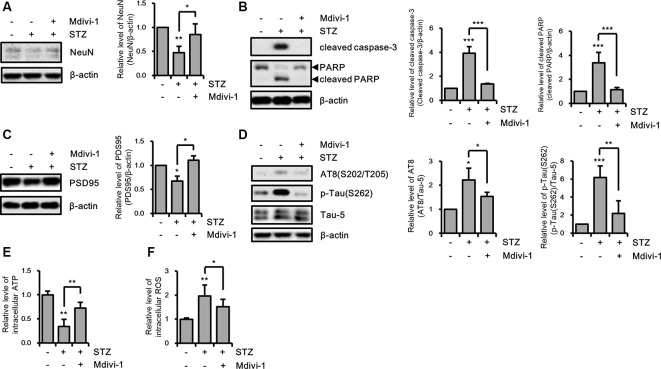
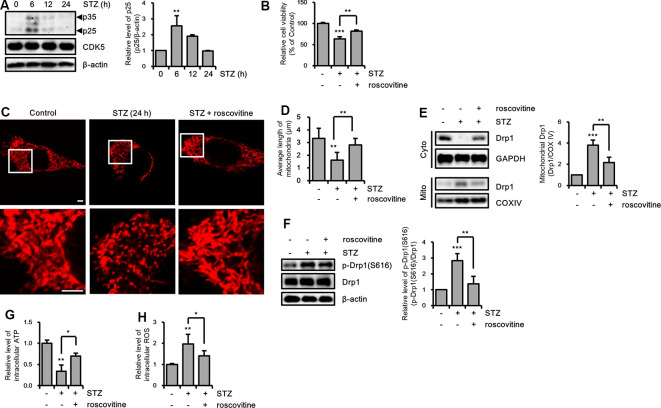
Aberrant brain insulin signaling plays a critical role in the pathology of Alzheimer's disease (AD). Mitochondrial dysfunction plays a role in the progression of AD, with excessive mitochondrial fission in the hippocampus being one of the pathological mechanisms of AD. However, the molecular mechanisms underlying the progression of AD and mitochondrial fragmentation induced by aberrant brain insulin signaling in the hippocampal neurons are poorly understood. Therefore, we investigated the molecular mechanistic signaling associated with mitochondrial dynamics using streptozotocin (STZ), a diabetogenic compound, in the hippocampus cell line, HT-22 cells. In this metabolic dysfunctional cellular model, hallmarks of AD such as neuronal apoptosis, synaptic loss, and tau hyper-phosphorylation are induced by STZ. We found that in the mitochondrial fission protein Drp1, phosphorylation is increased in STZ-treated HT-22 cells. We also determined that inhibition of mitochondrial fragmentation suppresses STZ-induced AD-like pathology. Furthermore, we found that phosphorylation of Drp1 was induced by CDK5, and inhibition of CDK5 suppresses STZ-induced mitochondrial fragmentation and AD-like pathology. Therefore, these findings indicate that mitochondrial morphology and functional regulation may be a strategy of potential therapeutic for treating abnormal metabolic functions associated with the pathogenesis of AD.
异常的脑胰岛素信号在阿尔茨海默病(AD)的病理过程中起关键作用。线粒体功能障碍在AD的进展中起作用,海马体中过度的线粒体分裂是AD的病理机制之一。然而,海马神经元中异常脑胰岛素信号诱导的AD进展和线粒体碎片化的分子机制尚不清楚。因此,我们使用致糖尿病化合物链脲佐菌素(STZ)在海马细胞系HT-22细胞中研究了与线粒体动力学相关的分子机制信号。在这个代谢功能失调的细胞模型中,STZ诱导了AD的特征,如神经元凋亡、突触丧失和tau蛋白过度磷酸化。我们发现,在STZ处理的HT-22细胞中,线粒体分裂蛋白Drp1的磷酸化增加。我们还确定,抑制线粒体碎片化可抑制STZ诱导的AD样病理。此外,我们发现Drp1的磷酸化是由CDK5诱导的,抑制CDK5可抑制STZ诱导的线粒体碎片化和AD样病理。因此,这些发现表明,线粒体形态和功能调节可能是治疗与AD发病机制相关的异常代谢功能的潜在治疗策略。