Muntané-Carol Guillem, Alperi Alberto, Faroux Laurent, Bédard Elisabeth, Philippon François, Rodés-Cabau Josep
Quebec Heart and Lung Institute, Laval University, Quebec City, QC, Canada.
Front Cardiovasc Med. 2020 Aug 13;7:139. doi: 10.3389/fcvm.2020.00139. eCollection 2020.
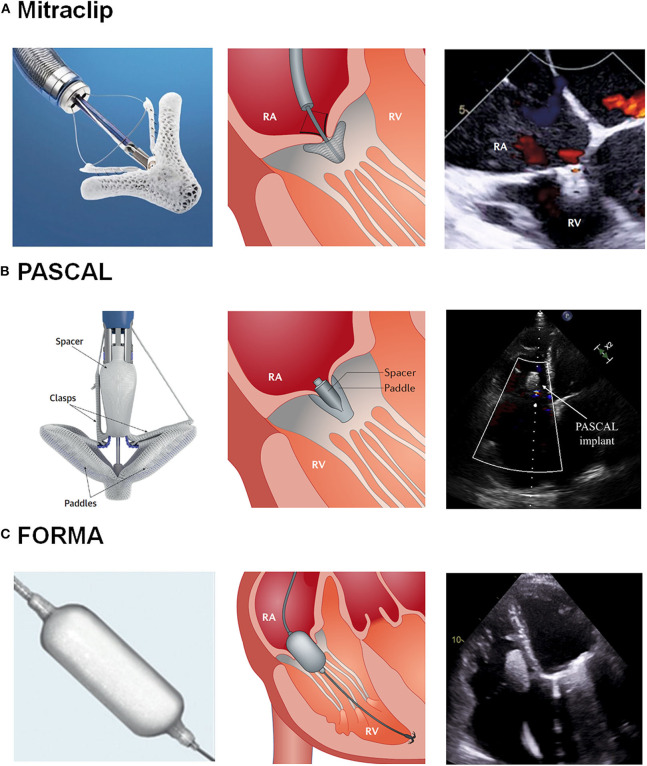
Transcatheter tricuspid valve intervention (TTVI) has recently emerged as an alternative for the treatment of severe tricuspid regurgitation (TR). Multiple percutaneous devices have been developed in the last decade with promising early results. Among them, the coaptation devices are designed to reduce TR severity by valve leaflet plication or occupying the regurgitant orifice with a spacer. To date, the MitraClip/TriClip devices (Abbott, Santa Clara, CA, USA), the PASCAL system (Edwards Lifesciencies, Irvine, CA, USA), and the FORMA device (Edwards Lifesciencies, Irvine, CA, USA) have been used as coaptation devices for treating severe TR. The present document aimed to review the clinical evidence on coaptation devices in the field of TTVI, describing its design characteristics, main procedural steps, and early and mid-term outcomes.
经导管三尖瓣介入治疗(TTVI)最近已成为治疗严重三尖瓣反流(TR)的一种替代方法。在过去十年中开发了多种经皮装置,早期结果令人鼓舞。其中,贴合装置旨在通过瓣膜小叶折叠或用间隔物占据反流口来降低TR的严重程度。迄今为止,MitraClip/TriClip装置(美国加利福尼亚州圣克拉拉市雅培公司)、PASCAL系统(美国加利福尼亚州尔湾市爱德华兹生命科学公司)和FORMA装置(美国加利福尼亚州尔湾市爱德华兹生命科学公司)已被用作治疗严重TR的贴合装置。本文件旨在综述TTVI领域中贴合装置的临床证据,描述其设计特点、主要操作步骤以及早期和中期结果。