Czumbel László Márk, Kiss Szabolcs, Farkas Nelli, Mandel Iván, Hegyi Anita, Nagy Ákos, Lohinai Zsolt, Szakács Zsolt, Hegyi Péter, Steward Martin C, Varga Gábor
Department of Oral Biology, Faculty of Dentistry, Semmelweis University, Budapest, Hungary.
Institute for Translational Medicine, Medical School, University of Pécs, Pécs, Hungary.
Front Med (Lausanne). 2020 Aug 4;7:465. doi: 10.3389/fmed.2020.00465. eCollection 2020.
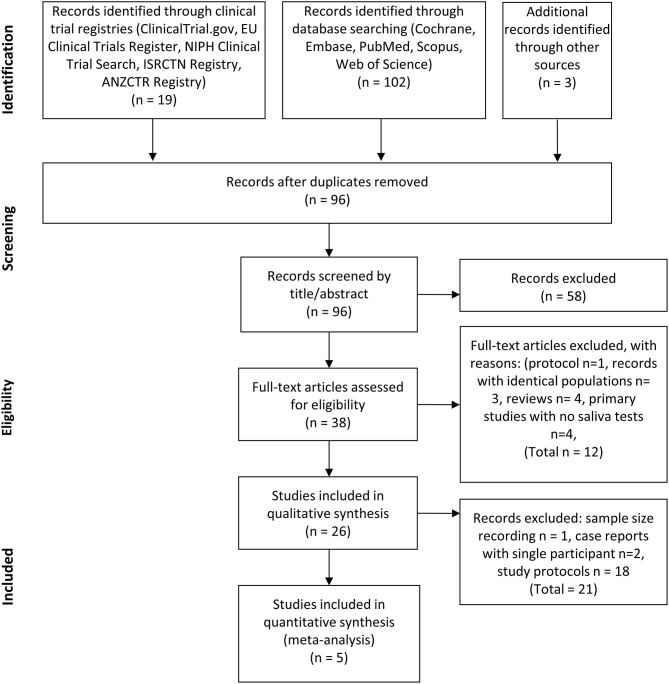
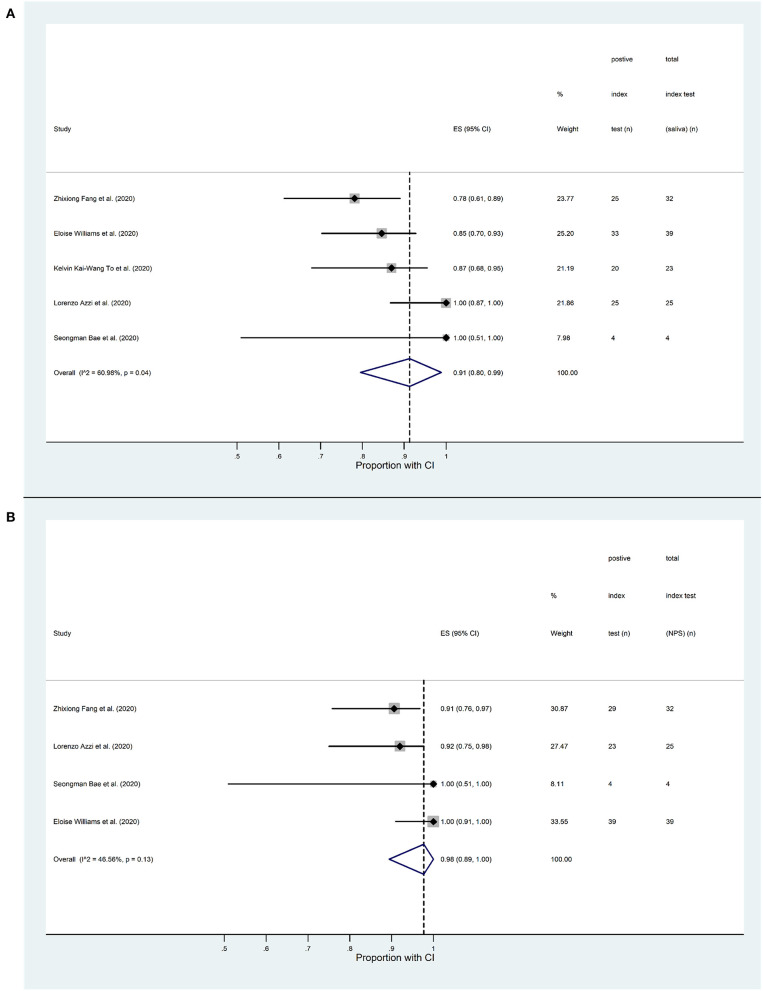
COVID-19 is a serious and potentially deadly disease. Early diagnosis of infected individuals will play an important role in stopping its further escalation. The present gold standard for sampling is the nasopharyngeal swab method. However, several recent papers suggested that saliva-based testing is a promising alternative that could simplify and accelerate COVID-19 diagnosis. Our aim was to conduct a meta-analysis on the reliability and consistency of SARS-CoV-2 viral RNA detection in saliva specimens. We have reported our meta-analysis according to the Cochrane Handbook. We searched the Cochrane Library, Embase, Pubmed, Scopus, Web of Science and clinical trial registries for eligible studies published between 1 January and 25 April 2020. The number of positive tests and the total number of tests conducted were collected as raw data. The proportion of positive tests in the pooled data were calculated by score confidence-interval estimation with the Freeman-Tukey transformation. Heterogeneity was assessed using the measure and the χ-test. The systematic search revealed 96 records after removal of duplicates. Twenty-six records were included for qualitative analysis and 5 records for quantitative synthesis. We found 91% (CI 80-99%) sensitivity for saliva tests and 98% (CI 89-100%) sensitivity for nasopharyngeal swab (NPS) tests in previously confirmed COVID-19 patients, with moderate heterogeneity among the studies. Additionally, we identified 18 registered, ongoing clinical trials of saliva-based tests for detection of the virus. Saliva tests offer a promising alternative to NPS for COVID-19 diagnosis. However, further diagnostic accuracy studies are needed to improve their specificity and sensitivity.
新型冠状病毒肺炎(COVID-19)是一种严重且可能致命的疾病。对感染者进行早期诊断对于阻止其进一步蔓延将发挥重要作用。目前采样的金标准是鼻咽拭子法。然而,最近的几篇论文表明,基于唾液的检测是一种有前景的替代方法,它可以简化并加速COVID-19的诊断。我们的目的是对唾液标本中严重急性呼吸综合征冠状病毒2(SARS-CoV-2)病毒RNA检测的可靠性和一致性进行荟萃分析。我们已根据《 Cochr ane系统评价手册》报告了我们的荟萃分析。我们在Cochrane图书馆、Embase、Pubmed、Scopus、科学网和临床试验注册库中搜索了2020年1月1日至4月25日期间发表的符合条件的研究。收集阳性检测数和进行的检测总数作为原始数据。通过Freeman-Tukey变换的得分置信区间估计计算合并数据中阳性检测的比例。使用I² 测量法和χ²检验评估异质性。系统检索在去除重复记录后共得到96条记录。纳入26条记录进行定性分析,5条记录进行定量合成。我们发现,在先前确诊的COVID-19患者中,唾液检测的敏感性为91%(95%CI 80-99%),鼻咽拭子(NPS)检测的敏感性为98%(95%CI 89-100%),各研究之间存在中度异质性。此外,我们还确定了18项已注册的、正在进行的基于唾液检测病毒的临床试验。唾液检测为COVID-19诊断提供了一种有前景的替代NPS的方法。然而,需要进一步的诊断准确性研究来提高其特异性和敏感性。