Hawkes Colin Patrick, Mostoufi-Moab Sogol, McCormack Shana E, Grimberg Adda, Zemel Babette S
Division of Endocrinology and Diabetes, The Children's Hospital of Philadelphia, Philadelphia, USA.
Department of Pediatrics, The University of Pennsylvania Perelman School of Medicine, Philadelphia, USA.
Data Brief. 2020 Aug 5;32:106131. doi: 10.1016/j.dib.2020.106131. eCollection 2020 Oct.
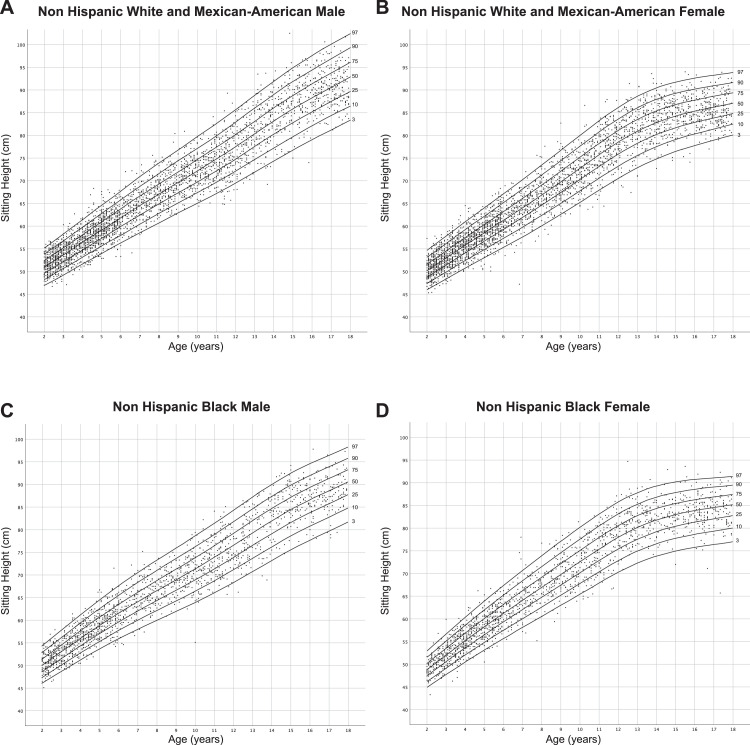
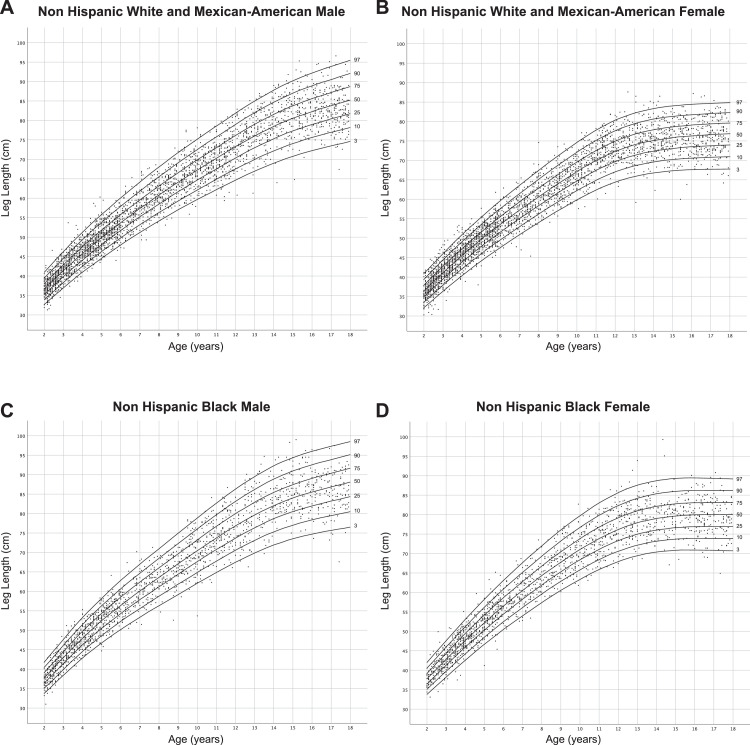
Population-specific reference data are required to interpret growth measurements in children. Sitting height and leg length (standing height minus sitting height) measurements are indicators of proportionality and can be used to evaluate children with disordered growth. NHANES III recorded sitting height and standing height measurements in a strategic random sample of the United States population from 1988 to 1994, and we have previously published reference charts for sitting height to standing height ratio in this population. In this study, we have developed separate sitting height and leg length reference charts for Non-Hispanic Black, Non-Hispanic White, and Mexican-American children in the United States. In addition, we provide mean (SD) and LMS data to support the use of these reference charts in clinical care.
解读儿童生长测量数据需要特定人群的参考数据。坐高和腿长(身高减去坐高)测量是比例指标,可用于评估生长紊乱的儿童。美国国家健康与营养检查调查(NHANES)III在1988年至1994年对美国人群进行的战略随机抽样中记录了坐高和身高测量数据,我们之前已发表了该人群坐高与身高比值的参考图表。在本研究中,我们为美国非西班牙裔黑人、非西班牙裔白人及墨西哥裔美国儿童分别制定了坐高和腿长参考图表。此外,我们还提供了均值(标准差)和LMS数据,以支持这些参考图表在临床护理中的应用。